



Resignation Letter Format India 2026: Samples, Email Template & Free Download
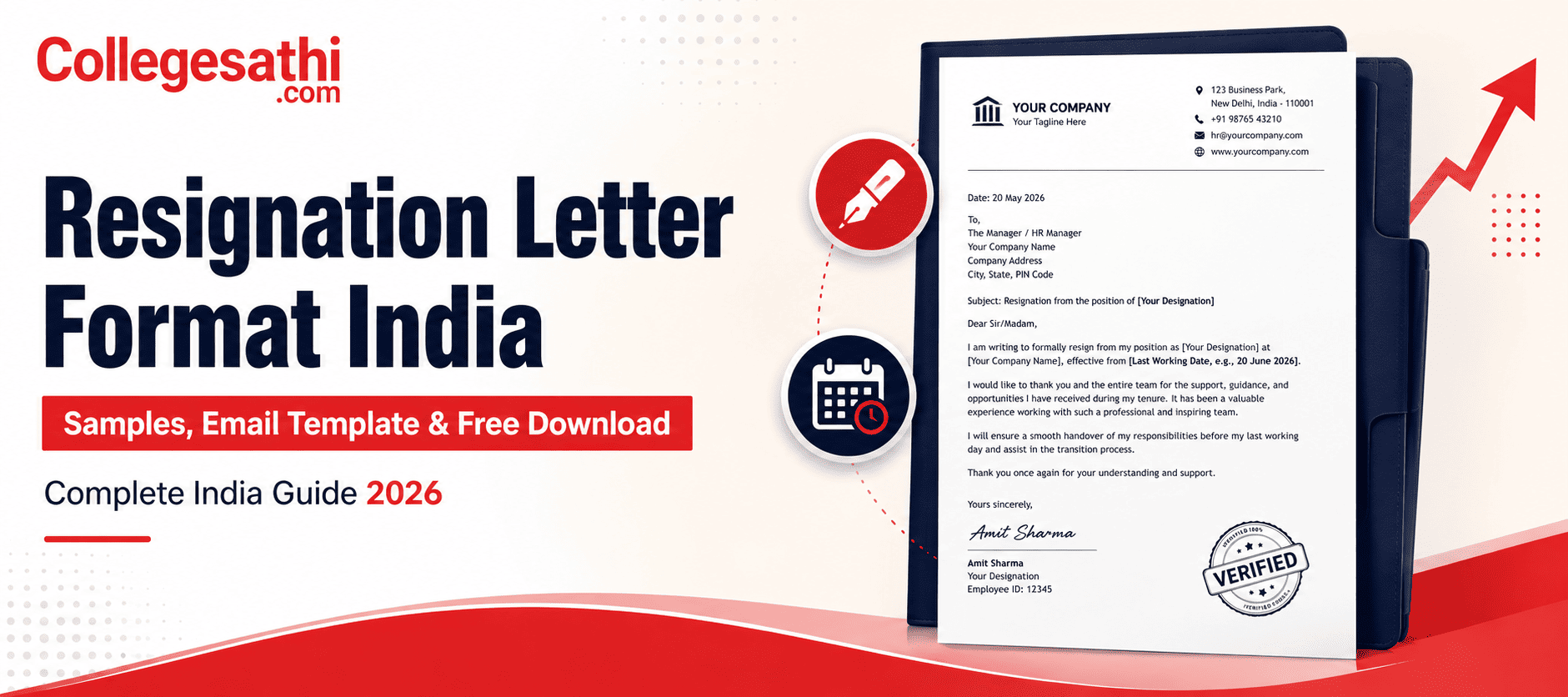

Why Your Resignation Letter Matters More Than You Think
The way you exit a company shapes how that company talks about you for years. A well-written resignation letter isn't just a formality — it's the document that triggers your relieving letter, sets your last working date, and influences how your background verification goes 6 months later when your next employer calls them for a reference.
In the Indian job market, where notice periods are often 60 to 90 days and HR processes can be rigid, getting your resignation letter format right matters. A sloppy resignation can delay your exit by weeks. A professional one keeps doors open at companies you might want to return to or get referred from.
This guide covers exactly how to write a resignation letter in the Indian context — what to include, what to leave out, ready-to-use samples for different scenarios, and answers to the most common questions Indian professionals ask before quitting their job.
What is a Resignation Letter?
A resignation letter is a formal written document submitted by an employee to notify their employer of their intention to leave the company. It typically includes the date of resignation, the intended last working day, the notice period being served, and a brief courteous closing statement.
The employment resignation letter serves as the official trigger for your exit process — it starts the clock on your notice period, schedules your exit interview, and authorises HR to begin processing your relieving letter, full and final settlement, and Form 16.

Your career, our expertise - talk to a counsellor
Resignation Letter Format: What to Include
A standard resign letter format in the Indian corporate context follows a clear structure. Whether you're submitting a resignation letter to your manager, HR, or directly to the CEO at a startup, these elements should always be present:
- Your full name and designation at the top
- Date of resignation in DD/MM/YYYY format
- Recipient's name and designation (your reporting manager or HR head)
- Subject line clearly stating "Resignation from [Designation]"
- Opening line stating you're formally resigning
- Effective resignation date and your proposed last working day
- Reason for leaving (optional and brief — better career opportunity, personal reasons, further studies)
- Notice period commitment as per your contract
- Handover offer — willingness to help transition responsibilities
- Gratitude statement for the opportunity
- Signature, name, and contact details
Keep the entire letter under 250 words. A short, professional resignation reads better than a long emotional one — even if you're leaving for reasons that genuinely affected you.
Simple Resignation Letter Sample (Most Common Format)
Here's a clean simple resignation letter sample that works for most Indian corporate roles in IT, finance, marketing, sales, and operations:
[Your Name]
[Your Designation]
[Date: DD/MM/YYYY]
To,
[Manager's Name]
[Manager's Designation]
[Company Name]
Subject: Resignation from the Position of [Designation]
Dear [Manager's Name],
I am writing to formally resign from my position as [Designation] at [Company Name], effective [Today's Date]. As per my employment contract, I will serve my notice period of [X days/months] and my last working day will be [Last Working Date].
I am grateful for the opportunities and growth I have experienced during my time at [Company Name]. The knowledge and relationships I've built here will continue to shape my career going forward.
I am committed to ensuring a smooth transition during my notice period. I will complete all pending assignments, document ongoing work, and assist in training my replacement to the best of my ability.
Please let me know how I can be of further assistance in making this transition as smooth as possible.
Sincerely,
[Your Full Name]
[Employee ID]
[Contact Number]
Download Simple Resignation Letter (Word Format)
Your career, our expertise - talk to a counsellor
Resignation Letter Examples for Different Scenarios
1. Job Resignation Letter for Better Opportunity
The most common reason for resignation in India. Keep it brief — don't name the new company or detail the new role. A simple "I have accepted an offer that aligns with my long-term career goals" works.
2. Resignation Letter for Teacher
Teachers in CBSE, ICSE, and State Board schools typically resign at the end of an academic session to avoid disrupting students. The resignation letter for teacher should mention completion of the current academic year, exam responsibilities handed over, and student records updated. School managements appreciate timing aligned with the academic calendar.
3. Resignation Letter for Personal Reasons
Family relocation, health issues, or care responsibilities. A short mention of "personal reasons" without specifics is acceptable in India. HR teams don't typically push for details when "personal reasons" is cited respectfully.
4. Resignation Letter for Higher Studies
Many Indian professionals leave to pursue full-time master's programs, MBAs, or international studies. Mention the program and start date — this helps HR prioritise your exit clearances.
5. Immediate Resignation (Without Notice Period)
Generally not advisable unless there's a serious reason — health emergency, family crisis, or unethical work environment. If you must resign immediately, offer to buy out the notice period as per your contract.
Notice Period Rules in India (2026)
Indian employment contracts typically specify one of these notice periods:
| Industry / Role Level | Typical Notice Period |
|---|---|
| Entry-level / freshers | 30 to 60 days |
| Mid-level IT (TCS, Infosys, Wipro) | 60 to 90 days |
| Senior management / leadership | 90 days, sometimes more |
| BPO and customer support | 30 to 60 days |
| Startups | 30 to 60 days (often flexible) |
| Banking and BFSI | 90 days, often non-negotiable |
Your job resignation letter should clearly state which notice period you're serving. If you want to negotiate a shorter notice — through buyout or mutual agreement — discuss it with HR after submitting the letter, not within the letter itself.
Your career, our expertise - talk to a counsellor
What to Do After Submitting Your Resignation Letter
- Wait for acknowledgement — Most HR teams respond within 2 to 3 working days with an acceptance letter
- Document the handover — Create a written handover document for your successor
- Complete exit clearances — Return laptop, ID card, access cards; clear pending expense reports
- Request your relieving letter — Submit a formal request 1 week before your last working day. Need a template? Check our relieving letter format guide
- Request your experience letter — Often issued together with the relieving letter. See our experience letter format guide
- Update your LinkedIn and Naukri profiles after your last working day, not before
- Refresh your resume — Download free templates from our resume format guide
Common Mistakes to Avoid in Resignation Letters
- Writing it emotionally — Even if you're leaving because of difficult experiences, keep the letter neutral and professional
- Including too much detail about the new role — Don't share new salary, company name, or designation
- Forgetting to mention the last working date — This is the most common oversight; HR needs it to start exit processing
- Skipping the handover commitment — Companies value professionals who exit gracefully
- Using overly casual language — Even in startups, the resignation letter is a formal record
- Submitting it only via WhatsApp or verbal — Always submit via email and printed signed copy
Your career, our expertise - talk to a counsellor
Resignation, Career Transitions, and Higher Studies
If you're resigning to pursue further studies, an Indian university's online program might let you keep your career on track while you upgrade your qualification. Working professionals frequently use this route — pursuing an online MBA alongside their next job rather than taking a career break. Programs at Amity, NMIMS, Manipal, and other recognised universities are designed for this exact transition.
For tech professionals, an online MCA can support your move into senior technical roles. And if you're switching careers entirely, foundational programs like online BBA or online BCA from a UGC-recognised university build the credentials your new field demands.
Final Thoughts
A resignation letter is the first step in a clean professional exit. Done right, it positions you for a smooth transition, a good relieving letter, and lasting professional relationships. Done poorly, it can complicate your next 6 months — through delayed exits, withheld documentation, or strained references during background verification.
Keep it short, professional, and forward-looking. The Indian job market is closer-knit than most realise — your industry circle remembers how you exit. Make that memory a good one.
Frequently Asked Questions
Keep it brief, professional, and grateful. State your resignation, your last working day per your notice period, your willingness to handover, and a thank-you for the opportunity. Avoid mentioning grievances even if they motivated your exit. A polite resignation letter helps you exit cleanly and keeps relationships intact for future references or rehires.
For IT professionals at companies like TCS, Infosys, Wipro, and Cognizant, the standard notice period is 60 to 90 days. Banking and BFSI typically require 90 days. Startups and SMEs usually require 30 to 60 days. Senior leadership positions often have 3 months or longer. Your specific notice period is mentioned in your employment contract.
Yes. Email is now the standard mode of submitting resignation letters in Indian corporate environments. Send it to your reporting manager and HR together, with a clear subject line. Some traditional companies and government roles still prefer a printed signed copy in addition to the email. Either way, keep a copy for your records.
Mentioning a reason is optional. If you do, keep it brief and positive — "to pursue a better career opportunity," "for higher studies," or "for personal reasons" works. Avoid detailed explanations or grievances. The letter is a formal record, not a venue for emotional processing.
Once you've submitted a resignation letter and committed to serving your notice period, your employer cannot legally refuse it. They can ask you to extend the notice period for transition reasons, but you're not obligated to agree. If your employer is creating obstacles, document everything in writing and escalate to senior leadership or labour authorities if needed.
It's a personal financial decision. Many Indian professionals build 6 months of expenses as runway before resigning without a confirmed offer. If you have specific skills in demand (IT, healthcare, finance), job-search timelines are typically 2 to 3 months. Resigning without a backup is a calculated risk that depends on your skills, savings, and family situation.
Be clear and direct. The standard format is "Resignation from the Position of [Your Designation]" or "Resignation — [Your Name] | [Employee ID]". Avoid vague subjects like "Important" or "Need to discuss." Clear subject lines help HR process the resignation faster.
Resignation withdrawal is possible only if the employer agrees and hasn't formally accepted it yet or filled your replacement role. Once you've served part of your notice period and HR has begun replacement hiring, withdrawal becomes difficult. If you change your mind, raise it with HR and your manager immediately — earlier is much better.



Popular PG Programs
Trending UG Programs
Doctorate Programs
Executive Programs
Trending Online Universities
In Demand MBA Specializations
In Demand MCA Specializations
CollegeSathi aims to provide unbiased and precise information to aspirants, along with comparative guidance on universities and their programs. The content on the CollegeSathi website, including text, graphics, images, blogs, videos, and university logos, is meant for informational purposes only and should not be considered a substitute for official information provided by academic partners. While we make every effort to keep the information accurate and up to date, CollegeSathi does not guarantee the completeness or reliability of the content and is not responsible for any errors, omissions, or losses resulting from its use.
© CollegeSathi 2026. All Rights Reserved.