



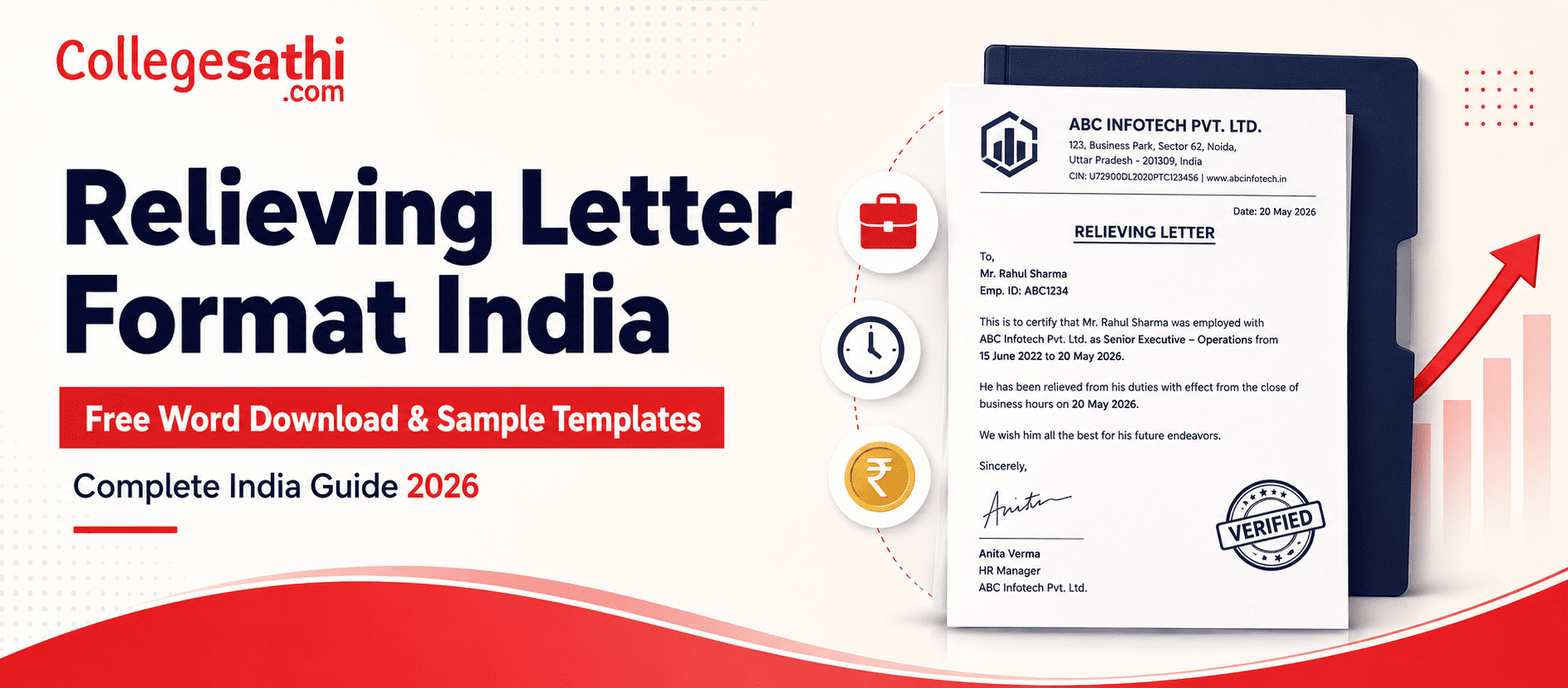
Relieving Letter Format India 2026: Free Word Download & Sample Templates

Why a Relieving Letter Matters in the Indian Job Market
You've resigned. Your last working day is two weeks away. Your new employer's HR team has already asked when you can share your relieving letter. And here's the catch — without it, many Indian companies won't let you join on your scheduled date. Some will even rescind the offer.
This document carries more weight in India than most professionals realise. Background verification teams at Infosys, TCS, Wipro, HCL, Accenture, and almost every mid-to-large Indian company treat the relieving letter as the primary proof that you exited your previous job cleanly. No pending dues, no abandoned projects, no unresolved disputes. Just a clear administrative closure.
This guide explains exactly what a relieving letter format looks like in India in 2026, includes ready-to-use samples for different employee types, walks you through how to request one professionally, and covers what to do when your employer delays or refuses to issue it. You'll also find a downloadable Word format you can customise.
What is a Relieving Letter? (Quick Answer)
A relieving letter is an official document issued by an employer that confirms an employee has been formally relieved of their duties on their last working day, with no pending dues, projects, or obligations. It is typically issued on company letterhead, signed by HR or a senior authorised signatory, and contains the employee's name, designation, last working date, and a clearance statement.
The relieving letter meaning in the Indian context is straightforward — it's the official "you're free to go" document. New employers ask for it specifically to confirm you've left your previous role without any hanging commitments or disputes that could legally follow you to your next job.

Your career, our expertise - talk to a counsellor
Experience Letter vs Relieving Letter: The Key Difference
Many Indian professionals confuse these two documents. Is relieving letter and experience letter same? No — they serve completely different purposes, though they're often issued together.
| Aspect | Relieving Letter | Experience Letter |
|---|---|---|
| Purpose | Confirms you've been formally released | Documents what you did at the company |
| Issued on | Last working day or shortly after | On request, anytime during/after employment |
| Content focus | Date of relieving, clearance, no dues | Role, responsibilities, performance, tenure |
| Used for | Joining a new company | Job applications, visas, higher studies |
| Length | Brief — 1 paragraph typically | Detailed — full page usually |
Most Indian companies issue both documents together on the last working day. But the relieving letter is the one your new employer absolutely needs before your joining date. For a deeper comparison and to download experience letter formats, check our complete guide on experience letter format with samples.
What a Valid Relieving Letter Must Include
There's no government-mandated employee relieving letter format in India, but Indian HR practice has settled on a clear set of must-have elements. A relieving letter missing these is typically sent back for correction by the new employer's onboarding team.
- Company letterhead with full registered name, address, logo, and contact details
- Date of issuance in DD/MM/YYYY format
- Employee's full name exactly as on official records
- Designation held at the time of exit
- Employee ID if applicable
- Last working date — the actual final day of employment
- Confirmation of resignation acceptance by the company
- No-dues clearance statement — confirming clearance from finance, IT, admin
- Best wishes statement — standard courtesy
- Authorised signatory's name, designation, and signature
- Company seal or stamp
Your career, our expertise - talk to a counsellor
Relieving Letter Format: Ready-to-Use Sample
Here's a standard relieving letter format in word that works for most Indian corporate roles — IT, sales, BPO, manufacturing, services, and startups:
[Company Letterhead — Name, Address, Phone, Website]
Date: [DD/MM/YYYY]
Place: [City, State]
To Whomsoever It May Concern
This is to certify that [Employee Full Name], who was employed with [Company Name] as [Designation], Employee ID [XXXX], has been formally relieved from her/his/their duties with effect from [Last Working Date].
Her/His/Their resignation submitted on [Resignation Date] has been duly accepted by the management. All assignments, responsibilities, and pending obligations have been satisfactorily handed over, and no dues are outstanding from either side at the time of relieving.
We thank [Employee Name] for the valuable contributions made during her/his/their tenure with [Company Name] and wish her/him/them success in future endeavours.
For [Company Name]
[Authorised Signatory's Signature]
[Full Name]
[Designation — HR Manager / Director]
[Company Seal / Stamp]
Download Standard Relieving Letter Format (Word)
Relieving Letter for Different Employment Types
Company Relieving Letter for IT Professionals
For IT roles at companies like TCS, Infosys, Wipro, HCL, Cognizant, or Indian product firms, the relieving letter often mentions clearance from project teams, hardware return, and access deactivation. Background verification for IT hires checks these specifics carefully.
Job Relieving Letter for Sales and BPO Roles
Sales executives and BPO professionals typically have additional clearances — sample collection, customer data handover, CRM access deactivation, and laptop or device return. The job relieving letter should mention these where relevant.
Employee Relieving Letter for Government and PSU Employees
Government and PSU exits follow more formal protocols. The relieving letter usually requires additional clearances from multiple departments and is signed by senior officers — Administrative Officer, Section Officer, or Director level.
Your career, our expertise - talk to a counsellor
How to Request a Relieving Letter From Your Employer
Knowing how to make relieving letter requests professionally matters because timing affects whether you can join your next job on schedule. Here's the practical approach:
Step 1: Submit your resignation in writing — Email is fine, but a printed signed copy adds weight. Mention your last working day clearly. Need a template? Check our guide on resignation letter format with samples.
Step 2: Complete your notice period — Most Indian employment contracts specify 30 to 90 days. Some companies allow buyout of notice period.
Step 3: Complete the exit clearance process — Return laptops, ID cards, access devices. Settle outstanding expenses. Hand over assigned projects formally.
Step 4: Request the relieving letter formally — Send a short, professional email to HR a week before your last working day.
Relieving Letter Request Email Template
Subject: Request for Relieving Letter — [Your Name] | [Employee ID]
Dear [HR Manager's Name],
As my last working day at [Company Name] is approaching on [Last Working Date], I would like to formally request my relieving letter.
I have completed all assigned tasks, returned company assets, and obtained necessary clearances from the IT, Admin, and Finance departments. Kindly issue my relieving letter on company letterhead at the earliest, as I require it for joining formalities at my next organisation.
Please let me know if any additional documentation is needed from my side.
Thank you for your support during my tenure.
Warm regards,
[Your Full Name]
[Employee ID]
[Contact Number]
What to Do if Your Employer Refuses or Delays the Relieving Letter
This is more common than many realise — particularly with smaller companies, startups, or in cases where exits weren't entirely amicable. If your employer is delaying or refusing your relieving letter, here's the practical escalation path:
- Send a written follow-up — Email HR, your reporting manager, and the company's senior leadership together
- Mention specific business impact — A pending joining date with a new employer carries weight
- Reference your fulfilled obligations — Notice period completed, dues cleared, assets returned
- Escalate to the labour commissioner — If the company continues to refuse, you can file a complaint with your state's labour department
- Provide alternative proof — Many new employers accept resignation acceptance email, salary slips, and Form 16 as interim proof while you pursue the relieving letter
The Industrial Employment (Standing Orders) Act and Indian Contract Act generally support an employee's right to receive a service certificate on exit. Withholding a relieving letter to coerce an employee — without a legitimate dispute — is not legally enforceable in most cases.
Your career, our expertise - talk to a counsellor
Relieving Letter and Higher Education in India
If you're a working professional planning to take up higher studies while continuing your career — through an online MBA, online MCA, or executive program — your relieving letter from previous employers can be required for admission verification. Universities like NMIMS, Manipal, Amity, and Jain often verify continuous work experience for executive admissions through this document combined with the experience letter.
For UG students considering an online BBA or online BCA after completing internships, relieving certificates from internships add credibility to your application even though they're not mandatory.
Final Thoughts
A clean exit from one job and a smooth entry into the next depends heavily on your relieving letter. Whether you're a fresher exiting your first job or a senior professional moving for a better opportunity, getting this document right protects your career trajectory.
For working professionals planning their next career move alongside a relieving letter, consider strengthening your profile with an industry-recognised qualification. CollegeSathi lists verified online MBA programs and other PG options designed specifically for working Indian professionals — flexible schedules, UGC-recognised, and accepted across Indian and international employers.
You'll also need a strong resume to complement your relieving letter when applying for new roles. Download free templates from our complete guide on resume format for Indian job seekers.
Frequently Asked Questions
A relieving letter is an official document issued by an employer confirming that an employee has been formally relieved of duties on their last working day, with no pending dues or obligations. In India, it's a near-mandatory document for joining most mid-to-large companies. Background verification teams use it to confirm clean exits from previous employment.
No. A relieving letter confirms your formal exit on your last working day with no pending dues. An experience letter documents what you did at the company — role, tenure, responsibilities, and performance. Most Indian companies issue both on exit, but they serve different purposes. New employers usually require both.
Write it on company letterhead with the date, employee's full name, designation, employee ID, and last working day. Include a statement confirming resignation was accepted, all dues are cleared, and assets were returned. End with a best wishes line. Sign with the HR manager's or authorised signatory's full name, designation, and company seal.
Employers cannot withhold relieving letters arbitrarily once you've completed your notice period, returned company assets, and cleared dues. If they refuse without a legitimate reason like unrecovered loans or pending disputes, you can escalate to the labour commissioner's office in your state. Indian labour law generally supports an employee's right to receive a service certificate on exit.
Most organised-sector companies issue relieving letters on the last working day itself or within 7 working days after exit. Some larger MNCs with automated HR systems issue them immediately upon exit clearance completion. Smaller companies may take 2 to 4 weeks. If you have a fixed joining date with your new employer, mention it in your request to help HR prioritise.
Yes, but only if you've bought out the remaining notice period through salary payment or your employer has waived it. If you leave without completing notice and without buying it out, your employer is within their rights to refuse the relieving letter. Some companies still issue it with a noted clause stating "served partial notice period." Many new employers will ask about this during background verification.
Yes. A relieving letter sent as a digitally signed PDF from the company's official email address is accepted by virtually all Indian employers and background verification agencies in 2026. Physical signed letters on letterhead are still common in traditional sectors like government, PSUs, and banking. For visa or international purposes, a physical signed copy may be specifically requested.
Contact your previous employer's HR department and request a duplicate copy. Most companies maintain digital records of issued letters for at least 5 years and can reissue them on request. If the company has shut down, you can use alternative proofs like PF transfer records, salary slips, Form 16, and bank statements to establish your previous employment for new employers and background verification agencies.



Popular PG Programs
Trending UG Programs
Doctorate Programs
Executive Programs
Trending Online Universities
In Demand MBA Specializations
In Demand MCA Specializations
CollegeSathi aims to provide unbiased and precise information to aspirants, along with comparative guidance on universities and their programs. The content on the CollegeSathi website, including text, graphics, images, blogs, videos, and university logos, is meant for informational purposes only and should not be considered a substitute for official information provided by academic partners. While we make every effort to keep the information accurate and up to date, CollegeSathi does not guarantee the completeness or reliability of the content and is not responsible for any errors, omissions, or losses resulting from its use.
© CollegeSathi 2026. All Rights Reserved.