



Experience Letter & Certificate: Format, Samples, How to Request & Everything You Need to Know

Most people don't think about their experience certificate until they urgently need one. You've just accepted a new offer, your joining date is two weeks away, and the new company's HR team is asking for your experience letter from your previous employer. That's when the anxiety sets in — especially if your old company is slow to respond or you parted on awkward terms.
Or maybe you're on the HR side: a former employee has reached out requesting a certificate, and you're not sure what it should say, who should sign it, or whether a specific format is required.
This guide covers both sides of that situation. By the end of it, you'll know exactly what a well-written experience certificate looks like, what it must contain to be credible, how to request one professionally, and how to issue one correctly. We've also included ready-to-use formats you can adapt immediately — no generic filler, just practical content.
What is an Experience Letter / Certificate and Why Does It Matter?
An experience letter (also called an experience certificate — the two terms are used interchangeably in India) is an official document issued by an employer that formally confirms an individual's employment with the organisation. It typically states the person's name, designation, period of employment, key responsibilities, and a general assessment of their performance and conduct.
The document serves as a verifiable record of your professional history. Unlike a resume, which is self-reported, an experience certificate comes from a third party — your employer — which is precisely what makes it credible. Background verification agencies, new employers, visa officers, and academic institutions all treat the experience certificate as a primary reference document, not a supporting one.
In the Indian job market, submitting an experience certificate at the time of joining a new company is close to standard practice. Most companies will ask for it along with your relieving letter. For certain roles — particularly in banking, government-adjacent organisations, and corporate enterprises — not having one can stall or even cancel an offer.
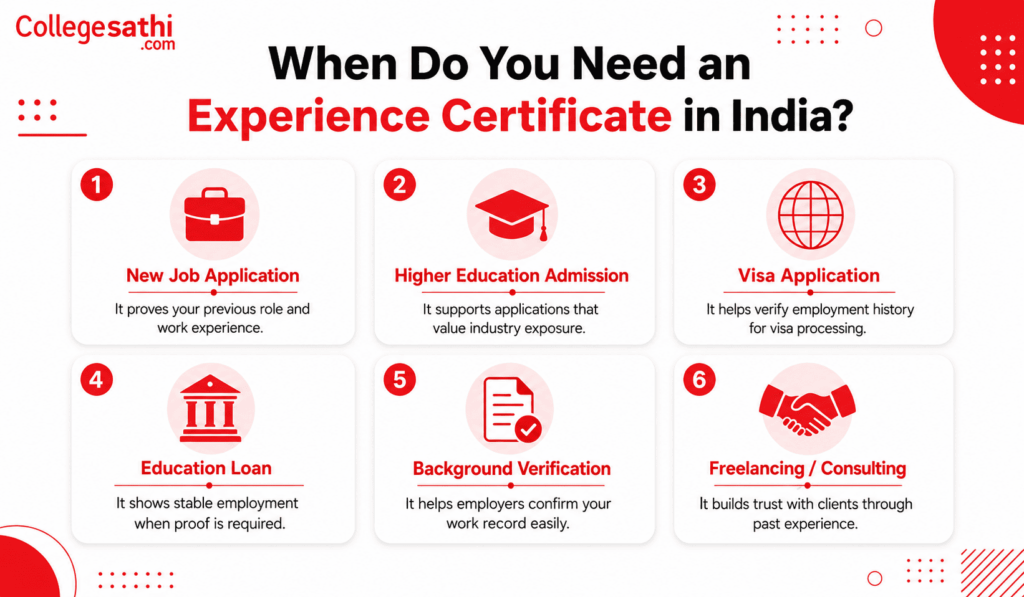
Beyond employment, an experience certificate is also commonly required when:
- Applying for higher education programs that require work experience as an eligibility condition
- Applying for visas — particularly skilled worker or student visas to countries like Canada, the UK, Germany, and Australia
- Applying for government tenders, where past project experience needs to be documented
- Requesting an education loan, where lenders want to verify current employment
- Transitioning into freelancing or consulting, where clients may want evidence of corporate experience
Experience Letter vs Relieving Letter: Not the Same Document
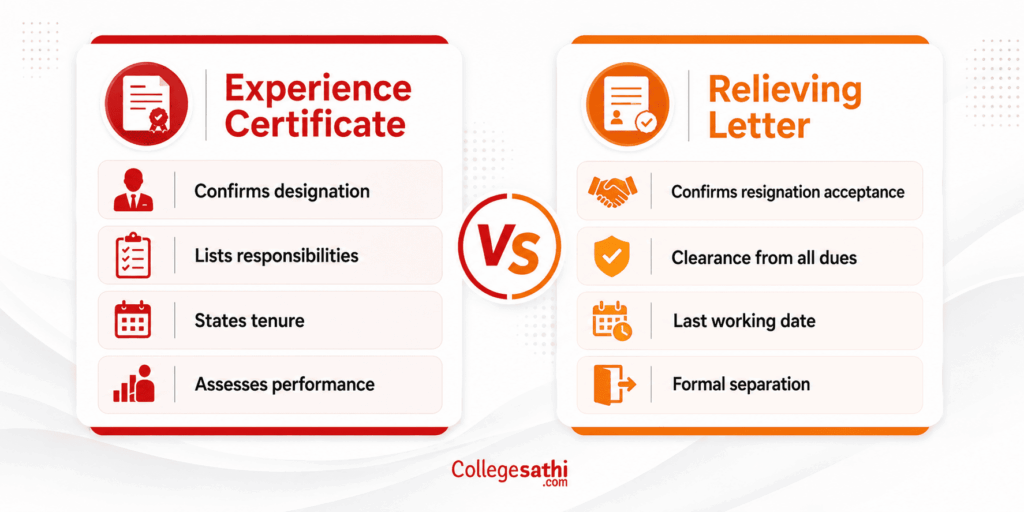
This is one of the most common points of confusion, particularly for first-time job changers. These two documents serve different purposes and cannot substitute for each other — although many companies issue them together.
| Parameter | Experience Certificate | Relieving Letter |
| Primary purpose | Confirms your role, tenure, and performance | Confirms your resignation is accepted and you've been formally relieved |
| Issued by | HR department or reporting manager | HR department or senior management |
| When issued | On request — after or during employment | On last working day or shortly after |
| Content focus | Job role, responsibilities, skills, conduct | Date of relieving, clearance confirmation, no dues |
| Used for | New job applications, education, visas | New job joining formalities |
| Tone | Formal recommendation / attestation | Administrative clearance |
In short: the relieving letter says 'you've been formally released from your duties here,' while the experience certificate says 'here is what you did while you were here.' Most new employers want both. If your former company issues only one, you can specifically request the other — here's our full guide to the relieving letter format, with a downloadable sample.

Your career, our expertise - talk to a counsellor
What a Valid Experience Certificate Must Include in India
There's no government-mandated template for experience certificates in India — no Companies Act provision or labour law that specifies a required format. But background verification agencies and corporate HR teams have developed a de facto standard over time. A certificate that's missing key elements is often sent back for correction, which delays the joining process.
Here's what a credible experience certificate must contain:
- Company letterhead: Full company name, registered address, logo, and contact details. Certificates not on official letterhead are routinely rejected by background verification agencies.
- Date of issuance: Written in full — DD/MM/YYYY format or written out ('12th May 2026, New Delhi'). This matters particularly if the certificate is used for visa applications.
- Employee's full name: As it appears on their official records — not a nickname or shortened version.
- Designation: The official job title held. If the employee was promoted during their tenure, both designations should ideally be mentioned.
- Period of employment: Exact joining date and last working date in DD/MM/YYYY format.
- Key responsibilities: A brief description of the work the employee handled — specific enough to be meaningful, but not so detailed it reads like a resume.
- Performance and conduct statement: A general assessment of work quality, attitude, and conduct. Avoid vague statements like 'good employee.' Phrases like 'demonstrated consistent professionalism' or 'maintained high standards of accuracy' are more useful.
- Authorised signature and designation: Signed by HR Manager, Department Head, or a senior authorised official. A signature without a printed name and designation below it is incomplete.
- Company seal or stamp: While not legally mandatory, the absence of a company seal on an experience certificate raises flags during physical background checks.
Experience Letter Format & Certificate Templates: Ready to Use
Below are two formats — one for a standard full-time employee and one for an intern. Both are designed to pass background verification and meet the requirements of most Indian corporate hiring teams.
Format 1: Standard Employee Experience Letter (Work Experience Letter Format)
[Company Letterhead — Name, Logo, Address, Phone, Website]
Date: [DD/MM/YYYY] Place: [City, State]
To Whomsoever It May Concern
This is to certify that [Employee Full Name], S/o / D/o [Parent's Name], was employed with
[Company Name] as [Designation] from [Joining Date] to [Last Working Date].
During this period, [he/she/they] was responsible for [key responsibilities — 2 to 3 lines].
[He/She/They] consistently demonstrated [relevant qualities: e.g., strong analytical thinking, excellent communication, reliability under pressure, and a constructive approach to teamwork].
Throughout [his/her/their] tenure, [Employee Name] maintained high professional standards and
contributed positively to the organisation. [He/She/They] leaves with our best wishes for all
future endeavours.
This certificate is issued upon the request of the individual for the purpose of [purpose, if specified — e.g., future employment / higher education / visa application].
Sincerely,
[Authorised Signatory's Signature]
[Full Name]
[Designation — e.g., HR Manager / Director]
[Company Name]
[Company Seal / Stamp]
Format 2: Internship Experience Letter Format
[Company Letterhead]
Date: [DD/MM/YYYY] Place: [City, State]
To Whomsoever It May Concern
This is to certify that [Intern's Full Name], a student of [University/College Name] pursuing
[Degree/Program Name], successfully completed an internship with [Company Name] from
[Start Date] to [End Date] in the [Department Name] department.
During the internship, [he/she/they] worked on [brief description of project or tasks].
[He/She/They] showed initiative, a willingness to learn, and the ability to manage assigned
tasks with minimal supervision. [His/Her/Their] contribution was genuinely useful to the team.
We wish [Intern Name] well in [his/her/their] academic and professional journey ahead.
Sincerely,
[Authorised Signatory's Signature]
[Full Name]
[Designation]
[Company Name]
[Company Seal / Stamp]
Your career, our expertise - talk to a counsellor
What to Emphasise in an Experience Letter, by Role
The standard format above works for almost any job. What changes from one role to the next is not the structure — it's the responsibilities and achievements you put in the middle paragraph. A background verification team reviewing an accountant's letter checks for different specifics than one reviewing a software engineer's. Here's what carries the most weight for the roles people ask about most often, and the vague phrasing that tends to get a certificate flagged for extra checking.
| Role | Spell out in the responsibilities line | What verification teams check | Vague phrasing to avoid |
| Software Engineer / IT | Languages, frameworks and cloud used; the module or service owned; team size; one measurable result (latency, failure rate, release frequency) | Named technologies and evidence of real ownership, not generic "development work" | "Worked on software development" |
| Sales / Business Development | Territory or segment; target achievement %; portfolio or account count; typical deal size; what was sold | Concrete numbers — quota %, revenue, number of accounts | "Responsible for sales" |
| HR | The HR domain owned (talent acquisition, payroll, employee relations, L&D, HRBP); headcount supported; HRIS used; hiring volume | Which HR sub-function, not just "HR activities" | "Handled HR functions" |
| Accountant / Finance | GL and reconciliations; GST and TDS filings; monthly book closure; statements under Ind AS; software used (Tally Prime, SAP FICO) | Specific compliance work, tools, and any audit exposure | "Handled accounts" |
| Marketing / Digital | Channels run; budget managed; the metric moved (traffic, leads, CPL, ROAS); tools used | Owned campaigns with outcomes, not "marketing activities" | "Did marketing work" |
| Customer Support | Channels (call / chat / email); daily ticket volume; resolution rate and CSAT; escalation handling | Volume and quality numbers | "Handled customer queries" |
| Teacher / Faculty | Subjects and grade levels; board (CBSE / ICSE / State); student strength; extra roles (class teacher, examiner) | Board and level — required for education-board and government-role verification | "Taught students" |
| Admin / Operations | Areas owned (office management, vendor coordination, logistics, document control); ERP or tools; scale (team size, throughput) | Scope, plus any process improvement introduced | "Handled admin work" |
The rule underneath the whole table: replace every adjective with a fact. "Good performer" tells a verifier nothing. "Closed 18 new accounts in FY 2023–24 at 112% of target" is checkable — and checkable is what makes a certificate credible.
Two Worked Examples: What "Good" Actually Looks Like
Rather than a blank template, here's what the middle of the letter looks like once it's actually filled in for two common roles. Everything in brackets is what you'd swap for real details.
Software Engineer — filled in
[Company Letterhead]
Date: 12/05/2026 Place: Bengaluru, Karnataka
To Whomsoever It May Concern
This is to certify that Rahul Verma was employed with Acme Technologies Pvt. Ltd. as a
Software Engineer from 12/07/2021 to 30/04/2024.
During this period, Rahul worked on the payments platform team, building and maintaining backend
services in Java and Spring Boot and owning the transaction-reconciliation module. He worked in an
Agile team of six and contributed to reducing the payment-failure rate from 2.1% to 0.7% across four
release cycles. In his final year he also mentored two junior engineers and led code reviews for the module.
He consistently demonstrated strong ownership of production issues, sound technical judgement, and a
collaborative approach with the QA and DevOps teams. He leaves with our best wishes for his future endeavours.
Sincerely,
Priya Menon
Engineering Manager
Acme Technologies Pvt. Ltd.
[Company Seal / Stamp]
Notice what makes it credible: named technologies, one real module, one measurable result, and a specific extra responsibility. A verifier can picture the actual job.
Sales Executive — filled in
[Company Letterhead]
Date: 12/05/2026 Place: New Delhi
To Whomsoever It May Concern
This is to certify that Priya Nair was employed with BrightRetail Pvt. Ltd. as a
Sales Executive from 03/01/2022 to 28/02/2025.
During this period, Priya managed the West Delhi territory, handling a portfolio of over 40 retail
accounts. She consistently achieved between 105% and 120% of her quarterly targets, onboarded 18 new
accounts in FY 2023–24, and maintained a client-retention rate above 90%.
She demonstrated persistence, clear client communication, and strong follow-through on her commitments.
She leaves with our best wishes for her future endeavours.
Sincerely,
Anil Kapoor
Regional Sales Head
BrightRetail Pvt. Ltd.
[Company Seal / Stamp]
Same principle, different specifics: territory, target percentages, account numbers, retention rate. Whatever the role, the pattern is the same — swap vague praise for verifiable detail.
Role-Specific Templates: Download and Customise
If you'd rather start from a pre-filled draft, download the version closest to your role below, replace the bracketed details with the employee's information, print on company letterhead, sign, and stamp.
Free role-specific experience letter templates (PDF & Word)
Don't see your exact role? The standard employee format (Format 1 above) works for any position not listed — managers, consultants, designers, doctors, nurses, lawyers, and more. Keep the structure and rewrite the responsibilities and qualities to match the real work handled.
How to Request an Experience Letter or Certificate From Your Employer
Knowing what a good experience letter or certificate should contain is only half the task. The other half is actually getting it — particularly if you've already left the company or you parted on complicated terms.
How to Write an Experience Letter Request: Who Should You Approach?
Your first point of contact should always be the HR department — not your reporting manager, not the finance team. HR is responsible for issuing experience certificates and maintains the employment records needed to create an accurate one. If HR is unresponsive, copy your reporting manager on the follow-up email. In smaller organisations where there's no formal HR function, the CEO or founder's office handles this.
Email Request Template
Subject: Request for Experience Certificate — [Your Full Name] | [Employee ID if known]
Dear [HR Manager's Name / HR Team],
I hope this message finds you well. I am writing to formally request an experience certificate for my tenure with [Company Name] as [Your Designation] from [Joining Date] to [Last Working Date].
I require this certificate for [mention reason: e.g., a new job application / higher education admission / visa processing]. If possible, I would appreciate receiving it within [mention timeline — e.g., five to seven working days].
For your reference, here are my details:
- Full Name: [Your Full Name]
- Employee ID: [If applicable]
- Department: [Your Department]
- Period of Employment: [Joining Date] to [Last Working Date]
Please let me know if any additional information is required from my side.
I genuinely appreciate your assistance.
Warm regards,
[Your Full Name]
[Your Contact Number]
[Your Email ID]
A few things worth flagging from experience:
- Send the email with a read receipt. This creates a timestamp record in case you need to follow up or escalate later.
- If there's no response in 10–15 working days, follow up once by email and once by phone. Stay polite — becoming aggressive typically slows the process down.
- If you're still employed and need the certificate for an education loan or ongoing visa application, clarify this upfront so HR understands you're not leaving.
- Digitally signed PDFs are accepted by most Indian employers and background verification agencies — you don't necessarily need a physical stamped copy unless specifically asked.
Your career, our expertise - talk to a counsellor
Experience Certificate and Higher Education in India: What Students and Professionals Need to Know
Experience certificates come up more frequently in the education context than most people expect. Here's where they appear:
MBA admissions: Most online and distance MBA programs in India that are designed for working professionals either require or prefer proof of work experience. An experience certificate is the standard documentation for this. If you're considering an online MBA, check whether your program requires the certificate at the application stage or only at enrolment.
MCA and technical postgraduate programs: Some online MCA programs have optional or preferred work experience criteria. Even when not mandatory, submitting an experience certificate alongside your application can strengthen your profile — particularly for programs that consider industry relevance in admissions.
BBA and BCA program: While undergraduate program like online BBA and online BCA typically don't require work experience as a criteria, internship experience certificates from summer internships or part-time roles can support scholarship applications and merit-based selections at some institutions.
Wrapping Up
An experience letter is one of those documents that seems straightforward until you actually need one in a hurry. Knowing what it should contain, who to approach, and how to ask for it professionally makes the whole process considerably smoother — whether you're the one requesting it or the one responsible for issuing it.
For students and professionals exploring online degree programs where work experience is either required or preferred, it's worth sorting out your experience documentation early. If you're exploring online programs across levels, CollegeSathi lists verified courses with clear eligibility criteria — so you can check upfront whether your experience documentation will be needed.
Frequently Asked Questions
No — they're two distinct documents. A relieving letter confirms that your resignation was accepted and that you've been formally released from your duties. An experience certificate, on the other hand, attests to your role, tenure, responsibilities, and performance. Most companies issue both when an employee leaves, but they serve different purposes. A new employer typically needs both — the relieving letter to confirm you've properly left your previous job, and the experience certificate to verify what you actually did there.
There's no specific central legislation in India that explicitly mandates experience certificates the way some countries require them. However, the Industrial Employment (Standing Orders) Act requires covered establishments to provide service certificates at termination, which is interpreted broadly to include experience documentation. In practice, virtually all organised-sector employers issue experience certificates on request as a standard HR function. If a company refuses without reason, you can raise the matter with the labour commissioner's office in your state.
Wait 10–15 working days after your first request before following up. When you do follow up, email both HR and your former reporting manager simultaneously — this often speeds things up. If you still don't receive a response, a polite phone call to HR usually resolves it. In cases where the company has shut down or HR is genuinely unreachable, your new employer's background verification team typically has alternative verification methods — including calling registered contacts and checking PF records through EPFO — that can confirm your employment without a formal certificate.
Technically, a certificate on plain paper is not invalid if it's signed by an authorised person — but practically, background verification agencies and most corporate HR teams will reject it or flag it for further verification. The company letterhead is what makes the document credibly traceable to the issuing organisation. If your employer operates informally and doesn't have printed letterhead, a PDF on a digitally designed template with the company's name, address, and contact details — signed and optionally stamped — is generally more acceptable than a handwritten plain-paper certificate.
Submitting a forged or fabricated experience certificate is treated as fraud under Indian law. Depending on the context, it can attract charges under Section 420 of the IPC (cheating and dishonestly inducing delivery of property), Section 465 (forgery), and Section 471 (using a forged document as genuine). In the employment context, the immediate consequences are job offer withdrawal, termination if already employed, and blacklisting by the organisation and its associated background verification agencies. In sectors like banking, insurance, and government, it can result in regulatory action as well. Background verification in India has become significantly more thorough since 2020 — the risk of detection is much higher than most people assume.
Yes, absolutely. You might need one while still employed for reasons like applying for an education loan, supporting a visa application, or submitting proof of employment for an academic program. In this case, your certificate will state your current employment dates without an end date, or with 'currently employed' noted. Be transparent with HR about why you need it — they issue these regularly for active employees and it's not interpreted as a sign that you're planning to leave.
Most organised-sector companies in India issue experience certificates within 7–15 working days of a formal request. Some larger companies with automated HR systems can turn these around in 2–3 days. Smaller companies or those with informal HR processes may take 3–4 weeks, particularly if the authorised signatory is unavailable. If you have a specific deadline — like a joining date or a visa appointment — mention it explicitly in your request email so HR can prioritise accordingly. Following up once after 10 days is reasonable and usually welcome.
Yes. A digitally signed PDF experience certificate sent via official company email is accepted by most Indian employers, universities, and background verification agencies. For visa applications, acceptance varies by country — some consulates specifically require a physical letter on letterhead with a wet signature. Always check the specific requirement of the institution or authority you're submitting to. As a general rule, if you think there's a chance you'll need the document for international use, request both a digital PDF and a physical signed copy when asking your employer.
An experience letter should always be written on official company letterhead. Start with the date and place of issue, then address it ‘To Whomsoever It May Concern.’ State the employee’s full name, their official designation, and their exact dates of employment (DD/MM/YYYY). Follow this with two to three lines describing their key responsibilities and a brief note on their conduct and performance — keep this honest and specific rather than generic. Close with a line wishing the employee well, the authorised signatory’s full name, designation, and company seal or stamp. The tone should be formal but not stiff — think of it as an official reference document, not a performance appraisal. Salary figures are not included in a standard experience letter unless the employee specifically requests a combined salary-cum-experience certificate for a particular purpose.
An experience letter — also known as an experience certificate, work experience letter, or company experience letter — is a formal document issued by an employer that officially confirms an individual’s employment history with that organisation. It states the person’s name, designation, period of employment, and typically includes a brief description of their responsibilities and conduct. It differs from a relieving letter (which is an administrative clearance document) and from a salary certificate (which is a financial document). The primary purpose of an experience letter is to serve as third-party proof of your professional background — one that employers, academic institutions, visa authorities, and background verification agencies treat as credible because it comes from the organisation you worked for, not from you.



Popular PG Programs
Trending UG Programs
Doctorate Programs
Executive Programs
Trending Online Universities
In Demand MBA Specializations
In Demand MCA Specializations
CollegeSathi aims to provide unbiased and precise information to aspirants, along with comparative guidance on universities and their programs. The content on the CollegeSathi website, including text, graphics, images, blogs, videos, and university logos, is meant for informational purposes only and should not be considered a substitute for official information provided by academic partners. While we make every effort to keep the information accurate and up to date, CollegeSathi does not guarantee the completeness or reliability of the content and is not responsible for any errors, omissions, or losses resulting from its use.
© CollegeSathi 2026. All Rights Reserved.