



Is UGC NET Mandatory for PhD Admission in 2026? Know the Truth


Are you eager to pursue a PhD in India but unsure if you need to crack the UGC-NET exam in 2026? With the recent update from the University Grants Commission (UGC), a lot of students are confused about whether they can get PhD admission without UGC NET to pursue their doctoral degree. However, the UGC-NET has offered huge credibility for pursuits for obtaining a PhD, as an Assistant Professor, or for obtaining a JRF (Junior Research Fellowship).
You can now take different paths to pursue your PhD journey without clearing the NET. In fact, many students are also exploring whether it is possible to pursue a PhD without a Master's degree in India, as UGC's evolving regulations have opened up more flexible entry routes than ever before. If you are already looking at applying through CUET-PG or through various university setups or entrance tests, or you are still aiming for NET. Regardless of your future plans to stay with NET or try a different approach, knowing what routes are available is a key consideration for your future study plans.
In this blog, we will tell you about PhD admission criteria in India, whether NET is mandatory for PhD in 2026, PhD admission without UGC NET, and a lot more and clarify which pathway is the best route for you.
What is UGC-NET?
The University Grants Commission - National Eligibility Test (UGC-NET) is a national-level exam, conducted by the National Testing Agency (NTA), on behalf of the UGC, to determine eligibility for Assistant Professor and Junior Research Fellowship (JRF). Whereas it used to be the main pathway to access PhD doctoral study, the UGC guidelines introduced other approaches, which will be considered in the following sections.
The primary objectives of UGC-NET are to:
- Qualify candidates for college or university-level teaching as an assistant professor.
- Provide candidates' eligibility for a Junior Research Fellowship or financial fellowship to study research on a full-time basis and be enrolled in a PhD program.
- It serves as a qualification for UGC NET PhD admission in PhD programs at many central and state universities.
- UGC-NET is administered by NTA, on behalf of UGC, usually twice a year, in June and December, in over 80 different subjects.

Previous Role of UGC-NET in PhD Admissions
For an extended period of time, the UGC-NET was a primary source for aspirants who wanted to pursue a doctoral course of study in India.
Here's how UGC-NET played an important role in PhD admissions:
1. Eligibility for Assistant Professorship and JRF
- Assistant Professor: Given that a UGC-NET candidate is qualified as an Assistant Professor in universities and Colleges in India.
- Junior Research Fellowship (JRF): Some candidates who scored above a specific benchmark were able to receive the JRF, which financially supported the candidates while conducting full-time research that led to a PhD.
2. Philosopher Doctorate Admissions
- Preferred Qualification: For PhD admissions, many universities prefer candidates who have cleared NET. Such candidates may also get an exemption from the entrance test.
- Direct Admission: Some universities allow direct admission to PhD programs for NET-qualified applicants, especially those with JRF. This qualification is accepted as proof of research ability.
3. Biannual Examination
- UGC-NET was conducted biannually as per the National Testing Agency (NTA) in November and December each year, and assigned subjects when it was accepted as a compulsory examination.

Your career, our expertise - talk to a counsellor
New UGC Regulations for 2022–2026: What has Changed?
Over the past few years, the University Grants Commission (UGC) has made significant moves to make the higher education process in line with the National Education Policy (NEP) 2020. In particular, there has been a focus on simplifying the PhD admission process across universities in India. Here's what has changed through 2022-2026:
1. Transition introduced by UGC PhD Regulations 2022
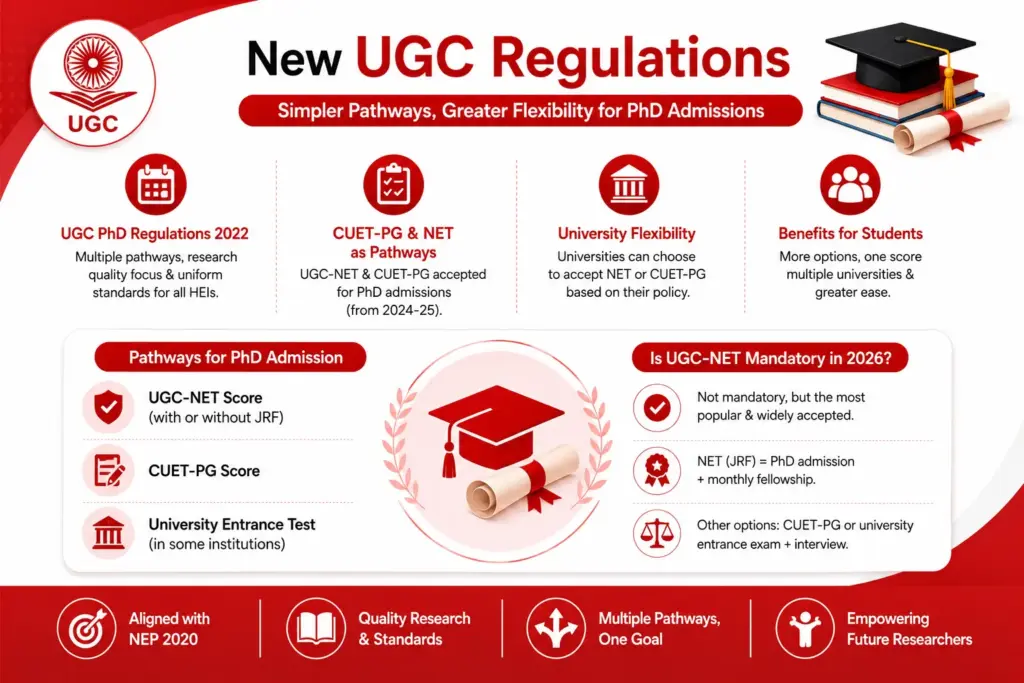
In November 2022, UGC released the Minimum Standards and Procedures for the Award of a PhD. Degrees Regulations, 2022. These new rules marked a clear change from earlier admission processes. To understand the full scope of these reforms, you can read about the major changes introduced by UGC in higher education policy. The UGC 2022 Regulations were introduced:
- Multiple pathways to attendance for a PhD, and not only UGC-NET or university exam.
- Greater responsibility for the quality of research outputs, faculty supervision, and thesis evaluation.
- The goal of standardisation is at the entry level for all higher education providers, whether central, state, deemed, or private.
2. CUET-PG and NET as Standard Admissions Pathways
CUET-PG was introduced by the National Testing Agency (NTA) as a common test for postgraduate and research admissions. It allows students to use one exam score to apply to multiple universities. Furthermore, starting in 2024-25, the UGC has publicly announced that UGC-NET will be accepted for PhD admissions in Indian universities. Therefore, these universities are no longer required to administer separate PhD entrance tests if they opt for net scores.
Key Learnings:
- UGC-NET: The UGC-NET score will now play a key role in PhD admissions. Candidates who qualify with JRF can use this score for applying to Assistant Professorships.
- CUET-PG: The CUET-PG exam is now becoming a common gateway for integrated PhD programs as well as combined PG+PhD courses. This gives students greater flexibility and a single route to enter advanced research programs.
Universities: Each university has the freedom to decide whether it will consider UGC-NET or CUET-PG scores for PhD admissions. Their choice will depend on internal policies, academic structure, and admission guidelines.
Benefits for Students
Now that students can apply for PhD programs using standardised methods. According to the university policy, students can apply for doctoral admissions with any of the following options as listed below:
- UGC-NET score (with or without JRF)
- CUET-PG score
- University entrance tests will still exist for some institutions
Is UGC-NET Mandatory for PhD in 2026?
UGC-NET is no longer a compulsory requirement for pursuing a PhD in 2026, but it is the most popular and recognised way for applying to a PhD course.
What has changed?
Until a few years ago, you could not pursue PhD programs in India without qualifying with the UGC-NET (especially with JRF), particularly in central and top public universities. However, with the new UGC PhD Regulations 2022, and recent updates by the UGC in 2023 and 2024, the UGC PhD admission process has become flexible. As of the 2024–25 academic year, UGC-NET scores are official pathways to PhD, particularly when:
- If you qualify for NET, you will have access to a PhD admission at a university without undergoing a separate university entrance exam.
- If you qualify for JRF, you will have access to a PhD admission with a fellowship paid monthly for the duration of your degree, which is perfect if you plan to pursue research full-time.
However, the UGC has also permitted universities to provide admission in several other ways, such as:
- CUET-PG score in universities that are accepting CUET for research-based PG and integrated PhD.
- University-level entrance exam, followed by an interview. This option is still used by many state, private, and deemed universities.
Your career, our expertise - talk to a counsellor
Is UGC-NET Necessary for a PhD?
In most private and state universities, it would be enough to pass the university's entrance exam and the applicable minimum NET exam for PhD eligibility requirements. Thus, passing UGC-NET is NOT a requirement to pursue a PhD program in India. However, it is still highly considered in:
- Central Universities and, top public institutions, like IITs, IIMs, and NITs, will generally also expect GATE or equivalent.
- Universities with high competition and limited PhD positions.
- Programs that offer funded positions for JRF.
If you are simply pursuing a PhD on a part-time basis or at a non-research institution, NET is not a requirement. However, if you plan to compete for research jobs, funded fellowships, or other academic positions, completing UGC-NET (either with or without a JRF) gives you an advantage.
Who Should Consider UGC-NET in 2026?
Despite the fact that UGC-NET is not the only option for PhD admission in India, there are certain categories of students and professionals who should consider taking UGC-NET. Let's take a closer look at who should opt for UGC-NET in 2026:
1. Aspiring Assistant Professor or Lecturer
For those who are willing to seek academic work, UGC-NET is still the most recognised pathway to become an Assistant Professor for those in Indian universities and colleges.
- Why? Because it is the required eligibility test for teaching participation in central universities, colleges, and many private universities.
- While universities have become flexible for admissions to PhD programs, the eligibility for teaching positions by the UGC still depends upon qualification for the NET.
If you plan to work in academia at the university level, it is important to qualify for UGC-NET, whether or not you wish to do a PhD.
2. Candidates Applying for JRF (Junior Research Fellowship)
A JRF is considered one of the most respected fellowships that can be granted to a research scholar. The UGC-NET JRF salary is financial support awarded to students for full-time research. The JRF will include the following:
- Monthly Stipends: Approx ₹31,000 per month for the 1st two years (with potential for extension).
- Research support: JRF candidates can have tie-ups with universities and research centres, or can be PhD candidates.
If you want to conduct high-end research in India and require research funding, a JRF is the way to go, and a UGC-NET is a necessity.
3. Candidates intending to apply to India's top-tier research universities
If you aim to apply to some of the best institutions in India, like the IITs, IIMs, or central universities, then UGC-NET is still very important. Although many universities now accept CUET-PG or their own entrance exams, most IITs and IIMs still prefer candidates who have cleared UGC-NET and have JRF status for full-time research positions.
Why? Because NET Qualification of a candidate ensures that an individual has a certain level of prerequisites, such as foundational knowledge of research and academics. It is an important aspect for institutions, as many candidates apply and arrive at prestigious schools to compete for limited research positions.
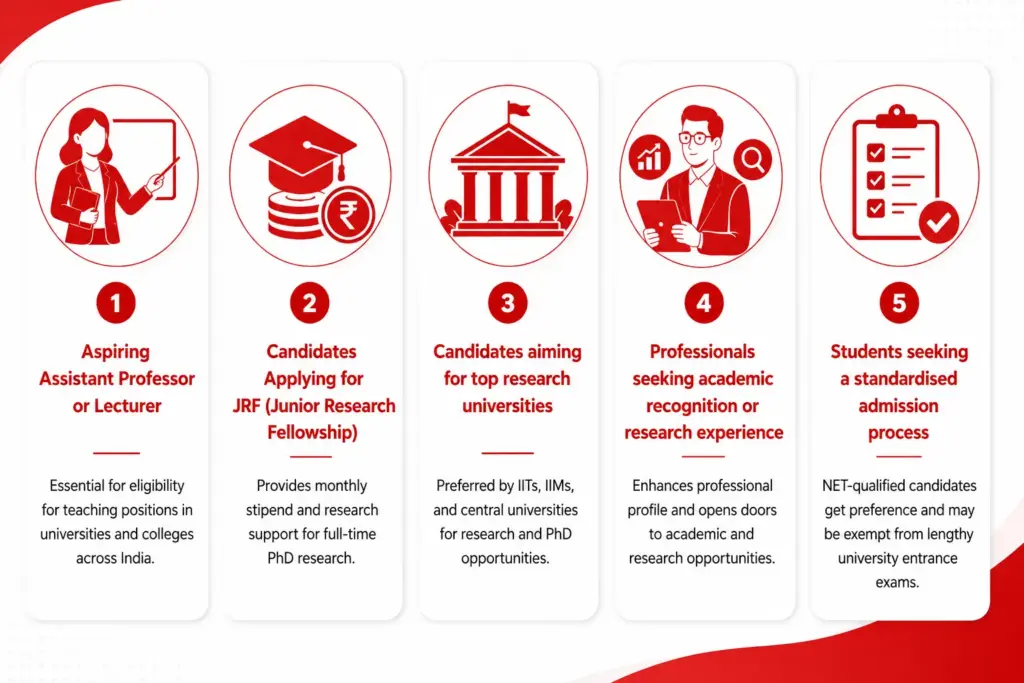
4. Professionals wanting some academic status or research experience
If you are a professional in research-intensive fields, then the UGC-NET remains a required qualification.
- It grants an academic status to your existing professional credentials, particularly in cases where you wish to pursue teaching or academic leadership positions.
- In addition, you access academic conferences, research funding, and potential partnerships.
Even if you are not currently pursuing a PhD, NET certification adds value to your career and connects you with the academic community.
5. Students Who Want a Standardised Admission Process
Students who wish to apply for the program with a standard admission process can pursue Ph.D through:
- Multiple Entry Routes: Although having a UGC-NET is not a requirement, it standardises the admission process through universities. NET-qualified students are prioritised over students who have to take individual university exams, so students qualified by NET are often exempt from sitting through long entrance exams.
Your career, our expertise - talk to a counsellor
PhD Admission Without UGC-NET: Is It Possible?
Yes, UGC-NET has historically been regarded as a credible and acceptable way to get into a Ph.D program, but it is not the only option in 2026. Because of the new UGC Ph.D Regulations and particularly the transition towards alternate entrance pathways like CUET-PG, or university-specific PhD tests, there are many universities with a number of opportunities to access PhD, with or without UGC-NET.
1. Universities with their own PhD Entrance Tests
Several universities still administer their own entrance exams for PhD admissions, which are typically followed by a research proposal or an interview, particularly state, private, and deemed universities. A few examples are:
- Jawaharlal Nehru University (JNU) - with its own entrance.
- University of Hyderabad, which has both a NET and a university entrance exam facility.
- Private institutions like Amity, Shiv Nadar, and many others usually have their own selection process for PhD, which is based frequently on interviews and research potential. If you are exploring such options, it is worth checking the list of UGC-approved online universities in India to ensure the institution you choose holds valid UGC recognition before applying.
2. CUET-PG qualification for PhD: The Common University Entrance Test for Postgraduate Programs (CUET-PG)
It is another recognised and commonly used qualification for PhD aspirants. Although it is often criticised for being primarily used to grant admission to postgraduate level programs, several universities have now adopted the CUET-PG examination requirement for research-based Master's programs, leading to integrated PhD options or direct admission to a PhD program, for example:
- Central universities and other participating universities under CUET-PG may consider CUET scores as the basis for eligibility to their PhD programs.
- Some institutions may even accept a strong CUET-PG performance to dismiss the second written test requirement.
It is important to note that each university's declaration on this matter is contingent on its policies. Thus, always check the PhD admissions brochure of the intended institution.
3. Merit-Based PhD Admissions
It is not prevalent, but some universities will admit students based on their postgraduate academic merit to PhD programs, especially for non-funded, part-time, or project-linked positions, specifically to:
- Private Universities, as this may be accommodated through faculty-led projects that may directly recruit students with good academic performance.
Interdisciplinary research centres, where experience and existing work matter more than standardised tests.
UGC-NET vs University PhD Entrance: Important Differences
Now that there are multiple options for PhD admission in India, it is important to understand how UGC-NET and university entrance exams are different. Both would ultimately qualify you for a PhD, but there could be some differences between them, even though they have extremely valuable positions depending on your situation. Let’s break it down:
| Features | UGC-NET | University PhD Entrance |
| National Validity | Yes, accepted across India | No, valid only within the conducting university |
| Fellowship Eligibility | Yes, with JRF, it includes a monthly stipend | No, usually no funding tied to the result |
| Competition Level | High–National-level exam with a broad pool | Limited to applicants for one university |
| Admission Scope | PAN India, applicable to many institutions | Specifically, admission to a particular university only |
| Exemption from Exam | Often exempt from university PhD tests | Requires a written test and an interview in most cases |
| Additional Benefits | Eligibility for Assistant Professor, JRF | Only valid for PhD admission, no teaching rights |
Which One Should You Choose?
- Do UGC-NET for national eligibility, fellowship potential, and lots of top places to choose from.
- Do University Entrance if you have a university in mind you are applying to, or if you do not want to stress over national-level competition.
Remember, both are good. Your choice depends on your preferences, background, and desired places of study.
Your career, our expertise - talk to a counsellor
Tips to Choose the Right Path for Your PhD
It’s normal to feel confused about how to pursue a PhD in 2026, since you now have different options like UGC-NET, CUET-PG, or university-level exams. The upside is that you can choose the path that best aligns with your academic goals and personal situation. Below are some practical insights to help you make the right decision:
1. Assess Your Career Ambitions
- If you want a teaching career in higher education, take the UGC-NET, as it is the baseline qualification for becoming an Assistant Professor in India.
- If you want a full-time research career or to be a fellowship aspirant, take the UGC-NET with JRF, as it provides a monthly stipend and recognition.
- If you are planning a PhD for personal enrichment or part-time work, then a university-based entrance exam (such as the CUET-PG) may be sufficient.
2. Check the University’s Process
The university's various eligibility processes differ for:
- Some Central and State Universities prioritise UGC-NET or UGC-NET with JRF for candidates eligible to apply.
- Some events accept the CUET-PG score as eligibility or as part of their own PhD entrance test.
Note: Always read the PhD admissions notification from the specific university to avoid mistakes or confusion, as well as the deadlines.
3. Check Available Scholarship and Funding Opportunities
- If you are looking for a sponsored PhD program, UGC-NET with JRF is the best option.
- You might have access to university funding, though this may be limited or attached to faculty initiatives.
- CUET-PG is typically not an option for direct fellowship opportunities for PhD students.
4. Match your Preparation Level
If you have decided to pursue a PhD program in 2026, ask the following questions to be prepared for the course:
- Are you well prepared and want to take a competitive exam? Consider UGC-NET, so you have more options.
- Are you well prepared, but want less pressure and are targeting a program? Consider a university's entrance exam, as it might be easier.
- Are you unsure, or would you like to explore your options? Consider trying CUET-PG - you can get two for one - a PG, and an integrated PhD.
5. Consider Time, Location, and Convenience
- UGC-NET will allow you to move nationally.
- University entrance exams are best if you want to study locally or are in the central region of the institution with which you have connections.
Conclusion
Do you need a UGC-NET qualification in 2026 to pursue a PhD? No, but it's still a matter of worth to you. UGC has issued new guidelines, and there are now many pathways to get into a PhD program in India, whether that is CUET-PG, a university's own entrance exam, or, in rare cases, just the matter of your postgraduate performance. In addition, UGC-NET, especially in terms of JRF, is still a gold standard if you are thinking of an academic career, funding, or entry to leading research institutions. The most important part is that your best path will depend upon your goals, preparedness, and the universities you wish to target.
So, be aware of university notifications, keep up to date with UGC changes, and follow the path that suits you. The path you will take into your PhD is your journey, so make it worthwhile! Still unsure whether you need UGC-NET for your PhD journey? A Collegesathi expert can help you explore the right universities, understand eligibility, and choose the best path, without the confusion.
Frequently Asked Questions
No, it is not compulsory. You can undertake a Ph.D in many alternative pathways, such as CUET-PG or through university entrance exams. However, UGC-NET is highly regarded and still preferred in many top universities.
Yes, you can. Many universities will accept students into Ph.D programs by conducting their own entrance tests or will allow CUET-PG scores. However, if you are aiming for a funded position or a central university, NET/JRF may give you more options.
Yes, in some universities. CUET-PG scores are now being accepted for integrated Ph.D programs or even as part of eligibility for Ph.D interviews. Always check the requirenments set by the university.
With JRF, there is a monthly fellowship of around ₹31,000+, preference for admission to Ph.D programs, and opportunities for full-time research in top institutions.
It depends on what you want to achieve. UGC-NET offers a nationwide credential and the possibility of a fellowship. University exams are targeted and often much less competitive. Pick what suits your plan.



Popular PG Programs
Trending UG Programs
Doctorate Programs
Executive Programs
Trending Online Universities
In Demand MBA Specializations
In Demand MCA Specializations
CollegeSathi aims to provide unbiased and precise information to aspirants, along with comparative guidance on universities and their programs. The content on the CollegeSathi website, including text, graphics, images, blogs, videos, and university logos, is meant for informational purposes only and should not be considered a substitute for official information provided by academic partners. While we make every effort to keep the information accurate and up to date, CollegeSathi does not guarantee the completeness or reliability of the content and is not responsible for any errors, omissions, or losses resulting from its use.
© CollegeSathi 2026. All Rights Reserved.