



Top PhD Scholarship and Fellowship Opportunities in India 2026


Pursuing a PhD is not an easy task, and the journey often requires more than just hard work and dedication. Financial assistance is another major factor that needs to be considered before opting for a PhD program. In India, many students have an excellent proposal for a research project but are unable to get funding. There are several PhD fellowships in India to reduce this financial burden for students.
Fellowships for PhD students in India generally provide regular cash payments, but also provide you with a lot of valuable academic and professional opportunities. For PhD students, there are many government-funded programs, well-regarded institutional fellowships, and some industry-funded opportunities available. The options are vast.
If you're still exploring how PhD programs work, eligibility, and structure, it’s helpful to first understand the broader landscape and key facts about PhD in 2026.
Thus, this blog will help you better understand PhD funding fellowships and PhD scholarships in India and how they can help you fund your research, and provide tips on how to apply for funding fellowships successfully.
Are you ready to discover how you will fund your academic career and advance your research journey?
Let's get started!
What Are PhD Fellowship Programs?
PhD fellowship programs in India are planned packages of financial assistance that aim to support the cohort of doctoral students during their research experience. A fellowship is generally a monthly stipend for living expenses, and most programs offer grant opportunities for equipment, travel, or other related research costs. Some fellowships will even waive tuition, offer tuition support, or allow access to international collaborations.
PhD fellowships are not only a source of funding, but also a form of recognition for academic merit and a demonstrable potential for research. Fellowships are typically competitive exams or invitations based on competitive and reliable selection procedures. In India, fellowships are provided by multiple entities such as agencies of the government, research councils, academic institutions, and private mediated organisations such as tech and internet leader Google.
In general, for students, obtaining a fellowship for PhD students in India could mean relief from economic interference or financial worries, which in turn could allow them to concentrate on carrying out great research. Fellows are granted access to networks that could benefit them in all academic, scientific, and professional communities.
Types of PhD Fellowships in India
Before looking at individual programs, it is useful to understand the main types of arrangements into which these fellowships fall.
Each of these categories focuses on specific institutions, eligibility, and benefits:
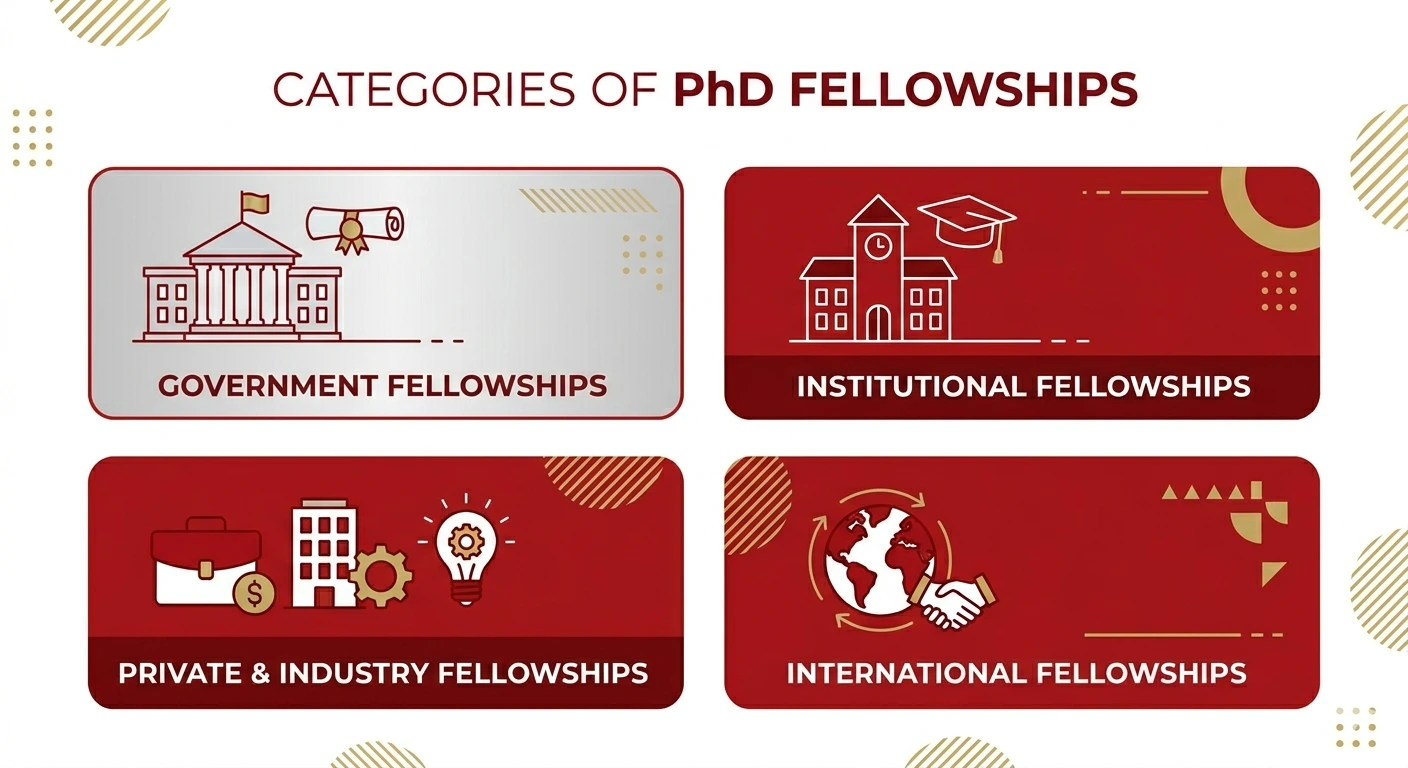
- Government-Sponsored Fellowships
These are provided through the government bodies overseeing higher education standards and funding, like UGC, CSIR, DST, DBT, and ICMR. They are usually the most popular and have the largest scope for different disciplines. - Institutions Sponsored Fellowships
Top research institutions such as IITs, IISc, TIFR, NITs, etc., offer internal fellowships for students undertaking doctoral studies in these institutions, and they share a similar funding model at the national level with certain standards. - Private & Industry Fellowships
Private organisations such as Google and Microsoft provide financial support for advanced research with specific fellowship grants, largely in areas of technology and computer science, with an emphasis on innovation and potential benefit to society. - International Fellowships
International programs such as Fulbright-Nehru and Commonwealth Scholarships allow Indian students to pursue research abroad or collaborate with international universities, often funding all costs related to the project.

Your career, our expertise - talk to a counsellor
Top Fellowships for PhD Candidates in India
India provides an extensive array of fellowships that offer not only financial grants but also mentorship, research facilities, and global opportunities. Not only that, the duration of PhD in India and Abroad also varies. Hence, to get a thorough and detailed analysis PhD scholarships in India and in fellowships, eligibility criterias, along with the duration, the below section will give you a clear picture.
1. UGC/CSIR-NET JRF
This fellowship is awarded to candidates who qualify for the National Eligibility Test (NET), conducted by UGC or CSIR. This is one of the most recognisable fellowships for any PhD aspirants
- Stipend: ₹37,000/month (for the first 2 years), ₹42,000/month (after SRF upgrade)
- Duration: 5 years (maximum)
- Area of study: Sciences (CSIR), Humanities, Social sciences, Commerce (UGC)
- Additional benefits: HRA, contingency grant, and annual leave.
- Eligibility: Master’s degree in relevant subjects with a minimum of 55% mark (50% for SC/ST/OBC-NCL/PW). Candidates would have to qualify for the Joint CSIR-UGC NET examination.
2. UGC NET Fellowship
UGC fellowship to the candidates who clear the NET-JRF in non-science subjects, such as arts, commerce, and management.
- Stipend Amount: ₹37,000/month for the first 2 years, and ₹42,000/month for the last 3 years after SRF upgrade
- Duration: 5 years
- Area of Study: Humanities, Social Sciences, Commerce, etc.
- Additional Benefits: Contingency grant and accommodation (if applicable)
- Eligibility: Postgraduate degree with a minimum of 55% mark (50% for SC/ST/OBC-NCL/PW). Candidates must qualify for the UGC NET-JRF examination.
3. Prime Minister's Research Fellowship (PMRF)
A highly reputed fellowship for outstanding students from IITs, IISc, and selected institutions to pursue a PhD degree in frontier areas of research.
- Stipend Amount: ₹70,000/month (Year 1–2), ₹75,000 (Year 3), ₹80,000 (Year 4–5)
- Duration: 5 years
- Area: Science, Engineering, and Technology
- Additional Benefits: ₹2 lakh/year research grant, and 1:1 mentorship
- Eligibility: Candidates must have a B.Tech./M.Tech./M.Sc. or are pursuing B.Tech./M.Tech./M.Sc. degree from IISc/IITs/NITs/IISERs/IIITs (within the last five years). Candidates must be offered admission in the PhD programme of one of the PMRF offering institutions.
4. DST-INSPIRE Fellowship
The DST-INSPIRE Fellowship, funded by the Department of Science and Technology of the Indian Government, intends to bring young and brilliant minds into basic science research. The fellowships are available to top performers at the post-graduation level without having to write an entrance examination as well.
- Stipend Amount: ₹60,000 per annum to students aged between 17 and 22 years. ₹1,25,000/month to the INSPIRE Faculty Fellowship program, including people aged between 27 and 32.
- Duration: 5 Years
- Field of Study: Natural Sciences and Basic Sciences
- Additional Benefits: ₹20,000 annual contingency; students can choose their host institution and supervisor, which allows for a flexible path in research, etc.
- Eligibility: First Rank holders in Postgraduate degrees in Basic and Applied Sciences, or those who have been offered admission in any PhD programme of any recognised University or Institution in India.
5. ICMR JRF
The Indian Council of Medical Research (ICMR) supports applications for its fellowships from early-career researchers in the fields of health and biomedical sciences. ICMR JRF applications are based on qualifying for the all-India level Exam conducted jointly with PGIMER.
- Stipend Amount: ₹35,000/month (JRF), ₹42,000/month (SRF)
- Duration: 5 Years
- Field of Study: Biomedical and health sciences
- Additional Benefits: ICMR research labs and institutes; ICMR supports research that covers national health priorities with the potential for public health impact.
- Eligibility: Postgraduate degree (M.Sc./M.A) in biomedical sciences or relevant subjects with a minimum of 55% marks (50% for SC/ST/OBC-NCL/PwD) and qualifying for the ICMR JRF examination to apply for the fellowship.
6. DBT-JRF (via BET Exam)
DBT-JRF Fellowships (this fellowship is funded by the Department of Biotechnology) are awarded to students based on the Biotechnology Eligibility Test (BET). The DBT-JRF is meant to support research in molecular biology, genetics, bioinformatics, and allied areas.
- Stipend Amount: ₹37,000/month (first 2 years)-₹42,000/month (last three years)
- Duration: 5 years
- Field of Study: Biotechnology, Life Sciences
- Additional Benefits: Placement in recognised research institutions, categorised into Category I (students applying for the fellowship) and Category II (project-based positions), adding an extra element of career track.
- Eligibility: Post-graduate degree in Biotechnology or a relevant area with at least 60% marks, and able to appear in the Biotechnology Eligibility Test (BET).
7. Google PhD Fellowship
Supported and supervised by Google Research to acknowledge PhD candidates in computer science undertaking innovative research.
- Stipend Amount: Full tuition + monthly stipend (variable)
- Duration: Up to 4 years
- Fields: Computer Science, AI, Machine Learning, etc.
- Additional Benefits: Research mentorship from a Google scientist and conference funding.
- Eligibility: Full-time PhD students studying in an Indian university. Candidates can only be nominated, and direct applications for the fellowship are not allowed.
8. ICSSR Doctoral Fellowship
This is an initiative by the Indian Council of Social Science Research for quality doctoral research in social science, especially on topics that matter for policy or are linked to social or economic challenges.
- Stipend Amount: ₹20,000/month
- Duration: 2 years (a year can be extended)
- Fields: Sociology, Economics, Political Science, etc.
- Additional benefits: ₹20,000/year contingency benefit; can apply to institutional or centrally administered pathways as a researcher-affiliated fellow or an independent researcher.
- Eligibility: Registered PhD scholars between 2-4 years in a UGC recognized institution with a master’s degree in social sciences and a minimum of 55 % marks.
9. TIFR Fellowship
When a researcher passes the TIFR entrance test to get admitted to the Tata Institute of Fundamental Research, it provides this fellowship for them; TIFR highlights fundamental research, having developed an interdisciplinary emphasis.
- Stipend Amount: ₹37,000/month (JRF), ₹42,000/month (SRF)
- Duration: 5 years
- Fields: Physics, Chemistry, Biology, Mathematics, Computer Science.
- Additional Benefits: High-end laboratories, direct supervision from India's leading scientists, and a culture of collaborative research.
- Eligibility: Candidates with a master's degree in a relevant field will be selected based on their entrance examination and interview.
10. Fulbright-Nehru Doctoral Research Fellowship
The fellowship is offered by the United States-India Educational Foundation (USIEF) and provides Indian PhD students funding to conduct part of their research at a U.S. institution. It promotes both academic and cultural exchange while supporting excellence in research.
- Stipend Amount: Monthly stipend in USD, round-trip airfare, J-1 visa support
- Duration: 6 to 9 months (stay in U.S.)
- Fields: Range of disciplines including STEM, humanities, and social sciences
- Additional Benefits: Access to U.S. university libraries and labs, as well as orientation and enrichment programs, provides a great opportunity for mid-stage PhD students seeking exposure and collaboration in a global context.
- Eligibility: Indian citizens- registered for a PhD at Indian institutions (universities) must have undertaken adequate research in identified resources in India and the U.S.
11. Commonwealth Doctoral Scholarship
This doctoral scholarship is funded by the UK government to provide financial support to students from low- and middle-income Commonwealth countries, including India, to pursue full-time doctoral studies in the UK. The scholarship focuses on the areas of study associated with potential developmental impact.
- Stipend Amount: Fully funded: tuition and airfare to and from the UK, and a monthly living allowance (GBP)
- Duration: 3-4 years
- Fields: Significance in terms of development-related disciplines (education, health, engineering, etc.)
- Additional Benefits: Thesis grant, warm clothing allowance, family allowance (when applicable); funded by the UK Foreign, Commonwealth & Development Office (FCDO).
- Eligibility: Citizens of Commonwealth countries with a graduate degree (i.e., MA, and M.Sc) as well as Indian citizens, must also possess a master's degree and have obtained admission to a UK university for a PhD program.
Application Strategy - How to Apply?
Most fellowships will all have applications that look similar, and if you are familiar with that process, it will be easier for you to leverage your application with a higher success rate.
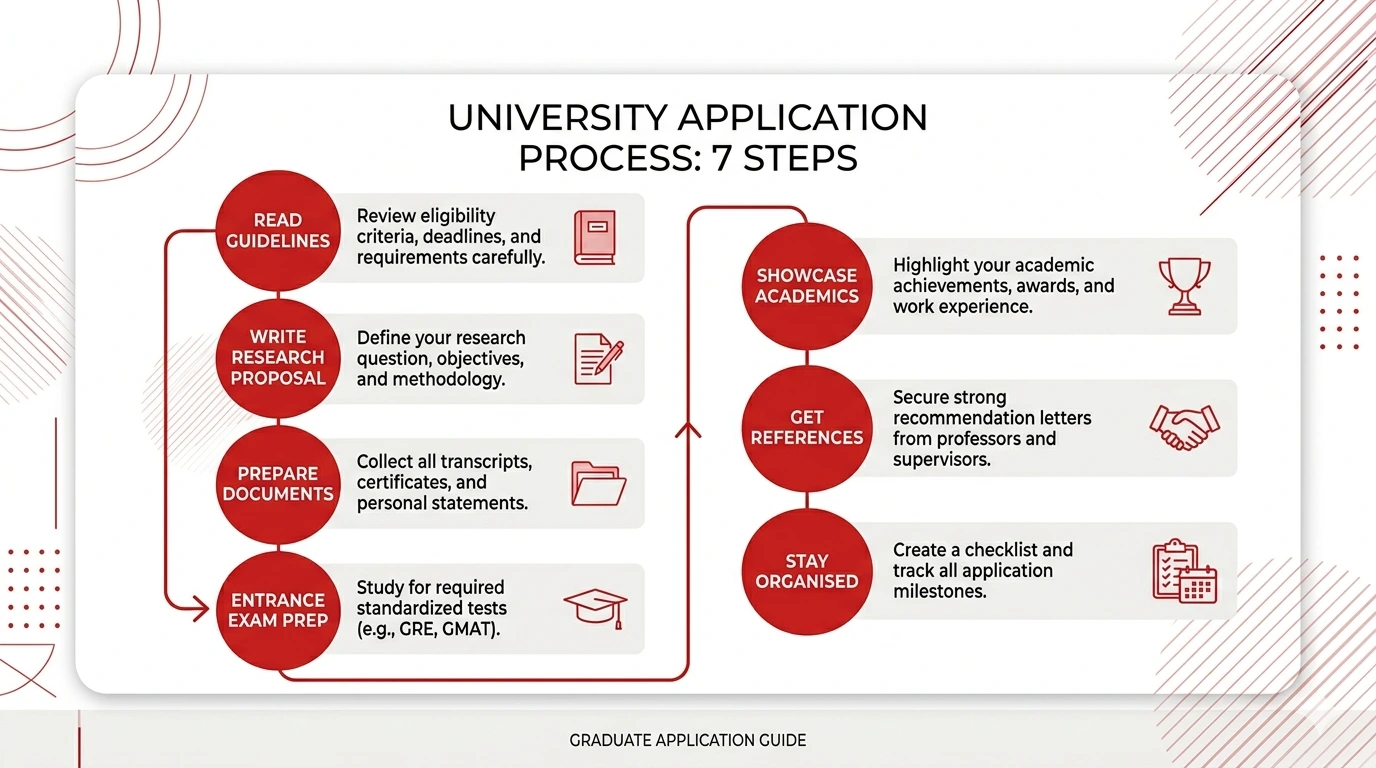
- Understand the Application Requirements
You should always read through the guidelines associated with the fellowship. Take note of the deadlines, application documents, eligibility requirements, and the subject of eligibility, if received. Some fellowships, such as a PMRF or Fulbright-Nehru, may have different nominating procedures, or you may be tied to a partner institution. - Put Together a Thoughtful Research Proposal
This is the most important and best practice for writing your application. You want a clear, original, and fully developed research proposal that shows feasibility and academic merit. You want to make sure you are networking and customising your proposal to match the goals of the fellowship and the funder. - Get Documents Ready
Documents common to most applications include undergraduate or graduate transcripts, reference letters, a statement of purpose (SOP), a CV, proof of admission or registration (if already registered), and identification. Ensure these are up to date and consistent. - Depends on your entrance exam preparation
Typical national-level fellowships, such as CSIR-UGC NET, ICMR JRF, and DBT-JRF, require you to qualify for different exams. Your preparation can help if you use previous year papers, online mock tests, and subject papers for your studies. - Showcase Your Academic Track Record
Bring attention to accomplishments such as publications, awards, internships, and previous research experience. This will help increase your competitiveness, especially for competitive fellowships like Google PhD or Commonwealth. - Ask for References Early
Typically, fellowships will ask for recommendation letters. Once you know you want to apply to a particular fellowship, please take time to contact professors or mentors who can best represent your work ahead of time, and do allow time for them to write a strong letter. - Be Organised
Make a tracker for deadlines, portals, and reminders for correspondence. Some fellowships may have many different steps from the application process, including interviews, document verification, etc.The most important point is that, PhD applicants still wonder if UGC-NET is mandatory or not. But it’s 2026 and UGC has made significant changes, so it is no longer compulsory but is still the most popular way for applying to a PhD course.
Your career, our expertise - talk to a counsellor
Top PhD Fellowship Programs in India: At a Glance
| Fellowship | Stipend | Duration |
| UGC/CSIR-NET JRF Fellowship | ₹35,000 - ₹42,000 | Up to 5 years |
| UGC NET Fellowship | ₹37,000 - ₹42,000 | Up to 5 years |
| Prime Minister’s Research Fellowship | ₹70,000 - ₹1,20,000 | 5 years |
| DST-INSPIRE Fellowship | ₹60,000 - ₹1,25,000 | 5 years |
| ICMR JRF Fellowship | ₹37,000 - ₹42,000 | 5 years |
| DBT-JRF (BET exam) Fellowship | ₹37,000 - ₹42,000 | 5 years |
| Google PhD Fellowship | Varies (covers tuition + stipend) | Up to 4 years |
| ICSSR Doctoral Fellowship | ₹20,000 | 2-3 years |
| TIFR Fellowship program | ₹37,000 - ₹42,000 | 5 years |
| Fulbright-Nehru Doctoral Fellowship | USD stipend + travel | 6-9 months (US stay) |
| Commonwealth Doctoral Fellowship | Fully funded (GBP) | 3-4 years |
A funded PhD not only reduces financial stress but also opens doors to better career opportunities in academia, research, and industry. If you’re wondering about how your life after PhD will be like and if you should go with the MBA degree, then you can check out this blog. It will give your career paths after completing your doctorate a clear picture.
Conclusion
Finding the right PhD fellowship is not only about funding. It is about finding the fellowship that will support your academic journey, support your research interests, and support your future aspirations. There are numerous fellowships in India and around the world, federally funded fellowships such as PMRF and CSIR, or internationally recognised fellowships such as Fulbright-Nehru and Google PhD Fellowships, and the list can go on.
The important thing is to be aware of the possibilities, plan in advance, and make your applications unique to the particulars of each fellowship. Each PhD scholarships in India and fellowships has its own expectations and benefits, and you should take the time to decide the right fit for you. Collegesathi can guide you through the right opportunities, helping you make informed decisions for your academic journey. There is a fellowship waiting for you, whether you are new to researching or have composed a half-finished proposal.
Frequently Asked Questions
Yes, you can apply for multiple fellowship programs, but you can only accept one fellowship.
Not for them all: some like PMRF and GOOGLE do require an offer, while others support application in the early phases.
No, only some fellowships like CSIR, UGC, and PMRF might require it.
Most of the fellowships are not taxable in India if they are used for research and study.
They can have more flexibility or more international exposure, but can be shorter or more comprehensive, covering different aspects.



Popular PG Programs
Trending UG Programs
Doctorate Programs
Executive Programs
Trending Online Universities
In Demand MBA Specializations
In Demand MCA Specializations
CollegeSathi aims to provide unbiased and precise information to aspirants, along with comparative guidance on universities and their programs. The content on the CollegeSathi website, including text, graphics, images, blogs, videos, and university logos, is meant for informational purposes only and should not be considered a substitute for official information provided by academic partners. While we make every effort to keep the information accurate and up to date, CollegeSathi does not guarantee the completeness or reliability of the content and is not responsible for any errors, omissions, or losses resulting from its use.
© CollegeSathi 2026. All Rights Reserved.