



PhD Without a Master’s in India: All You Need to Know (2026 Edition)


Earlier, the path to a PhD was through the master’s degree, i.e., you needed a master’s qualification before a PhD, but that pathway has changed in 2026. Recently, the Indian academic structure has brought new opportunities for students with a research-oriented mindset to gain entry to doctoral programs directly from the bachelor’s level. This is an excellent and progressive shift in pursuing a PhD without a master’s in India and emphasises getting students engaged with research and excellence in academic studies.
If you are wondering how to do a PhD without master’s in India, the answer lies in integrated and direct PhD programs offered by top institutions. However, the key conditions are that you need to have academic excellence, i.e., a minimum 75% in UG, and if not, you must have a UG degree with work experience. Pathway structures exist at reputed institutions like IISc, IITs, and IISERs, which allow undergraduate students to progress into research.
In this blog, we will discuss how you can pursue a PhD in India without a master's degree. We will examine eligibility, pathways, leading institutes, and skill sets necessary for being successful on this expedited academic journey.
Overview: Understand the Direct PhD Pathway in India
If you are wondering the PhD full form in India, it is Doctor of Philosophy. The traditional academic pathway consisted of three steps-
- First, the student will complete an undergraduate degree.
- Second, the student will complete a master's degree.
- Third, the student will enter a PhD program.
There are a number of leading Indian institutions that offer alternatives to this traditional pathway. A subset of aspirants can now embark on a PhD program right after undergraduate education. This type of option is referred to as a direct PhD or an integrated PhD program. Integrated PhD programs have a master's degree component integrated into an overall doctoral research degree.
On the other hand, when discussing PhD pathways, particularly technical PhD pathways, a candidate could apply to the PhD program without completing a master's degree if he/she has academic excellence and research experience. This type of degree is much more efficient in terms of time and allows for a more mature and high-calibre talent to be developed as an early-stage researcher.
This process is also in accordance with the global academic traditions. The majority of these pathways for PhD articulation exist primarily in science, engineering, and technology programs, at a time when there is an ever-increasing focus on undergraduate research.
Why Consider a PhD Without a Master’s?
Choosing to pursue a PhD directly after graduation is not just about saving time; it’s about aligning your academic path with your long-term goals.
- If you want faster entry into research careers.
- If you want to gain early research exposure.
- If you want an integrated learning experience.
- If you are looking for monthly financial support, such as stipends and research grants, alongside education.

Your career, our expertise - talk to a counsellor
How to Do a PhD Without a Master’s in India - 3 Proven Pathways
But now the time has changed, several leading Indian institutions offer alternatives to this traditional pathway to a PhD. If you are looking to pursue a PhD straight after your bachelor’s degree, there are a few well-structured options you can follow that vary in focus, process, and expectations.
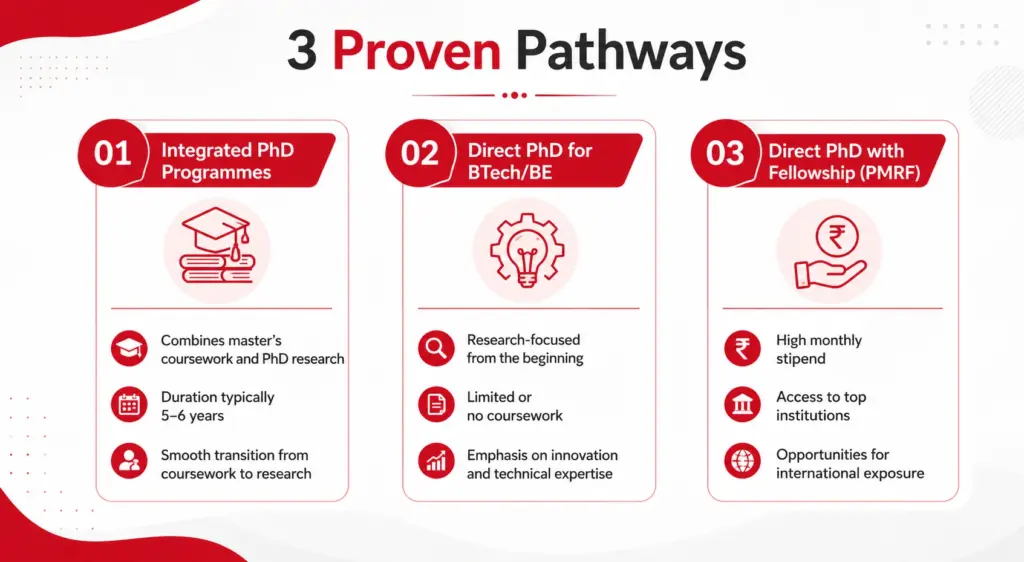
1. Integrated PhD Programmes
An integrated PhD degree is a program that combines master's level coursework and PhD research, which is tracked seamlessly while completing the integrated degree, which lasts typically 5-6 years. Integrated PhDs are ideal for students with a science background, such as a BSc, and are offered by the most recognised institutions, including IISc, IITs, and IISERs. When a student enters an integrated PhD program, they are enrolled as an integrated PhD student, and upon completion of the lower-level integrated coursework. They can engage in independent research as a PhD student. In some cases, you may need industry experience to enrol in this program, it will ensure readiness for a PhD program.
Key Features:
- Combines master’s coursework and PhD research
- PhD course duration is typically 5-6 years
- Smooth transition from coursework to research phase
2. Entry to the Direct PhD When you are a BTech/BE
Top engineering institutes, especially the IITs and IISc, provide direct PhD opportunities to outstanding BTech/BE graduates who do not yet hold a master's degree. The direct PhD degree is likely to be research-intensive, with little or no coursework. The best candidates for applying should already have a good research orientation and a strong academic background.
Key Features:
- Research-focused from the beginning
- Limited or no coursework
- Emphasis on innovation and technical expertise
3. Direct PhD with Fellowship (Example, PMRF)
The Prime Minister's Research Fellowship (PMRF) offers extremely high-performing BTech or integrated MSc candidates from top institutes an opportunity to pursue a direct PhD at participating institutions. This is the PhD eligibility criteria. Selection will be based on academic performance, research potential, and referee recommendations, and it has one of the most generous fellowship formats.
Key Features:
- High monthly stipend
- Access to top institutions
- Opportunities for international exposure
PhD Eligibility Criteria After a Bachelor's Degree
Today, the education industry has taken the lead, allowing students to attain a competitive edge in many ways. An emerging option is the direct PhD degree in philosophy right after graduation. It allows students to develop their academic intelligence and allows them to obtain their highest academic degree exponentially quicker than through the standard bachelor 's-PhD degree option. Most direct or integrated "PhD" programs in India require candidates with a good academic profile at the undergraduate level, generally in a science, engineering, or related field.
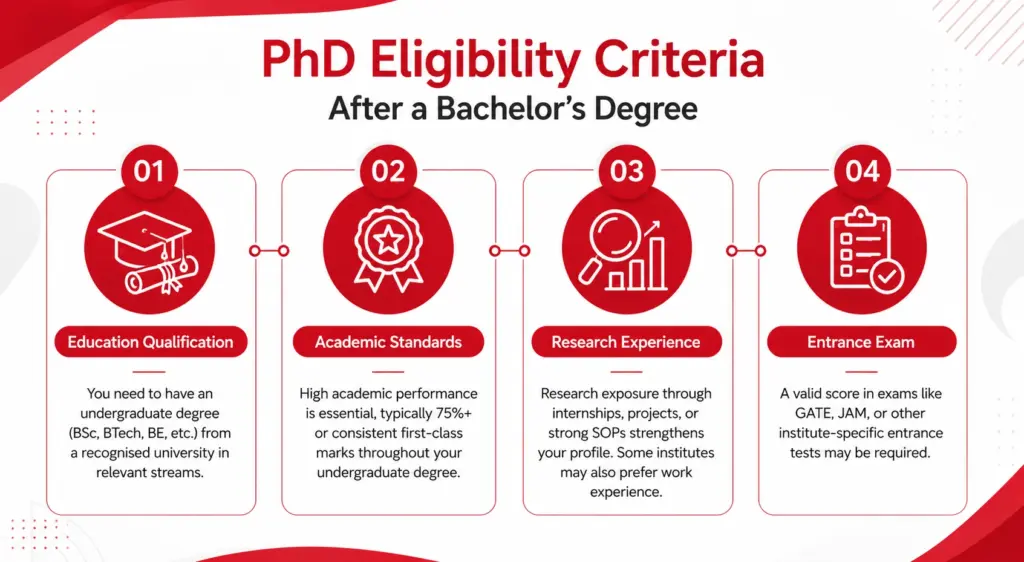
Here is the general PhD eligibility criteria:
Education Qualification:
- You need to have an undergraduate degree (BSc, BTech, BE, etc.) from a recognised university. Each program might specify exact streams, which could be Physics, Chemistry, Biology, Engineering, Mathematics, etc.
Academic Standards:
- The average percentage is quite high (often 75%+), or the applicant has first-class marks consistently in their undergraduate and postgraduate degrees.
Research Experience:
- Research exposure and experience through internships, minor projects, or excellent statements of purpose (SOPs) boost your profile meaningfully. Some universities also require work experience along with the UG degree.
Entrance exam:
- Some institutes may require a valid score in a GATE, JAM, or other entrance exams that the institute has defined.
Your career, our expertise - talk to a counsellor
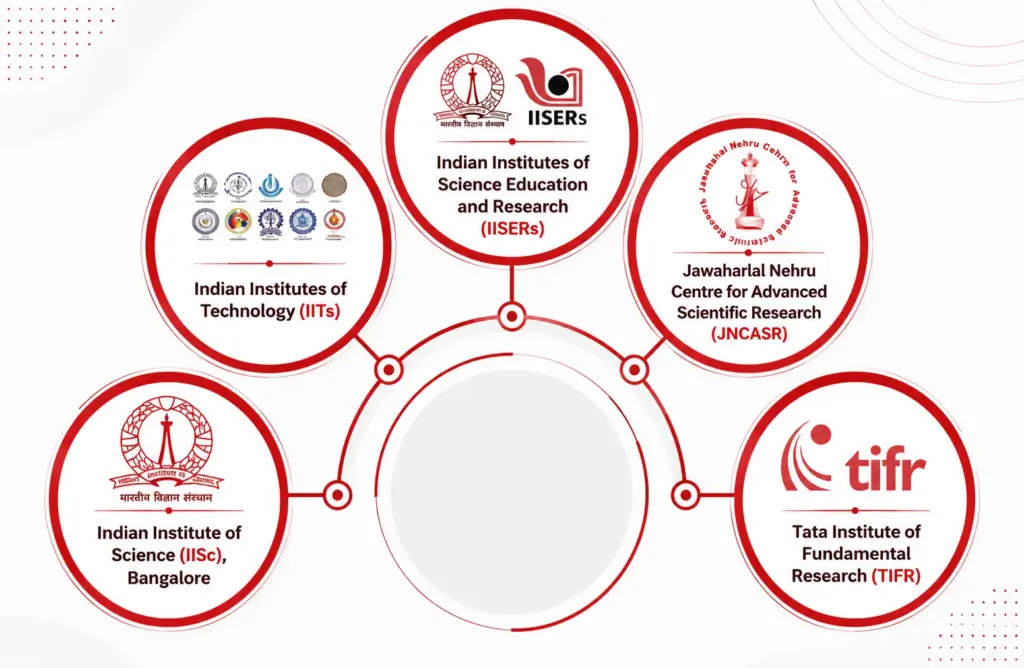
Top Institutes Offering Direct and Integrated PhD Programs
India's research institutes maintain that they develop research talent from undergraduate studies; the student’s background doesn’t matter. Moreover, students can participate in an integrated or direct PhD program that can provide a solid basis for formal academic conceptualisations and research experience. These programs are competitive and designed such that students are prepared with the tools to succeed in a variety of research careers.
1. Indian Institute of Science (IISc), Bangalore
IISc has both an integrated and a direct PhD program. A science degree student can apply for master's level courses under the integrated PhD program and have applied research training experience. An integrated program is also available for exceptional graduates with a BTech degree, one that captures the essence of direct entry into a PhD with respect to engineering and interdisciplinary studies. Applications are allowed via GATE, JAM, or a scaled aptitude test at the Institute and interviews.
2. Indian Institutes of Technology (IITs)
Various IITs have offered direct PhD degree programs, specifically for BTech/BE graduates, including IIT Bombay, Madras, Kanpur, Delhi, and Hyderabad. Most PhD programs at IITs will be research-based programs from the outset. These will be offered within engineering and science disciplines, as well as newer technology-based disciplines such as AI, data science, material science, etc. Significant criteria for admittance will be prior academic performance and GATE exam (or equivalent testing), as well as their potential for Research or Project work.
3. Indian Institutes of Science Education and Research (IISERs)
IISERs located in India offer Integrated PhD programs to BSc graduates in biology, chemistry, physics, and mathematics, where they complete their coursework along with early exposure to research. IISERs support innovative capacity, access to labs, and continued training and academic development.
4. Jawaharlal Nehru Centre for Advanced Scientific Research (JNCASR)
JNCASR has strong Integrated PhD programs in natural sciences, based on JAM or JEST, and an interview. JNCASR is respected as a source of research, as well as for its collaboration and interactive education environment.
5. Tata Institute of Fundamental Research (TIFR)
TIFR offers integrated PhD and direct PhD programs in physics, chemistry, biology, and computer science, which are all done through their own nationwide entrance test (TIFR GS), followed by an interview. TIFR processes over-complicated admissions and facilitates strong mentoring of young researchers.
Entrance Exams and Admission Process
If you want to get admission into a direct or integrated PhD program without a master's degree, it will take more than just academic merit; you need to pass a competitive exam and show your readiness to do research through interviews and written statements. Here is the breakdown of the updated rules for PhD admission 2026 without a master's degree.
1. Common Entrance Exams
Most institutions require one or more of the following exams scores from a national-level exam:
- NET (National Eligibility Test): Candidates who qualify UGC NET will be eligible for direct PhD admission for Junior Research Fellowship (JRF) and assistant professor post.
- GATE (Graduate Aptitude Test in Engineering): This is highly accepted as the examination to grant admission to direct PhD programs related to engineering and interdisciplinary sciences.
- JAM (Joint Admission Test for MSc): This is required to apply for Integrated PhD degrees in the pure sciences, which are offered by institutes like IISc and IISERs.
- JEST (Joint Entrance Screening Test): Generally used by programs in physics and theoretical computer science.
- Institute-specific exam: Some institutes conduct their own tests; this is especially true of some special programs, for example, IIT Madras and IISER Pune.
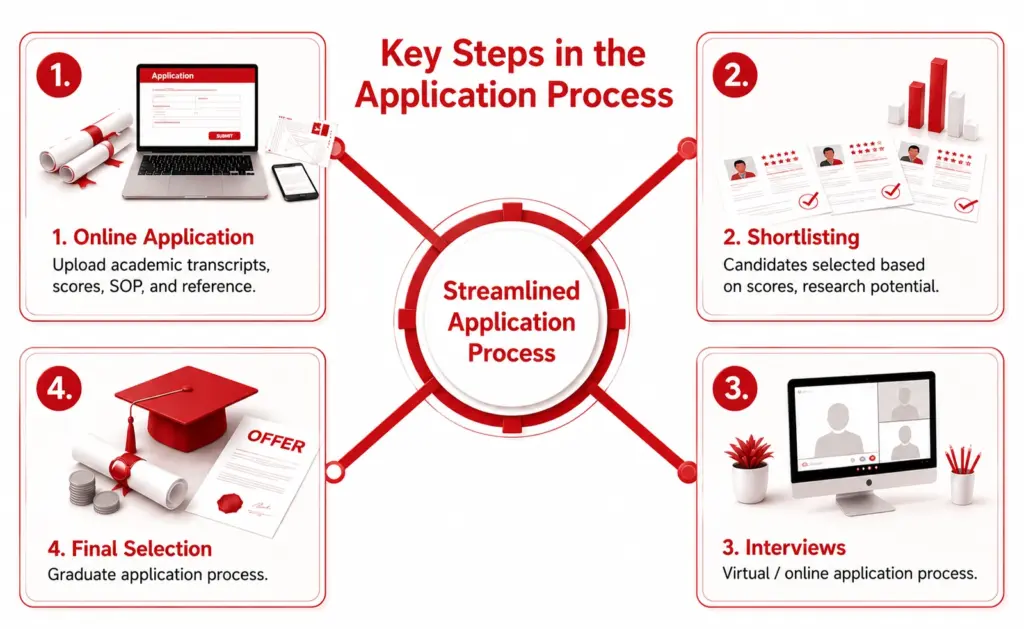
2. The Application Process
- Online Application: Most institutes invite applications for admission twice a year. The applicant is responsible for uploading their academic transcripts, entrance scores, statement of purpose, and letters of reference.
- Shortlisting: Based on entrance scores, academic record, and research potential.
- Interviews: They are usually research-based or technical. You could be asked to solve problems, present past work, or discuss fields of interest.
- Final Selection: Candidates who successfully complete the interview are offered admission, often accompanied by a stipend or fellowship.
Your career, our expertise - talk to a counsellor
Benefits and Challenges of Pursuing a Direct or Integrated PhD After Graduation
Starting a PhD program straight from a bachelor’s can be exhilarating but also demanding. Yes, you are getting it done more quickly, but with a greater expectation that you are “research-ready” right from the beginning of the journey. Here are some of the main advantages and challenges:
Advantages
- Faster Academic Progress: You will be able to skip the separate master’s program and will save yourself 2–3 years in advancing your academic career and reach your educational goals sooner.
- Early Research Opportunities: Generally,phd without masters in India, you will be engaged in research from the first day of the program; you will have more time to explore and engage with your interests.
- Institutional Context: These programs are well-defined and supported by the institution with funding support, such as fellowships that typically start at the beginning, mentoring, and good coursework to support younger researchers.
- Professional Fellowships: Many of these direct and integrated PhD programs are supported by either something like a PMRF fellowship or an Institute scholarship, which ensures you are supported in your research without the stress of securing funding.
Challenges
- Steep Learning Curve: There is an expectation for you to quickly grasp the advanced understanding of the same concepts that most master’s level students will require 2 years of coursework to cover, before they get into their research.
- Pressure for Performance: While the expectations of many institutes where you begin your PhD are high academically and on research outputs, there will soon be an expectation that you will be performing at a similar level, if not a greater level, than master’s students.
- Limited Time to Explore: If you are not sure of your proposal or research direction, it can feel like there is no time to think and step back.
How to Strengthen Your Application?
Direct and integrated PhD programs are competitive, and strong academics alone don't always serve adequately. Institutes want students who not only do well in exams but also demonstrate potential as researchers and clarity of intent as to why they are applying to the direct or integrated route.
Here is how you can improve your application:
Get Research Experience
- Engage in a research internship, such as SRFP, IAS, or summer research programs offered by specific institutes. Even if you only have a small research project, putting research experience on your CV shows initiative and is something beneficial that you can discuss in interviews.
Write a Strong SOP (Statement of Purpose)
- You need to show clearly your research focus, why you are applying directly to a PhD and not doing a master’s first, your academic history, and your aspirations. Ensure it resonates with your personal and academic context, is precise, and is relevant to the work the department is conducting.
Obtain Quality References
- Seek letters of reference from professors (or others) who can discuss your research strengths, academic abilities, and intellectual curiosity. A strong letter of recommendation (LOR) is often the deciding factor in competitive selections.
Prepare for the Interview
- Ensure you know the core concepts from undergraduate studies and be prepared to talk about your research interests or prior work. Depending on the program, you can apply for several interviews that will involve problem-solving with current scientific research.
Your career, our expertise - talk to a counsellor
Conclusion
Starting a PhD directly after graduation is an exhilarating opportunity to gain an academic and research career in the fastest time possible. This path is not for everyone; it requires a strong academic background, the ability to be instilled with a sense of curiosity about research, and a deliberate focus on your potential as a researcher.
However, if you’re someone who is enthusiastic about socially shaped research, it could be an accelerated way to get into high-end academic work, with supporting institutions and funding in place. Compared to the past, many of India's finest institutes are putting even more emphasis and financial support behind these programs, giving even more opportunities for those motivated enough to jump straight into research.
Frequently Asked Questions
Yes, several institutions, such as IISc, IITs, and IISERs, offer direct PhD entry to exceptional graduates from BTech/BSc.
Commonly used exams are GATE, JAM, JEST, and also institution-specific exams like TIFR GS.
No, there are now many institutions that offer direct or integrated PhD programs. So, you will not need a separate master's degree.
Have research experience, write a good SOP, and have a good set of recommendations. Good preparations for the entrance exam and interview are also key.
A direct PhD typically lasts 5 to 6 years, but it can depend on the institution and discipline.



Popular PG Programs
Trending UG Programs
Doctorate Programs
Executive Programs
Trending Online Universities
In Demand MBA Specializations
In Demand MCA Specializations
CollegeSathi aims to provide unbiased and precise information to aspirants, along with comparative guidance on universities and their programs. The content on the CollegeSathi website, including text, graphics, images, blogs, videos, and university logos, is meant for informational purposes only and should not be considered a substitute for official information provided by academic partners. While we make every effort to keep the information accurate and up to date, CollegeSathi does not guarantee the completeness or reliability of the content and is not responsible for any errors, omissions, or losses resulting from its use.
© CollegeSathi 2026. All Rights Reserved.