






CAT Quant Formulas Cheat Sheet - Topic-Wise Shortcuts
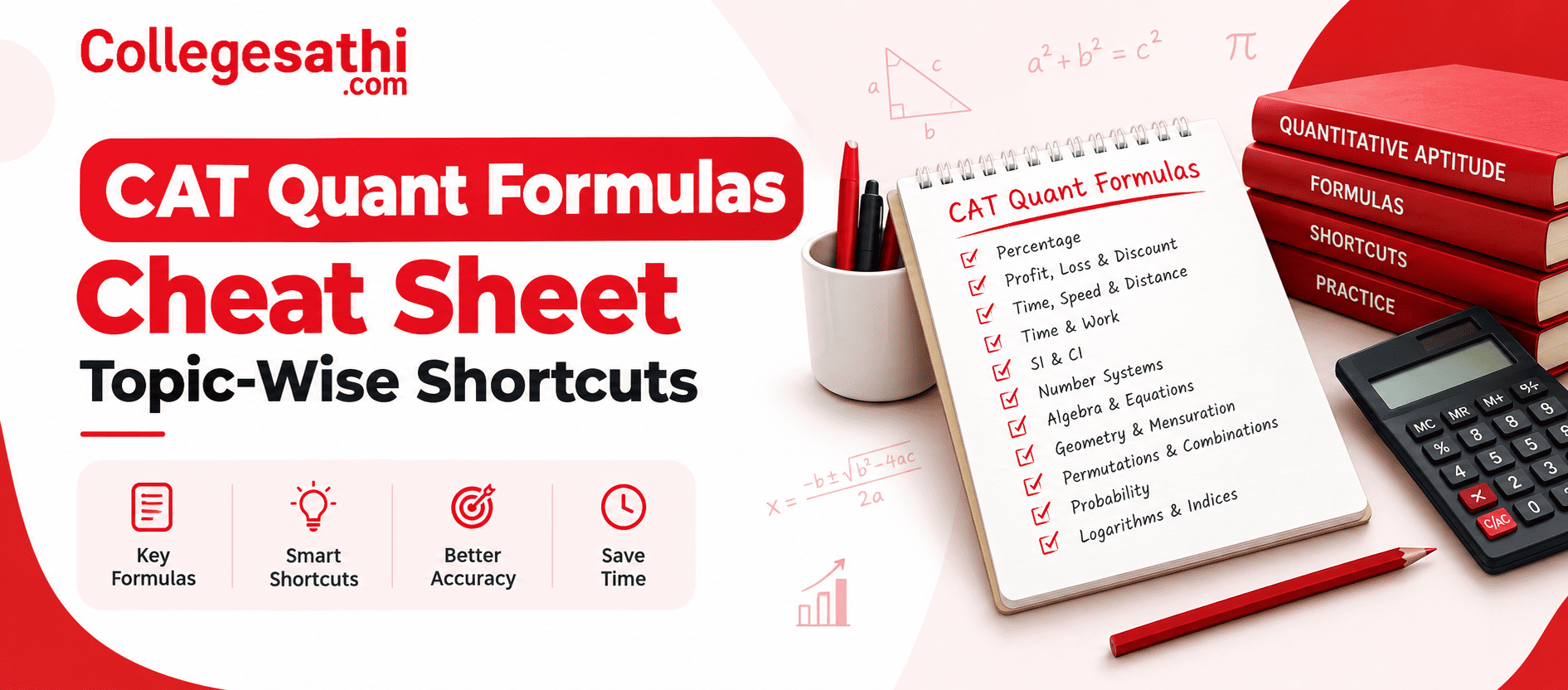

Quick Overview: In the CAT, Quantitative Aptitude is one of the sections that covers multiple formulas on topics like percentages, number systems, ratio & proportion, geometry, and more. This blog will serve as a topic-wise CAT formulas cheat sheet for the QA section.
Key Takeaways
- Number of Questions: 22
- Total Marks for QA: 66
- QA Section Duration: 40 Minutes
- Important Topics: Number Systems, Geometry & Mensuration, Time & Work, Algebra & Equations, and more.
CAT Quant Formulas & Shortcuts: Topic-Wise
CAT quant formulas can help you attempt this section of the paper in a faster way with accuracy. Shortcuts will help you save time in the examination to attempt all 22 questions within 40 minutes.
CAT examination assesses learners’ mathematical skills through the Quantitative Aptitude section. Also, this section of the exam will have 22 questions that need to be solved within 40 minutes.
To excel in this, you should have a strong grasp of CAT quant formulas for several topics like geometry & mensuration, percentage, profit, loss & discount, number systems, and more. Alongside this, you should be familiar with the CAT Topic-Wise Weightage to get the desired score.
Below are the topic-wise CAT formulas for the QA section:
Percentage
- Percentage = (Value / Total Value) × 100
- Increase / Decrease: Final Value = Initial × (1 ± R/100)
- Successive change = a + b + (ab/100)
- A is R% more than B ⇒ B is (100R / (100 + R))% less than A
Profit, Loss & Discount
- Profit = SP - CP
- Loss = CP - SP
- Profit % = (Profit / CP) × 100
- Discount % = (Discount / MP) × 100
- SP (with profit) = CP × (1 + P/100)
- SP (with loss) = CP × (1 - L/100)
- Equal gain and loss % on same CP ⇒ Overall Loss % = (x² / 100)
Time, Speed & Distance
- Speed = Distance / Time
- Distance = Speed × Time
- Time = Distance / Speed
- Average speed (equal distances) = (2xy) / (x + y)
- Relative speed (same direction) = x - y
- Relative speed (opposite direction) = x + y
- Boat and Stream:
- Downstream speed = B + R
- Upstream speed = B - R
Time & Work
- Work = Rate × Time
- If A can do a job in x days ⇒ A’s 1-day work = 1/x
- Combined work: (A + B)’s 1 day work = (1/x + 1/y)
- Total time = xy / (x + y)
- Work efficiency ∝ 1 / Time
Simple & Compound Interest
- SI = (P × R × T) / 100
- CI = P × (1 + R/100)ᵗ - P
- Population formula: Pₙ = P × (1 + R/100)ⁿ
- Difference between CI & SI (for 2 years) = P × (R/100)²
Number Systems
- (aⁿ × bⁿ) = (ab)ⁿ
- aⁿ ÷ aᵐ = aⁿ⁻ᵐ
- a⁰ = 1 (for a ≠ 0)
- Divisibility rules for 2, 3, 4, 5, 6, 8, 9, 11 - must-know for CAT basic arithmetic.
- HCF × LCM = Product of the numbers
Algebra & Equations
- (a + b)² = a² + 2ab + b²
- (a - b)² = a² - 2ab + b²
- (a + b + c)² = a² + b² + c² + 2(ab + bc + ca)
- (a³ + b³) = (a + b)(a² - ab + b²)
- Quadratic Equation: ax² + bx + c = 0
- Roots = [-b ± √(b² - 4ac)] / 2a
- Sum of roots = -b/a, Product of roots = c/a
Progressions
- AP nth term = a + (n-1)d
- Sum of n terms of AP = (n/2)[2a + (n-1)d]
- GP nth term = arⁿ⁻¹
- Sum of n terms of GP = a(rⁿ - 1)/(r - 1)
- HP nth term = 1 / [a + (n-1)d]
Geometry
- Triangles
-
-
- Area = ½ × base × height
- Heron’s formula = √[s(s-a)(s-b)(s-c)]
- Pythagoras: a² + b² = c²
-
- Circle
-
-
- Area = πr²
- Circumference = 2πr
-
- Rectangle / Square
-
-
- Area = l × b, Perimeter = 2(l + b)
- Area (square) = a²
-
- Polygon
-
- Sum of interior angles = (n - 2) × 180°
Mensuration
- Cube: Volume = a³ ; TSA = 6a²
- Cuboid: Volume = l × b × h ; TSA = 2(lb + bh + hl)
- Cylinder: Volume = πr²h ; CSA = 2πrh
- Cone: Volume = (1/3)πr²h ; Slant height = √(r² + h²)
- Sphere: Volume = (4/3)πr³ ; CSA = 4πr²
Permutations & Combinations
- Permutation: nPr = n! / (n–r)!
- Combination: nCr = n! / [r!(n–r)!]
- Relationship: nCr + nC(r–1) = n+1Cr
Probability
- P(E) = (Favourable outcomes) / (Total outcomes)
- P(E’) = 1 – P(E)
Logarithms & Indices
- logₐ(xy) = logₐx + logₐy
- logₐ(x/y) = logₐx – logₐy
- logₐxᵇ = b × logₐx
- logₐ1 = 0 ; logₐa = 1
- Change of base: logₐb = log_cb / log_ca
Quick Tip: Revise the formulas on a daily basis and practice their application to remember the shortcuts and to ensure accuracy.
Why are the CAT Quant Formula Shortcuts Important?
CAT Quant formula shortcuts play a major role in aspirants’ exam preparation. Some of the reasons why it is important to consider are mentioned below:
- Time Management: CAT formulas and their shortcuts will help you manage time in the actual exam. It will assist you in attempting lengthy questions faster.
- Effective Revision: Through the CAT formulas sheet, you will be able to memorize concepts of important topics like arithmetic, algebra, geometry & mensuration, and others.
- Enhances Speed: CAT quant formula shortcuts will help you not waste time, leading you to enhance your speed of answering the questions.
- Boosts Confidence: Aspirants who know formulas are generally able to attempt the questions with multiple approaches, which increases self-confidence. This eventually leads the candidate to appear in the examination with confidence.
Conclusion
Quantitative Aptitude is one of the sections of the Common Admission Test, which assesses mathematical and application skills of learners. It includes multiple topics, such as percentage, profit & loss, geometry & mensuration, permutation, probability, and many more. Knowing the topic-wise shortcuts of the CAT Quant will help you manage time in the actual exam, boost confidence, increase the speed of answering questions, and more.
Connect with our Collegesathi experts to know about the online universities / institutions offering admission in the online MBA courses.
Frequently Asked Questions
Arithmetic, Algebra, Geometry & Mensuration, and Modern Mathematics are some of the high-yield topics to study for the Quant section of the Common Admission Test.
No, to pass the CAT QA section, it is important for you to clear the concepts and practice questions, as solely relying on the formula shortcuts is not enough.
CAT quant formulas will help you manage time in the examination, increase confidence level, and assist in last-minute revision. These are some of the reasons why you should remember formulas.
You can keep a CAT formula sheet to revise the QA formulas anytime, as per your suitability.
On the basis of the CAT Exam Pattern 2026 , 22 questions for a total of 66 marks will be there in the Common Admission Test.



Popular PG Programs
Trending UG Programs
Doctorate Programs
Executive Programs
Trending Online Universities
In Demand MBA Specializations
In Demand MCA Specializations
CollegeSathi aims to provide unbiased and precise information to aspirants, along with comparative guidance on universities and their programs. The content on the CollegeSathi website, including text, graphics, images, blogs, videos, and university logos, is meant for informational purposes only and should not be considered a substitute for official information provided by academic partners. While we make every effort to keep the information accurate and up to date, CollegeSathi does not guarantee the completeness or reliability of the content and is not responsible for any errors, omissions, or losses resulting from its use.
© CollegeSathi 2026. All Rights Reserved.