






CAT 2026 Topic-Wise Weightage: Which Topics to Prioritize
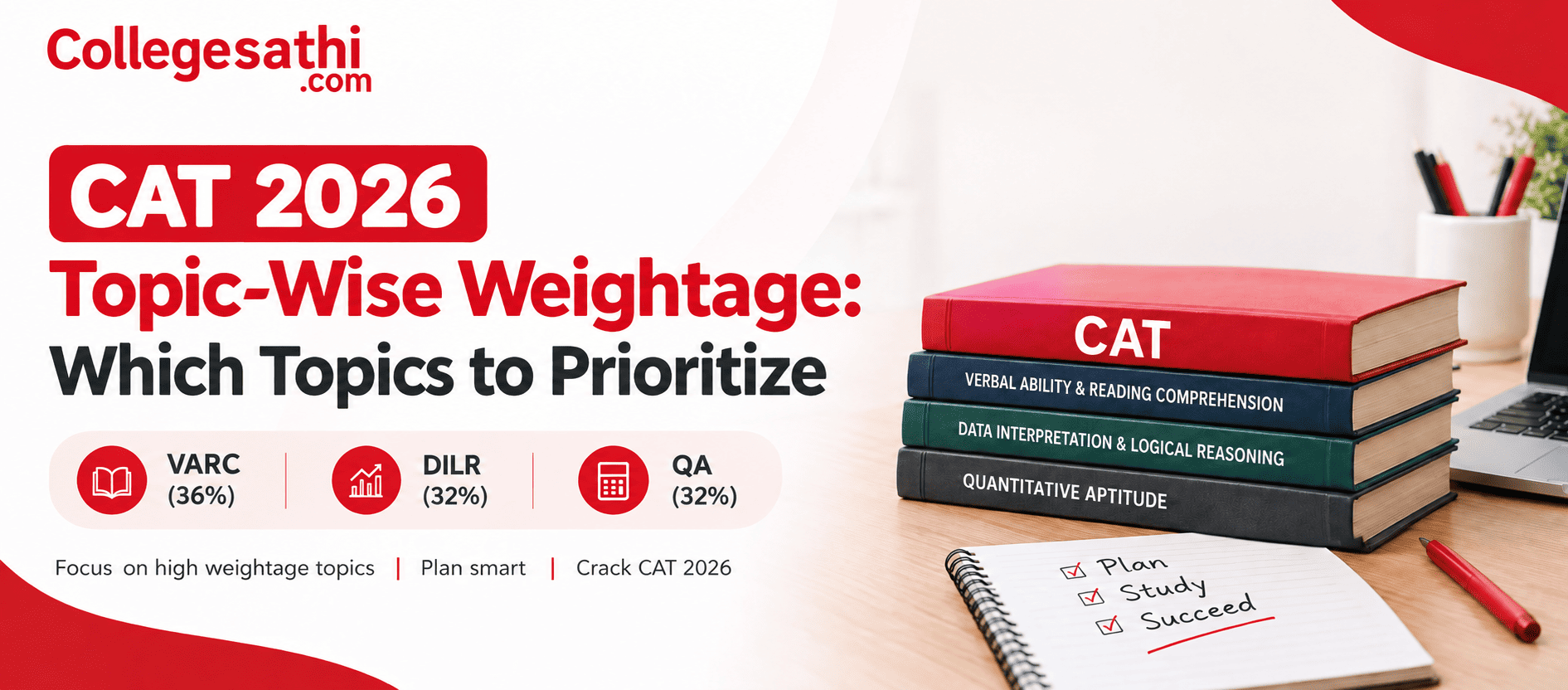

Quick Answer: CAT 2026 has three sections, VARC, DILR, and QA, with roughly 36%, 32%, and 32% weightage. Within these, Reading Comprehension, Arithmetic, Algebra, and DILR puzzles and arrangements carry the most questions. This blog breaks down the topic-wise weightage for each section and tells you what to prioritize first.
Key Takeaways
- Exam pattern: 68 questions, 204 marks, 120 minutes, 40 minutes per section.
- Highest weightage topics: Reading Comprehension in VARC, Arithmetic and Algebra in QA, and Puzzles and Arrangements in DILR.
- Section weightage: VARC around 36%, DILR around 32%, QA around 32%.
- Best approach: Focus on high weightage topics first, then use remaining time to cover the rest.
The CAT exam syllabus is not fixed by the IIMs in any official document. Coaching institutes and CAT toppers use a pattern built from past years' papers, and this pattern tells you clearly which topics repeat and how often. This blog uses that pattern to break down CAT weightage section by section, so you know exactly which topics to study and how.
CAT 2026 Exam Pattern: Section-Wise Weightage and Time Allotted
Before the topic-wise weightage, here is the exam structure it is based on:
| Section | Questions | Marks | Time |
| VARC (Verbal Ability and Reading Comprehension) | 24 | 72 | 40 minutes |
| DILR (Data Interpretation and Logical Reasoning) | 22 | 66 | 40 minutes |
| QA (Quantitative Aptitude) | 22 | 66 | 40 minutes |
| Total | 68 | 204 | 120 minutes |
- Marking scheme: +3 for a correct MCQ, -1 for a wrong MCQ.
- TITA (Type In The Answer) questions have no negative marking, even if wrong.
- Section-wise timing is fixed. Time does not carry forward from one section to another.
VARC Weightage: Which Topics Matter the Most
VARC has the highest weightage among all the topics in CAT. It has 24 questions, and the section is divided into verbal ability and reading comprehension. Some of the main topics of VARC and their weightage are mentioned below:
| Topic | Questions (out of 24) | Approximate Weightage |
| Reading Comprehension | 16 | 66% |
| Para Jumbles | 2 to 3 | 10% |
| Para Summary | 2 to 3 | 10% |
| Odd Sentence Out / Para Completion | 2 to 4 | 12% |
What this means for your prep:
- Reading Comprehension should get the largest share of your VARC study time, since it typically has 4 passages and 16 of the 24 questions.
- Build a daily reading habit across varied topics, business, science, culture, and opinion pieces, since passage topics vary every year.
- Practise Para Jumbles and Para Summary regularly. These are shorter to solve and are a reliable way to score marks.
DILR Weightage: Which Topics Matter the Most
This section involves more hands-on learning. Interpretation of data in various formats is tested in this section. Some of the important topics' weightage is mentioned below:
| Topic | Questions (Last 5 Years) | Approximate Weightage |
| Bar/ Line and other Graph Charts | 56 | 17% |
| Arrangements/ Ordering/ Grouping | 44 | 14% |
| Quant/Number-based LR & DI | 42 | 13% |
| Distribution/ Allocation/ Matching | 31 | 9% |
What this means for your prep:
- Prioritize Puzzles and Arrangements. This is the single biggest part of DILR topics for CAT, and getting comfortable here can make the biggest impact on your score.
- Practise reading tables and charts quickly, since DILR sets are timed at roughly 8 to 10 minutes each within the 40-minute section.
- In the actual exam, spend the first few minutes scanning all sets and attempt the easier ones first. Set selection matters more in DILR than your speed.
QA Weightage: Which Topics Matter the Most
This section is generally considered to be more challenging by learners. You must have a detailed understanding of key mathematical concepts like arithmetic, algebra, mensuration, and geometry. Some of the important topics and their weightage are given below:
| Topic | Approximate Weightage in QA | What to Practise |
| Arithmetic | 38% | Percentages, ratios, time speed and distance, time and work, averages, profit and loss, simple and compound interest, mixtures |
| Algebra | 30% | Linear and quadratic equations, functions, inequalities |
| Geometry and Mensuration | 18% | Triangles, circles, coordinate geometry, area and volume |
| Number System | 9% | Divisibility, remainders, factors, base systems |
| Modern Math | 5% | Permutations and combinations, probability, sequences and series |
What this means for your prep:
- Master Arithmetic first. It is the single largest topic in QA, and most questions have the same concepts applied in different ways.
- Algebra should be the second priority. Strong basics here will also help with DILR sets that involve equations.
- Treat Geometry, Number System, and Modern Math as important too. Cover the core concepts well, but do not spend extra time here at the cost of Arithmetic and Algebra.
CAT 2026 Topic-Wise Weightage: What Should be Your Priority
The table given below mentions all the topics with their weightage, so you can quickly recap or look at this table before starting your preparation.
| Priority | Section | Topic | Why It Matters |
| 1 | VARC | Reading Comprehension | 16 of 24 VARC questions |
| 2 | QA | Arithmetic | Single largest QA topic |
| 3 | DILR | Puzzles and Arrangements | More than half of DILR questions |
| 4 | QA | Algebra | Second largest QA topic |
| 5 | DILR | Tables and Charts (DI) | Appears in nearly every DILR set |
| 6 | VARC | Para Jumbles and Para Summary | Quick, high-accuracy questions |
| 7 | QA | Geometry and Mensuration | Steady presence most years |
| 8 | QA | Number System | Smaller but recurring share |
| 9 | DILR | Games and Tournaments | Appears occasionally, worth basic practice |
| 10 | QA | Modern Math | Smallest QA share, cover the basics |
How Should You Use This Weightage to Plan Your Prep?
- Start with the priority topics first. These alone cover a large share of the total questions across all three sections.
- Set a weekly target. For example, one week on Reading Comprehension and Arithmetic together, the next on Algebra and DILR Arrangements.
- Take a sectional mock test every week once you have covered the basics, and check your accuracy on high-weightage topics specifically, not just your overall score.
- Revisit low weightage topics like Modern Math or Games and Tournaments only after your core topics are solid. A few marks here should not come at the cost of your stronger areas.
- In the last month before the exam, shift your focus fully to timed mocks and error analysis, rather than learning new topics.
Conclusion
CAT 2026 topic wise weightage is not fixed. Some topics like Reading Comprehension, Arithmetic, Algebra, and DILR Puzzles and Arrangements together form a large part of the paper. Your aim should be to cover these core topics first, and then focus on the rest, as it will be a more efficient way to cover every topic equally.
If you want help with this weightage breakdown, or want help in choosing the right career path, you can talk to a CollegeSathi expert for free guidance.
Frequently Asked Questions
VARC makes up around 36% of the exam, with 16 out of 24 questions coming from Reading Comprehension. DILR and QA make up about 32% each, with Puzzles and Arrangements being common in DILR, while Arithmetic and Algebra are common in QA.
It totally depends on you. If you can revise all the topics and practice enough, it is definitely possible.
The traditional 2 Year MBA at IIM would require a CAT score. But you can apply for specific alternative courses like executive MBA programs or research degrees without CAT.
IIM Indore is going to conduct the CAT Exam in 2026.
A CAT exam is considered to be moderately difficult for learners in general, due to the high level of competition and strict time limits. Over 3 Lakh candidates appear every year to give the examination.



Popular PG Programs
Trending UG Programs
Doctorate Programs
Executive Programs
Trending Online Universities
In Demand MBA Specializations
In Demand MCA Specializations
CollegeSathi aims to provide unbiased and precise information to aspirants, along with comparative guidance on universities and their programs. The content on the CollegeSathi website, including text, graphics, images, blogs, videos, and university logos, is meant for informational purposes only and should not be considered a substitute for official information provided by academic partners. While we make every effort to keep the information accurate and up to date, CollegeSathi does not guarantee the completeness or reliability of the content and is not responsible for any errors, omissions, or losses resulting from its use.
© CollegeSathi 2026. All Rights Reserved.