



CAT Exam 2026: Syllabus, Exam Pattern, Trends, Cutoff & Preparation Tips

Common Admission Test, also known as CAT, is a prerequisite for admission to IIMs and other leading management institutes across the country. All IIMs (Bangalore, Lucknow, Ahmedabad, Calcutta, Kozhikode, and Indore) conduct the CAT exam every year for admission to postgraduate-level management courses. IIM Indore will be conducting the CAT 2026 across 170 cities in CBT (Computer-Based Test) mode in three slots.
The CAT registration process started on August 3, 2026, and is currently ongoing. The registration window will close on September 15, 2026. Candidates can access the application form on the official website of CAT, i.e., iimcat.ac.in. Candidates will be provided with the option to choose any 5 preferred cities for the examination. CAT scores are accepted across 1,600+ B-schools across the country. Apart from the IIMs, non-IIM member institutions also accept CAT scores for admissions.
CAT 2026: Highlights
The CAT 2026 pattern is expected to follow the 68-question, two-hour structure used in CAT 2025, with 40 minutes allotted to each section. Check out all the key details about the CAT 2026 exam in the table below:
| Particular | Details |
| Exam Name | Common Admission Test (CAT) 2026 |
| Conducting Institute | IIM Indore |
| Exam Level | National |
| Exam Mode | Computer-Based Test (CBT) |
| Exam Date | November 29, 2026 |
| Number of Sections | 3 |
| Total Questions | 68 |
| Duration | 120 minutes |
| Sections | VARC, DILR and QA |
| Exam Sessions | 3 |
| Test Cities | Around 170 |
| Application Website | iimcat.ac.in |
| Registration Fee | ₹2,700 for General/EWS/NC-OBC; ₹1,350 for SC/ST/PwD |
CAT 2026 Important Dates
The CAT 2026 registration process has already commenced. Candidates should keep track of the following dates:
| CAT 2026 Event | Date |
| Registration Starts | August 3, 2026, 10:00 AM |
| Registration Closes | September 15, 2026, 5:00 PM |
| Admit Card Release | November 4, 2026 |
| CAT 2026 Exam | November 29, 2026 |
| Answer Key/Response Sheet | First week of December 2026, tentative |
| Result | First week of January 2027, tentative |
The registration deadline is September 22, 2026, and candidates are advised not to wait until the last day because incomplete applications or unsuccessful fee payments will not be considered complete.

Your career, our expertise - talk to a counsellor
CAT 2026 Exam Slots
CAT 2026 will be conducted in three sessions on the same day. The expected timings are:
- Slot 1: 8:30 AM to 10:30 AM
- Slot 2: 12:30 PM to 2:30 PM
- Slot 3: 4:30 PM to 6:30 PM
The slot is allotted to candidates by the examination authority. Candidates should carefully check their admit card for the exact test centre, reporting time and other instructions.
CAT 2026 Eligibility Criteria
Before applying for CAT 2026, candidates must fulfill the minimum eligibility criteria. These are as under:
- Candidates must hold a bachelor’s degree from a recognized university or institution.
- General, EWS and NC-OBC candidates must have scored at least 50% or equivalent CGPA.
- SC, ST & PwBD candidates must have secured at least 45% marks or equivalent CGPA.
- Candidates appearing for their final-year bachelor's degree examination can also apply.
- Candidates awaiting their final results may apply, subject to the conditions specified by the examination authority.
- There is no age limit for appearing in CAT.
It is to be noted that even if a candidate meets the CAT eligibility criteria, it does not guarantee his/her admission to any of the IIMs. Each of the IIMs has its own criteria for granting admission. Some of the key factors taken into consideration are past academic records of a candidate, his/her CAT scores, work experience, diversity, etc. While some of the IIMs include Written Ability Test(s) and/or Personal Interviews in their selection criteria, the weightage assigned to each of the criteria can vary from year to year for each of the IIMs.
Your career, our expertise - talk to a counsellor
CAT 2026 Registration Fees
Candidates have to pay the application fee while submitting the CAT application form. The fee is different for different categories. The table below shows the CAT registration fees for different categories:
| Category | CAT 2026 Registration Fee |
| General/EWS/NC-OBC | ₹2,700 |
| SC/ST/PwBD | ₹1,350 |
The fee is paid only once, irrespective of the number of IIM programs selected in the application form. The CAT registration fee is non-refundable.
How to Register for CAT 2026?
Candidates can complete the CAT registration process online through the official CAT website. The broad application process involves the following steps:
- Visit the official CAT website.
- Complete the new candidate registration using the required details.
- Log in using the generated credentials.
- Fill in personal, academic and other required information.
- Upload the photograph, signature and required documents.
- Select the preferred test cities.
- Select the IIM programs as applicable.
- Pay the application fee.
- Submit the completed application form.
- Download and retain the confirmation page for future reference.
Candidates should carefully verify all details before submitting the application. A correction window is provided only for specified fields, so applicants should avoid depending on the correction facility to fix major errors.
Your career, our expertise - talk to a counsellor
CAT 2026 Registration: Important Guidelines
A mistake in the CAT application form can create unnecessary problems later. Candidates should therefore keep the following points in mind:

- Register within the specified timeline.
- Check the spelling of your name and other personal details carefully.
- Enter academic marks and qualification details exactly as required.
- Upload documents in the prescribed format and size.
- Select test cities carefully.
- Check category and reservation details before submission.
- Make sure the fee payment is successful.
- Save the completed application and payment confirmation.
For CAT 2026, the correction facility is limited. Candidates who successfully complete registration and fee payment by 15th September and can use the correction window for specified fields such as photograph, signature and test-city preferences.
CAT 2026 Exam Pattern
CAT 2026 will consist of three sections:
- Verbal Ability and Reading Comprehension (VARC)
- Data Interpretation and Logical Reasoning (DILR)
- Quantitative Ability (QA)
The expected structure based on the latest CAT pattern is:
| Section | Questions | Time |
| VARC | 24 | 40 minutes |
| DILR | 22 | 40 minutes |
| QA | 22 | 40 minutes |
| Total | 68 | 120 minutes |
The CAT 2026 examination has a 68-question format and candidates need to complete the entire paper in two-hours. Candidates will receive 40 minutes to complete each section and cannot move to another section before the allotted time. This makes time management an important part of CAT preparation.
Your career, our expertise - talk to a counsellor
CAT 2026 Marking Scheme
The CAT paper generally includes both Multiple Choice Questions (MCQs) and non-MCQ/TITA-type questions. The standard marking scheme is:
- +3 marks for every correct answer
- -1 mark for an incorrect MCQ
- No negative marking for non-MCQ questions
Candidates should therefore avoid blind guessing, particularly in MCQs.
CAT 2026 Syllabus
There is no single officially prescribed chapter-wise CAT syllabus. However, previous CAT papers provide a clear indication of the topics candidates should prepare. Check the section-wise CAT syllabus below:
CAT VARC Syllabus
The VARC section primarily tests reading comprehension and verbal reasoning skills. Important areas include:
- Reading Comprehension
- Para Jumbles
- Para Summary
- Odd Sentence OutSentence Completion
- Inferences
- Main Idea
- Author's Tone
- Vocabulary in Context
- Logical Structure of Passages
Reading comprehension generally forms a substantial part of VARC. Candidates should therefore develop the habit of reading editorials, essays, articles and long-form content from different subjects.
CAT DILR Syllabus
DILR is divided broadly into Data Interpretation and Logical Reasoning. Data Interpretation topics:
- Tables
- Bar graphs
- Line graphs
- Pie charts
- Caselets
- Data comparison
- Ratios and percentages
- Charts
- Data sufficiency
Logical Reasoning topics:
- Seating arrangements
- Puzzles
- Blood relations
- Directions
- Coding-decoding
- Syllogisms
- Venn diagrams
- Number and letter series
- Scheduling
- Games and tournaments
- Selection and distribution
DILR is often considered one of the more unpredictable sections because the difficulty of individual sets can vary significantly.
CAT Quantitative Ability Syllabus
QA tests mathematical concepts primarily at the school level, but questions require application and logical thinking. Important topics include:
- Arithmetic
- Percentages
- Profit and Loss
- Simple and Compound Interest
- Ratio and Proportion
- Averages
- Time, Speed and Distance
- Time and Work
- Number System
- Algebra
- Linear and Quadratic Equations
- Geometry
- Mensuration
- Probability
- Permutation and Combination
- Set Theory
Arithmetic and Algebra are particularly important areas for CAT preparation.
Your career, our expertise - talk to a counsellor
CAT 2026 Preparation Strategy
Preparing for CAT requires more than completing the syllabus. Since the examination is highly competitive, aspirants should focus on accuracy, speed, question selection and consistency.
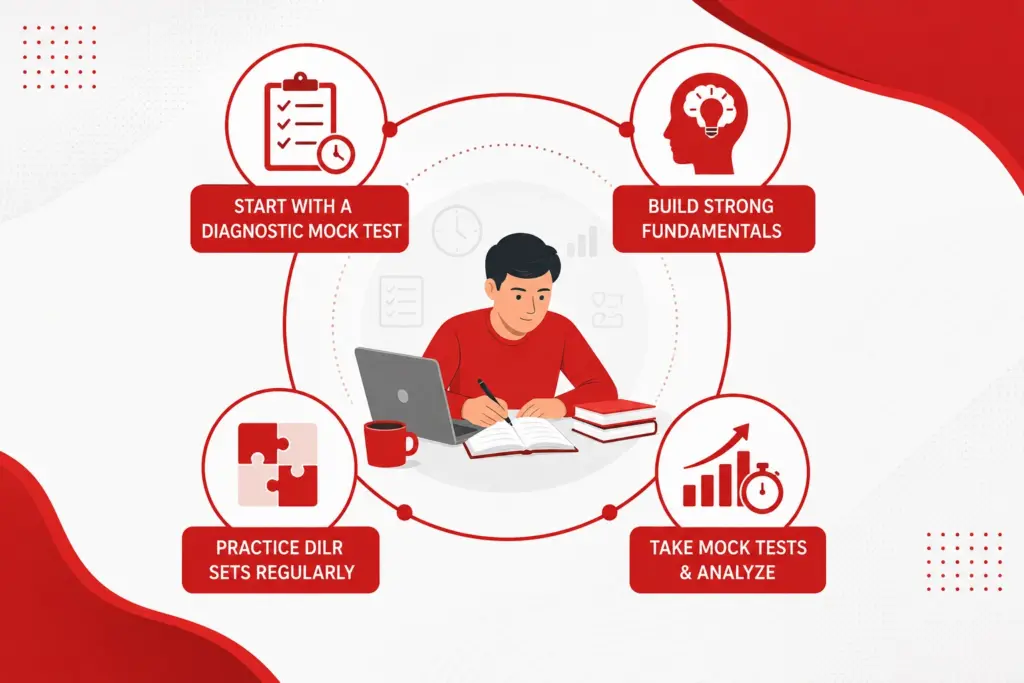
Start With a Diagnostic Mock Test
Before beginning serious preparation, take a full-length CAT mock test. Do not worry about your initial score. The purpose is to identify your strengths and weaknesses.
Analyze:
- Which sections are taking the most time?
- Which topics are causing mistakes?
- Are you losing marks because of concepts or calculation errors?
- Are you attempting too many difficult questions?
- Which section is your strongest?
This analysis can help you create a realistic preparation plan.
Build Strong Fundamentals
Candidates are advised not to start solving difficult CAT-level questions immediately. First, revise the basic concepts of arithmetic, algebra, geometry, grammar, and logical reasoning. For QA, candidates with weak mathematical fundamentals should initially focus on percentages, ratios, averages, profit and loss, equations and number systems. For VARC, regular reading is more valuable than simply memorizing vocabulary.
Practice DILR Sets Regularly
DILR can become challenging if candidates are unfamiliar with different types of sets. Practice at least a few sets regularly rather than studying the section only once or twice a week. While practicing, focus on choosing the right set. In CAT, attempting one easy set accurately can be more useful than spending 20 minutes struggling with a difficult set.
Take Mock Tests
Mock tests should become an important part of CAT preparation, particularly during the later stages. After every mock, analyze:
- Attempts
- Accuracy
- Sectional score
- Time spent per question
- Unattempted easy questions
- Incorrect answers
- Questions that could have been skipped
Simply taking multiple mocks without analyzing them is unlikely to improve performance significantly.
CAT Preparation: How Many Hours Should You Study?
There is no fixed number of hours that guarantees a high CAT percentile. The ideal study time depends on the candidate's existing preparation, academic background and available time. A student preparing full-time may devote several hours a day to preparation, while a working professional may need to follow a shorter but more consistent schedule.
A practical weekly plan can include:
| Preparation Area | Suggested Focus |
| VARC | Reading + RC practice |
| DILR | Regular set practice |
| QA | Concept building + questions |
| Mock Tests | Full-length tests |
| Analysis | Detailed review of mistakes |
Consistency is more important than studying for a large number of hours on a few days and then taking long breaks.
Your career, our expertise - talk to a counsellor
CAT Preparation Tips for Working Professionals
Working professionals often face the challenges of balancing the CAT preparation with their jobs. Instead of trying to study for several hours on weekdays, candidates can divide their preparation into smaller sessions.
For example:
- Use mornings for QA concepts.
- Practice RCs during commute or breaks where possible.
- Reserve weekends for DILR sets and mock tests.
- Maintain an error log.
- Use weekdays for revision and weekends for intensive practice.
Working professionals should also consider their work experience as an important part of their eventual B-school profile.
CAT 2026: Previous-Year Cutoff for Top IIMs
The CAT percentile required for admission is much higher than the minimum qualifying percentile published by an IIM. A candidate may meet an institute's minimum cutoff but still not receive a call because actual shortlisting depends on the complete admission criteria and the applicant pool.
The following figures can be used as indicative CAT 2025 percentile ranges, rather than guaranteed admission cutoffs:
| Institute | Indicative CAT 2025 Percentile |
| IIM Ahmedabad | 99–100 |
| IIM Bangalore | 99–100 |
| IIM Calcutta | Around 99 |
| IIM Lucknow | 97–98 |
| IIM Indore | 97–98 |
| IIM Kozhikode | 97–98 |
| IIM Amritsar | 95–96 |
| IIM Tiruchirappalli | 94–95 |
| IIM Raipur | 94–95 |
| IIM Mumbai | Around 90+ |
These figures should be treated as indicative competitive ranges, not official admission guarantees. IIMs use institute-specific selection criteria, and the actual percentile needed for a call can vary by category, academic profile and other factors. For example, IIM Lucknow's published admission process demonstrates that shortlisting involves more than CAT percentile alone.
Your career, our expertise - talk to a counsellor
CAT 2025 Cutoff for Top Non-IIM B-Schools
CAT scores are also accepted by several highly regarded non-IIM institutions.
| Institute | Indicative CAT 2025 Percentile |
| FMS Delhi | 98–99 |
| IIFT Delhi | 95–99 |
| SPJIMR Mumbai | 95–99 |
| IMT Ghaziabad | 95–97 |
| JBIMS Mumbai | Around 96 |
| MDI Gurgaon | 97–99 |
| IMI New Delhi | Around 90 |
Candidates should check the admission policy of each institute separately because the cutoff percentile is only one part of the selection process.
CAT Score vs CAT Percentile: What Is the Difference?
Many aspirants confuse CAT score with percentile. CAT score refers to the marks obtained by a candidate based on the examination's marking scheme. CAT percentile indicates how a candidate performed relative to other test takers. For example, a 99 percentile means that the candidate performed better than approximately 99% of candidates.
Since IIM and B-school shortlisting is largely percentile-driven, aspirants should focus on improving their accuracy and overall percentile rather than simply targeting a particular raw score.
Your career, our expertise - talk to a counsellor
List of Indian Institutes of Management
There are currently 22 IIMs in India. CAT scores are used for admission to the flagship postgraduate management programs offered by the IIMs, subject to each institute's admission criteria. The IIMs are:
| Indian Institutes of Management (IIMs) | ||
| IIM Ahmedabad | IIM Amritsar | IIM Bangalore |
| IIM Bodh Gaya | IIM Calcutta | IIM Guwahati |
| IIM Indore | IIM Jammu | IIM Kashipur |
| IIM Kozhikode | IIM Lucknow | IIM Mumbai |
| IIM Nagpur | IIM Raipur | IIM Ranchi |
| IIM Rohtak | IIM Sambalpur | IIM Shillong |
| IIM Sirmaur | IIM Tiruchirappalli | IIM Udaipur |
However, not every IIM offers exactly the same programs or follows identical admission criteria. Candidates should visit the individual institute's admission website before applying.
Top 10 Institutes Accepting CAT Scores Except IIMs
CAT provides access to a large number of B-schools beyond the IIMs. Some prominent CAT-accepting institutions include:
- FMS Delhi
- SPJIMR Mumbai
- IIFT Delhi
- MDI Gurgaon
- IMT Ghaziabad
- IMI New Delhi
- KJ Somaiya Institute of Management, Mumbai
- Goa Institute of Management
- BIMTECH Greater Noida
- JAGSoM/JIMS and other CAT-accepting institutes
CAT is also accepted by several IIT management departments and other universities. Candidates should check whether they need to apply separately to each institute because appearing for CAT does not automatically constitute an application to every CAT-accepting B-school.
Your career, our expertise - talk to a counsellor
CAT 2026 Admission Process
Clearing CAT is only the first stage of the B-school admission process. The general process includes the 7 steps. However, it may vary from institute to institute:
- CAT registration
- CAT exam
- Result/ Percentile
- B-School shortlisting
- WAT/ PI/ GD where applicable
- Final selection
- Admission
IIMs may consider factors such as:
- CAT overall percentile
- Sectional percentile
- Class 10 marks
- Class 12 marks
- Graduation marks
- Work experience
- Academic or gender diversity
- Written Ability Test
- Personal Interview
- Other institute-specific parameters
Therefore, candidates should not assume that a particular CAT percentile guarantees admission to a particular IIM.
CAT 2026 Exam Day Guidelines
Candidates should reach the test centre according to the reporting instructions mentioned on their admit card. Some basic points to remember are:
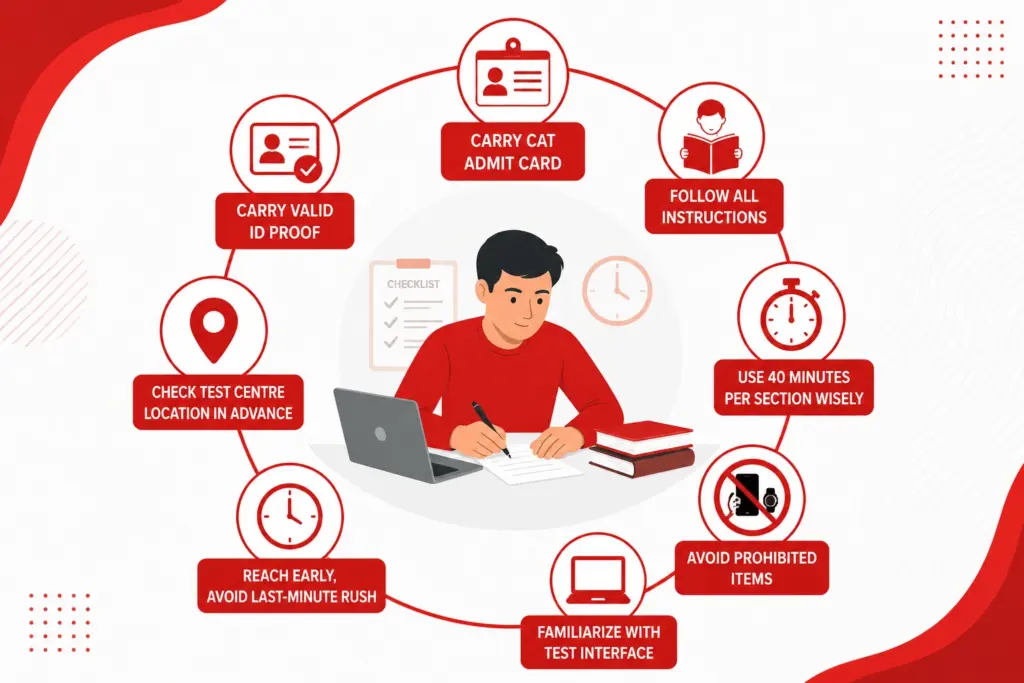
- Carry the CAT admit card.
- Carry the required original identification document.
- Check the test-centre location in advance.
- Reach the centre well before the reporting deadline.
- Follow all instructions given by the test-centre authorities.
- Do not carry prohibited items into the examination hall.
- Use the 40-minute sectional time efficiently.
Candidates should also familiarize themselves with the computer-based interface before the examination. The official CAT website provides mock-test resources to help candidates understand the test environment.
Your career, our expertise - talk to a counsellor
What After CAT 2026?
After appearing for CAT, candidates should not simply wait for the result. They should start preparing for the next stage of the admission process. This includes:
Prepare for Personal Interviews
Candidates should be prepared to discuss:
- Academic background
- Graduation subject
- Work experience
- Career goals
- Why MBA?
- Why a particular institute?
- Current affairs
- Hobbies and interests
- Strengths and weaknesses
Keep Documents Ready
Candidates may need academic marksheets, degree certificates, category certificates, work-experience documents and other supporting documents during the admission process.
Apply to Non-IIM B-Schools
Candidates should maintain a balanced B-school list comprising dream, target and safer options. Depending only on IIM calls can limit opportunities, particularly if the CAT percentile is lower than expected.
Online and Blended Management Programs Offered by IIMs and Other Universities
IIMs offer online, blended, or executive management programs. However, aspirants should not assume that every online or blended program is equivalent to the flagship two-year residential MBA/PGP. Examples of programs offered by IIMs include:
| Institute | Program/Mode | Duration |
| IIM Ahmedabad | Blended Post Graduate Program in Management | 2 years |
| IIM Mumbai | Blended Post Graduate Program in Management | 2 years |
| IIM Lucknow | Blended/Executive Management Programs | Varies |
| IIM Kozhikode | Executive Post Graduate Program | 2 years |
| IIM Raipur | Executive MBA programs | 2 years |
Renowned universities such as NMIMS, Amity, LPU, etc. also offer online MBA programs to allow learners to pursue the program without waiting another year. Some of the top universities in India that offer online MBA programs include
- NMIMS Online
- Amity University Online
- Manipal University Online
- VIT Online
- LPU Online
- Jain University Online
- Chandigarh University Online
- Shoolini Online
- IGNOU
- JNU Online
The admission requirements, eligibility, mode of delivery and award associated with these programs can differ from the flagship full-time MBA/PGP. Candidates should therefore carefully check the official program page before applying.
CAT 2026 Preparation: Common Mistakes to Avoid
Even well-prepared candidates can lose marks because of avoidable mistakes. Some common errors include:
- Starting preparation without taking a diagnostic test
- Ignoring one section because it is considered difficult
- Spending too much time on one question
- Taking mocks without analyzing them
- Focusing only on overall score and ignoring sectional performance
- Guessing too many MCQs
- Using too many preparation resources at the same time
- Ignoring previous-year CAT papers
- Leaving mock-test analysis until the last few weeks
CAT is fundamentally a test of decision-making under time pressure. Candidates need to know not only how to solve a question but also when to leave it.
CAT 2026: Final Preparation Strategy
With the exam scheduled for November 29, 2026, aspirants should use the remaining preparation period strategically. The first stage should focus on strengthening concepts and identifying weak areas. This should be followed by topic-wise practice, sectional tests and regular full-length mocks.
As the examination approaches, candidates should shift their focus from learning new concepts to revision, mock analysis, question selection and time management. Most importantly, aspirants should avoid comparing their preparation with other candidates. CAT is a highly competitive examination, but improvement in accuracy and question selection can make a significant difference to the final percentile.
Your career, our expertise - talk to a counsellor
Conclusion
CAT 2026 is an important opportunity for MBA aspirants targeting IIMs and other leading management institutes. With IIM Indore conducting the exam on November 29, 2026, candidates should now focus on strengthening their concepts, understanding the latest exam pattern and regularly analyzing their performance through mock tests.
A high CAT percentile can significantly expand the number of B-school options available to an aspirant, but the examination is only one part of the admission journey. Academic performance, work experience, personal interviews and institute-specific selection criteria can also influence the final outcome.
For candidates appearing in CAT 2026, the best approach is to prepare consistently, practice questions from all three sections, take regular mocks and develop the ability to identify which questions to attempt and which to leave. With a structured strategy and sufficient practice, aspirants can approach the examination with greater confidence and make informed decisions about their MBA options.
Frequently Asked Questions
Yes. CAT 2026 registration opened on August 3, 2026, and candidates can submit applications until September 15, 2026, 5 PM.
IIM Indore is conducting CAT 2026. The examination will be held on November 29, 2026, in three sessions.
The CAT 2026 exam is expected to have 68 questions across VARC, DILR and QA, following the CAT 2025 pattern.
There is no single percentile that guarantees admission to an IIM. For the most competitive IIMs, candidates generally target 99+ percentile, while several newer IIMs may have lower competitive ranges. Actual selection depends on the institute's admission policy, category and overall candidate profile.
Yes. Candidates who are currently in the final year of their bachelor's degree or are awaiting their final-year results can apply, subject to the applicable conditions.
No. CAT is required for admission to the IIMs' flagship management programs and is accepted by many other B-schools, but several management institutes use other entrance examinations such as XAT, NMAT, SNAP, CMAT, MAT or their own admission tests.
CAT consists of Verbal Ability and Reading Comprehension (VARC), Data Interpretation and Logical Reasoning (DILR), and Quantitative Ability (QA).
Candidates get 40 minutes for each section. They cannot switch between sections during the allotted sectional time. The total examination duration is 120 minutes.



Popular PG Programs
Trending UG Programs
Doctorate Programs
Executive Programs
Trending Online Universities
In Demand MBA Specializations
In Demand MCA Specializations
CollegeSathi aims to provide unbiased and precise information to aspirants, along with comparative guidance on universities and their programs. The content on the CollegeSathi website, including text, graphics, images, blogs, videos, and university logos, is meant for informational purposes only and should not be considered a substitute for official information provided by academic partners. While we make every effort to keep the information accurate and up to date, CollegeSathi does not guarantee the completeness or reliability of the content and is not responsible for any errors, omissions, or losses resulting from its use.
© CollegeSathi 2026. All Rights Reserved.