



SGPA to Percentage Calculator: The Easy Way to Convert Your Grades

A student's grades play an important role in evaluating his or her performance, and universities use different methods of grading to assess students. While some universities use a system of percentages, others grade a student's performance on a certain semester using SGPA (Semester Grade Point Average). Because many job applications, scholarship schemes, and higher education admission procedures require marks in the form of percentages, it is essential to convert SGPA to a percentage.
If you've ever wondered how your SGPA is converted to a percentage or been at a loss to describe it during an interview or application process, you're certainly not alone in this issue. The conversion process might seem complicated at first, but with the right formulas and tools like an SGPA to Percentage Calculator, it's very simple. This blog will walk you through all you need to know about SGPA, its calculation, and how to convert a percentage to SGPA calculator
using different methods.
If you're a student looking for clarity or a professional guiding students, this guide will make you never doubt SGPA conversion again. So, let's simplify it once and for all!
What is SGPA?
SGPA stands for Semester Grade Point Average. It is a grading system used by universities and colleges to measure a student’s academic performance in a single semester.
Instead of displaying marks in percentages, universities assign grades and grade points to subjects. The SGPA is then calculated using the weighted average of these grade points based on credit points. Students often use an SGPA to calculator tool to simplify calculations and avoid manual errors.
GPA simplifies grading by providing a single uniform score on a fixed scale, usually on a 10-point or 4.0-point scale. The major role of SGPA is to ensure uniform evaluation of the students, especially in higher education, where students study courses having varying credit values. Since various subjects carry varying weightage, SGPA considers both grades and credit points to reflect the actual performance of the student. At the end of the program, multiple SGPAs are averaged to arrive at the CGPA (Cumulative Grade Point Average), which is the student's overall performance.
Understanding the SGPA to Percentage Calculator
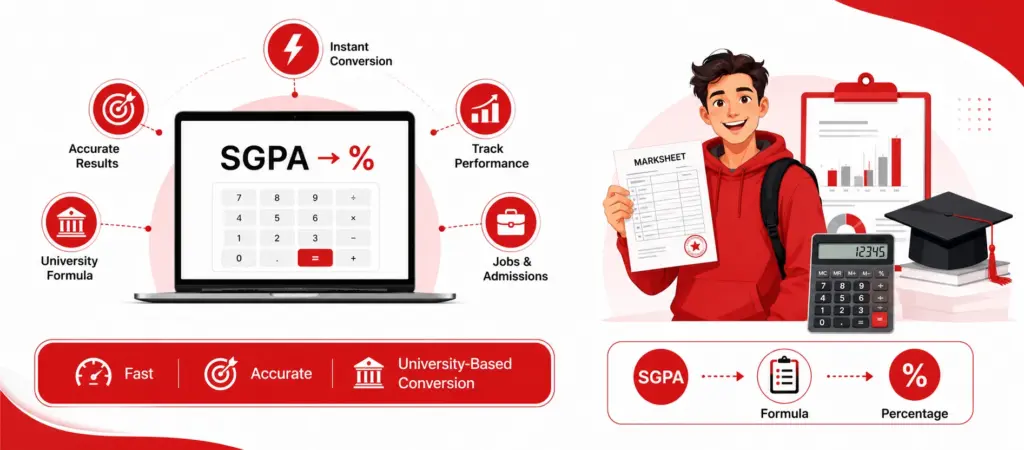
An SGPA to Percentage Calculator is an online or offline application that helps students easily convert SGPA to percentage. Because of the diverse grading scales and conversion procedures followed by different universities, the calculator makes the task simpler and provides immediate and accurate results.
Most of the SGPA to Percentage calculators require students to input their SGPA and the total credit points completed during the semester. The calculator applies the university-approved conversion formula and gives the equivalent percentage. This eliminates calculation errors and gives consistency, especially when filling out application forms for competitive examinations, internship placements, or admissions to postgraduate programs.
Apart from simplifying the conversion, calculators also allow students to keep track of their academic performance across several semesters. Advanced calculators even allow users to calculate CGPA (Cumulative Grade Point Average) by adding a number of SGPA scores. and if you're specifically looking to convert your overall CGPA, our CGPA to Percentage Calculator makes the process instant and error-free. Whether you convert SGPA manually or you utilize an online calculator, you should be aware of the formulas applied in the process to maintain accuracy.
In simple terms, using a percentage to the SGPA calculator or SGPA converter helps students:
- Convert SGPA to percentage quickly
- Avoid calculation mistakes
- Apply university-approved formulas
- Track academic performance
- Prepare for jobs and admissions

Your career, our expertise - talk to a counsellor
SGPA to Percentage Key Elements
Before learning how to calculate a percentage from SGPA, it is important to understand how SGPA itself is calculated.
SGPA calculation is based on two major factors:
- Grade Points (GPs): Grade Points is the value that is assigned to a certain grade earned in a course. All universities have a grade point system in which letter grades (A, B, C, etc.) have numerical equivalents.
- 2. Credit Points (CPs): Credit Points represent the weightage of a subject for a particular semester. Core subjects carry higher credit points than elective courses, meaning that they carry higher importance in the computation of the SGPA. By combining both of these factors, universities calculate SGPA using a common formula in order to render a just and fair academic assessment.
Step-by-Step Guide to Calculate SGPA
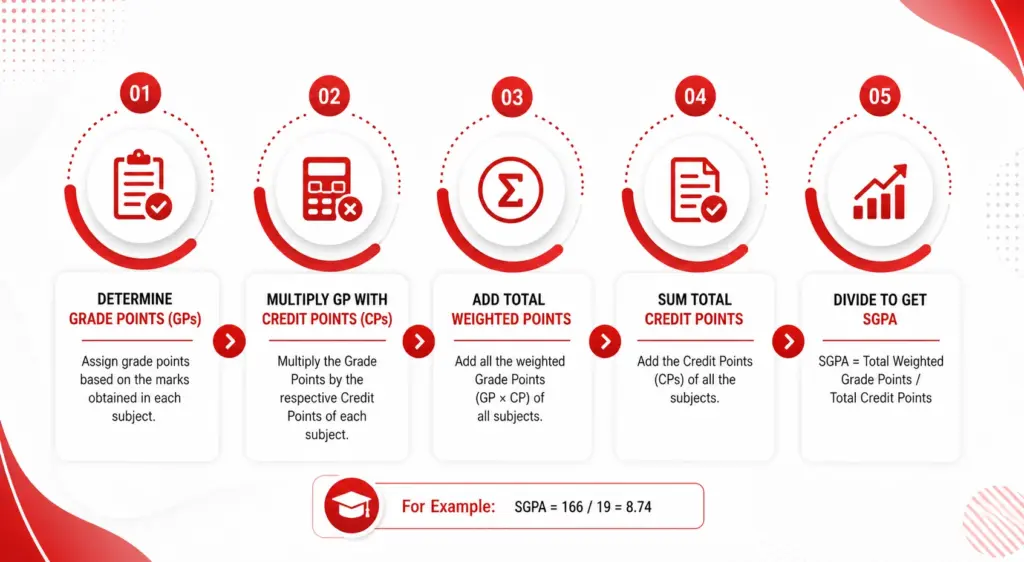
To calculate SGPA, apply the following steps:
1. Determine the Grade Points (GPs) earned in each of the subjects.
A grade is then assigned to each of the subjects based on the marks obtained. The grade is then linked to a Grade Point (GP), which is already defined under the university's grading system. For instance, where the student scores 90-100%, it could be allocated a Grade Point of 10, or where the student scores 80-89%, it could be allocated a Grade Point of 9. It is important to refer to the university's grading scale to exactly understand the corresponding GPs.
2. Multiply the Grade Points by the respective Credit Points (CPs) in each subject.
Each topic is allocated a specific number of Credit Points (CPs), which is the topic's weightage or importance in the overall syllabus. More intense courses, i.e., core courses, could be allocated higher CPs, and elective or less intense courses could be allocated lower CPs. For determining the weighted mark per topic, Grade Point is multiplied by Credit Points. For example, when a topic is allocated a Grade Point of 9 and 4 Credit Points, the weighted mark per topic will be 9 × 4 = 36.
3. Add the total weighted Grade Points (GP × CP) in all subjects.
Once the weighted scores for each subject are determined, the weighted scores are to be summed up to get the overall weighted Grade Points. It is the cumulative mark of all the subjects, grades, and weightage. Let us assume that a student has five subjects with weighted scores of 36, 28, 30, 32, and 40. The total weighted Grade Points would be 36 + 28 + 30 + 32 + 40 = 166.
4. Sum up the total Credit Points for all subjects.
The Credit Points of all the subjects are added together. This is a necessary step because the SGPA is a weighted average, i.e., it is weighted both by course weightage and grades. If the Credit Points of the five subjects are 4, 3, 3, 4, and 5, then the total of Credit Points would be 4 + 3 + 3 + 4 + 5 = 19.
5. Divide the total weighted Grade Points by the total Credit Points to get the SGPA.
Finally, the SGPA is obtained by the division of total weighted Grade Points by total Credit Points: SGPA=Total Weighted Grade Points/Total Credit Points.
For Example, SGPA= 166/19 = 8.74. This SGPA is the student's total performance in the current semester. Since SGPA is on a 10-point scale, the higher the number approaching 10, the better the performance, and a low SGPA could indicate areas where improvement is required.
Your career, our expertise - talk to a counsellor
SGPA Calculation Example
Formula: SGPA (Si) = Σ (Ci x Gi) / Σ Ci
Example:
Here’s an example to understand the SGPA calculations better. If a student has the following grades and credit points in a semester:
| Subject | Grade | Grade Point (GP) | Credit Points (CP) | GPxCP |
| Subject 1 | A | 9 | 4 | 36 |
| Subject 2 | B+ | 8 | 3 | 24 |
| Subject 3 | B | 7 | 3 | 21 |
| Subject 4 | A+ | 10 | 2 | 20 |
| Total | - | - | 12 | 101 |
Now, let’s apply the formula: SGPA= 101/12 = 8.42 This means that the resulting decimal is the SGPA of the student for the concerned semester.
How to Calculate Percentage From SGPA?
After you get the SGPA, it is easy to convert it to a percentage. Universities use varying formulas for conversion, but the most popular one is:
Percentage = (SGPA × 10) - 7.5.
Let's use this with the SGPA of 8.42 we calculated above:
Percentage =(8.42×10)−7.5 =84.2−7.5 =76.7%
This indicates the student's percentage equivalent is 76.7%. A few universities use slightly different approaches, so it's always better to refer to the official guidelines first before applying a general formula.
Your career, our expertise - talk to a counsellor
Difference Between SGPA vs CGPA
In a student's life, two major grade terms are encountered, which are SGPA (Semester Grade Point Average) and CGPA (Cumulative Grade Point Average). Although both are utilized for measuring performance, they function separately and with different calculation methods. Students need to know the variations between SGPA and CGPA in order to monitor their performance, pursue further studies, or seek employment opportunities.
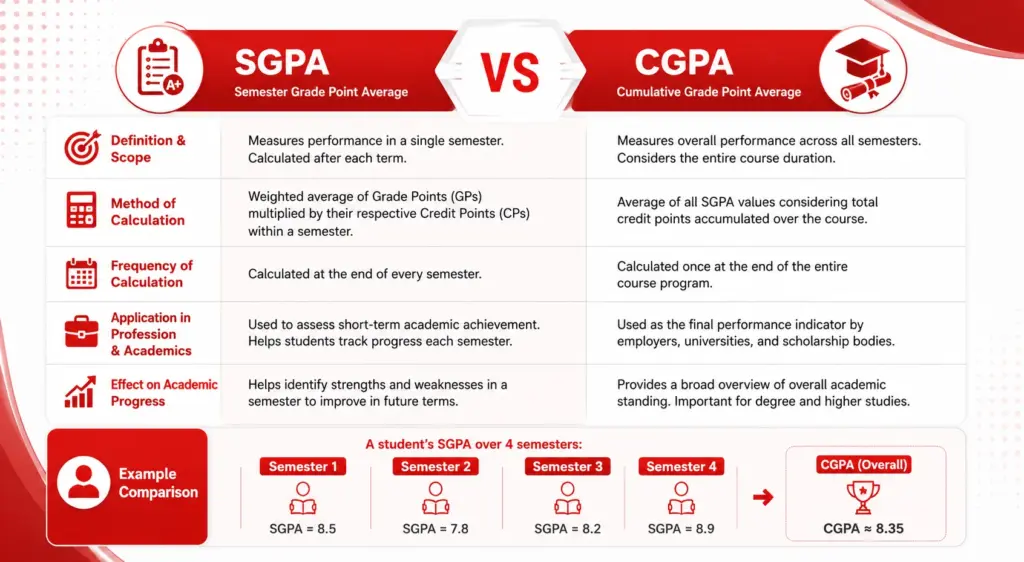
- Definition & Scope
- SGPA is a measurement of a student's performance during a semester. It is determined after each term and provides an idea about the performance of a student during a specified period.
- CGPA (Cumulative Grade Point Average) does provide some idea, at least, about a student's performance during the course span through several semesters. CGPA is the combined total of SGPA marks collected throughout the duration of the course. If you'd like a deeper understanding of how CGPA is converted to a percentage, our detailed guide on CGPA Conversion to Percentage covers every step clearly.
- Method of Calculation
- SGPA is calculated by finding the weighted average of the Grade Points (GPs) earned in a semester, multiplied by their respective Credit Points (CPs).
- CGPA, however, is obtained by taking the average of all the SGPA values over semesters in terms of the total credit points accumulated over the course.
- Frequency of Calculation
- SGPA is determined at the end of every semester. Since the university courses are divided over semesters, students acquire a fresh SGPA after every semester.
- The CGPA is calculated at the completion of the whole course program, usually at the last semester, in an effort to portray a complete academic record.
- Application in Profession & Academics
- Colleges measure short-term academic achievement using SGPA, enabling students to monitor their progress semester by semester.
- CGPA is the ultimate performance measure and is taken into consideration by employers, colleges, and certification schemes. It becomes important in applying for jobs, admission to universities, and scholarships.
- Effect on Academic Progress
- SGPA allows students to understand their strengths and weaknesses during a particular semester so that they can do better in the subsequent terms.
- CGPA provides a broad outlook as it determines the final academic position of a student, which is normally required for degree conferring and advanced studies.
- Example Comparison
- Let's assume that we have a student who is pursuing a four-semester course with the following SGPA scores:
Semester 1: SGPA = 8.5 Semester 2: SGPA = 7.8 Semester 3: SGPA = 8.2 Semester 4: SGPA = 8.9
SGPA to Percentage Calculator Online: Why Students Prefer It
Using an SGPA to percentage calculator online is much easier than manual calculation. The major benefits include:
- Instant results
- Accurate calculations
- No manual errors
- User-friendly interface
- Time-saving
- Supports multiple university formulas
Many students also use a percentage to SGPA calculator to reverse-calculate their academic scores.
Your career, our expertise - talk to a counsellor
Why is SGPA to Percentage Conversion Important?
Knowing how to calculate SGPA to percentage is extremely important because many companies still prefer percentage-based evaluation systems for the job placement. You may need percentage scores for:
- Government exams
- Job placements
- Scholarships
- University admissions
- Study abroad applications
- Internship opportunities
Which is why you need an online SGPA to percentage calculator to quickly check your percentage scores.
Conclusion
It is essential for students to understand how to calculate a percentage from SGPA, especially those who are applying to universities, scholarships, or employment that requires marks in percentages. Although SGPA provides a systematic grading system, calculate SGPA to percentage are still widely used by many institutions for convenient comparison. That is why it is important to know the correct method of conversion to prevent mistakes in your academic documents. Fortunately, the procedure is easy!
Either from a proper formula of a university or an SGPA-to-percentage calculator, you can obtain the exact outcomes in a jiffy. You just need to re-check the method of conversion. A well-converted percentage can open the gates to brighter prospects, from college to dream jobs. So, whether you're applying or getting ready for the next career milestone, understanding how to convert SGPA to a percentage calculator online keeps you ahead with confidence. Now, go ahead and calculate yours easily.
Confused about which university accepts your SGPA or percentage score? Collegesathi helps students compare top online universities, check eligibility criteria, and get expert admission guidance for career-focused programs.
Frequently Asked Questions
An SGPA to percentage calculator is a tool that helps students convert SGPA scores into percentages using university-approved formulas.
No, different universities employ different conversion formulas. Always double-check your institute's policy.
A semester grade point average of 8.0 or above is always considered as a good SGPA in any university.
Yes, percentage scores are sometimes needed by some recruiters, so conversion is necessary.
SGPA gives a standardized grading method, but percentage provides a more explicit numerical indication of marks.
Yes, by following the SGPA formula and applying Grade Points and Credit Points for each course.



Popular PG Programs
Trending UG Programs
Doctorate Programs
Executive Programs
Trending Online Universities
In Demand MBA Specializations
In Demand MCA Specializations
CollegeSathi aims to provide unbiased and precise information to aspirants, along with comparative guidance on universities and their programs. The content on the CollegeSathi website, including text, graphics, images, blogs, videos, and university logos, is meant for informational purposes only and should not be considered a substitute for official information provided by academic partners. While we make every effort to keep the information accurate and up to date, CollegeSathi does not guarantee the completeness or reliability of the content and is not responsible for any errors, omissions, or losses resulting from its use.
© CollegeSathi 2026. All Rights Reserved.