



CGPA to Percentage Calculator & Formula Guide 2026 | Easy Conversion
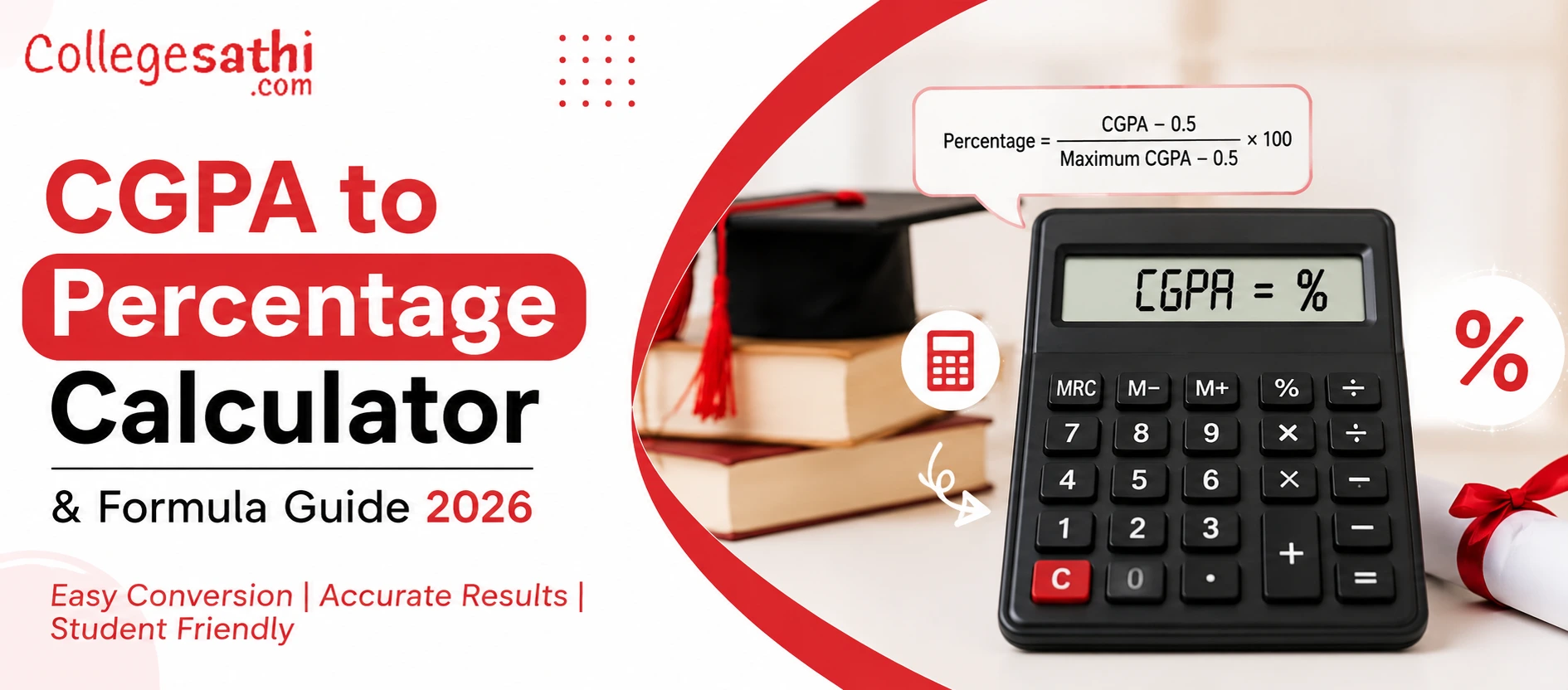

Do you often examine your grade sheet to find the percentage from CGPA? You’re not alone! The CGPA to percentage conversion causes problems for numerous students in their pursuit of higher education or job applications that need percentage evaluation. Most educational institutions operate under the CGPA system, but some universities and employers, together with competitive exams, require candidates to present their grades as percentages. The correct way to convert CGPA into a percentage requires a complete understanding to preserve an accurate academic record presentation.
Students need the CGPA system to review their complete academic results instead of examining each individual subject mark. Each institution adopts unique standards to calculate CGPA to percentage, thus creating potential difficulty in the conversion process. Hence, the following blog presents an explanation of what CGPA represents, together with its calculation process, followed by step-by-step instructions to transform CGPA scores to percentages and vice versa. Students who are eager to know how to convert CGPA into percentage will learn all relevant information through this blog, whether they are students seeking higher education or job candidates.
Let’s dive in!
What is CGPA?
CGPA stands for Cumulative Grade Point Average. It is a grading system used by schools, colleges, and universities to measure a student’s overall academic performance across all subjects. Instead of showing marks in percentages, institutions assign grade points to subjects. These grade points are then averaged to calculate the final CGPA.
The CGPA system is widely used because it reduces unnecessary pressure caused by tiny mark differences and gives a broader overview of academic performance. Many countries, including India, the USA, Canada, and several European nations, use CGPA or GPA-based systems for academic evaluation.
Quick CGPA to Percentage Conversion Table
Here’s a quick CGPA to percentage converter table for students. If you'd rather skip the manual lookup, our CGPA to Percentage Calculator gives you instant, accurate results for any CGPA value in seconds.
| CGPA | Percentage |
| 10 | 95% |
| 9.5 | 90.25% |
| 9 | 85.5% |
| 8.5 | 80.75% |
| 8 | 76% |
| 7.5 | 71.25% |
| 7 | 66.5% |
| 6.5 | 61.75% |
| 6 | 57% |
| 5 | 47.5% |

Your career, our expertise - talk to a counsellor
Computing CGPA from Grade Points (GPs)
The weighted average of Grade Points from assigned subjects constitutes the calculated GPA system. A grade system is established through student marks, which allows for grading subjects before final CGPA calculation. CGPA can be calculated using the following formula: CGPA = (Sum of Grade Points in all subjects) / (Total Number of Subjects).
For example, if a student has obtained grade points of 8, 9, 7, and 9 in four subjects, the CGPA would be: (8+9+7+9) / 4 = 8.25. The resulting value showcases the overall academic performance of the students. However, it is necessary for you to convert CGPA to percentage as there are universities, companies and scholarship programs that require you to present marks in the form of percentage.
Grading System: Understanding the Scale
There are varied educational boards and universities that have adopted different grading scales. Below is the general example of how grades are assigned:
| Percentage Range | Grade | Grade Point (GP) |
| 90-100% | A+ | 10 |
| 80-89% | A | 9 |
| 70-79% | B+ | 8 |
| 60-69% | B | 7 |
| 50-59% | C+ | 6 |
| 40-49% | C | 5 |
| Below 40% | F | 0 |
Your career, our expertise - talk to a counsellor
How to Calculate CGPA
Although the method to convert CGPA to percentage depends on the university or board's specific formula, here are some of the commonly used methods:
Standard Formula (Common in Indian Universities): Most Indian universities and boards, including CBSE, use the following formula: Percentage = CGPA × 9.5. For example, if a student has a CGPA of 8.2, the percentage will be: 8.2 × 9.5 = 77.9%
University-Specific Formulas: Different universities and institutions have their own conversion methods. Some common ones include:
- CBSE (India): Percentage = CGPA × 9.5
- AICTE & UGC Guidelines: Percentage = (CGPA - 0.5) × 10
- Mumbai University: Percentage = CGPA × 7.1 + 11
- Anna University: Percentage = CGPA × 10
CGPA to Percentage for a 4.0 Scale (International Standard): For universities following a 4.0 scale (for instance, in the US and some European countries), conversion is usually determined by: Percentage = (CGPA / 4.0) × 100 For example, if a student has a 3.5 CGPA on a 4.0 scale, the percentage will be: (3.5 / 4.0) × 100 = 87.5%
Why is CGPA to Percentage Conversion Important?
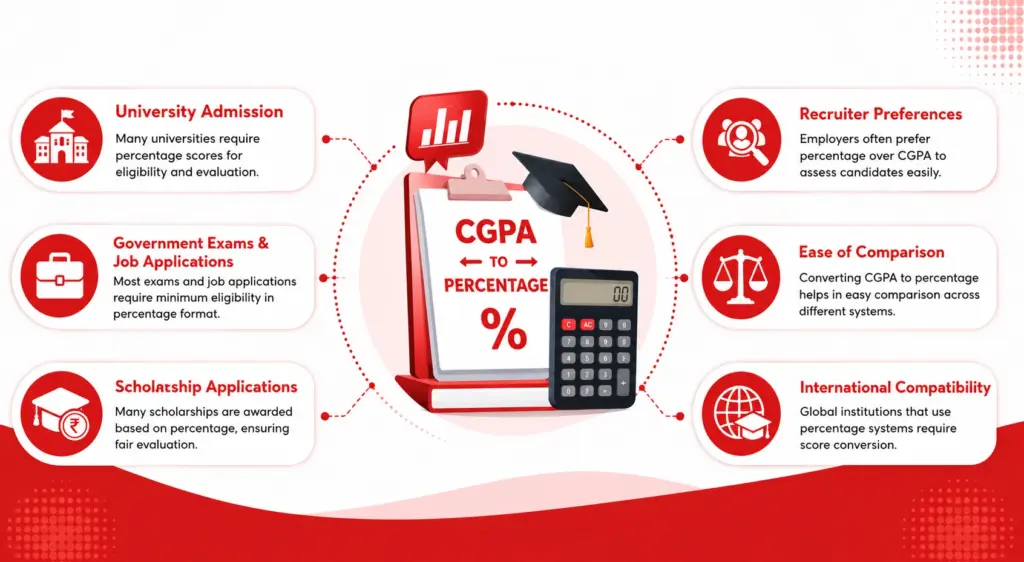
Many reasons exist for students to convert their CGPA into a percentage scale. Many employers and universities have minimum eligibility criteria in percentage format. Therefore, a proper CGPA to percentage conversion becomes necessary.
- University admission: University admissions requirements usually require students to submit percentage scores for evaluation when determining their academic eligibility. Institutions establish specific entry requirements which demand the conversion of CGPA to percentage format.
- Government Exams and Job Applications: Employment exams as well as government job applications, demand a minimum grade scale expressed as percentage points. To fulfill the requirement, candidates need to submit their educational documents as a percentage score report.
- Scholarship Applications: Academic merit determines the distribution of many scholarships and their review through percentage scores. Such evaluation methods enable a standardized assessment of all candidates.
- Recruiter Preferences: Most traditional firms, together with corporate recruiters, use percentage-based evaluation instead of CGPA. Academic achievement knowledge becomes more legible and straightforward through percentage grading, so employers usually need candidates to present their scores as percentages.
- Ease of Comparison: Students, along with educators and employers, can easily evaluate academic performance between different grading systems by receiving a transformation of CGPA into percentage grades.
- International Education Compatibility: The worldwide institutions adopting percentage grading require students to convert their scores before applying to international studies or exchange terms.
Your career, our expertise - talk to a counsellor
How to Convert Percentage into CGPA
Students also often need to reverse the process and convert percentages into CGPA.
The standard formula used by CBSE and many Indian universities is:
CGPA=Percentage/ 9.5
Example
If a student scores 85%:
85/9.5=8.95
So, 85% converts to approximately 8.95 CGPA.
Advantages of the CGPA System
CGPA has become widely adopted throughout the world because it provides several advantages. The percentage-based system provides absolute mark outcomes, yet CGPA enables the evaluation of student performance through a comprehensive method.
Three major benefits exist for CGPA, which all students should understand before searching for a CGPA to percentage converter.
1. Provides a Comprehensive Assessment
The main strength of using CGPA lies in its capability to evaluate academic performance throughout an educational period without emphasizing single-subject grades. The cumulative score generated by CGPA represents student consistency better because it considers academic performance throughout multiple disciplines. A CGPA evaluation system groups almost identical scores in the same range, like 8.5 and 8.6 CGPA, which enables students to avoid competing over minor variations (for instance, between 85% and 86%).
2. Encourages a Stress-Free Learning Environment
Graduate Point Average as a system reduces student pressure through its grading bands rather than fixed mark evaluation. By using CGPA, the evaluation process creates a stress-free environment since small mark fluctuations do not produce significant CGPA score modifications. Students who achieve between 89% to 91% typically get the same grade point, such as a 9 GP, thus reducing unnecessary stress related to small mark variations. The grading method allows students to learn concepts deeply rather than memorize information for grades.
3. Globally Recognized and Standardized
International educational institutions as well as universities generally accept CGPA scores instead of percentages, thus simplifying student applications for foreign education. The educational systems of the USA, Canada and Australia use CGPA/GPA instead of percentages, thus allowing CGPA to function effectively in international applications. A student who maintains an 8.5 CGPA scale out of 10 can convert that to the 4.0 GPA measure followed by U.S. universities. Students find CGPA simple to modify between educational institutions because of its ease of conversion for international academic purposes and employment applications.
4. Encourages Consistent Performance
Students receive better incentives to avoid performing outstandingly in one class or term through CGPA's process of averaging over several semesters or years. The CGPA system provides protection from low scores because it distributes marks throughout different grades, while the percentage system relies on solitary evaluations. The combination of different semester grades allows students to maintain moderate CGPA scores even when they score 6.5 in one semester and 9.0 in another semester, because these extreme grades balance out each other.
5. Reduces Performance Anxiety and Pressure
The grading system prevents students from competing or being misdirected through its system of marking students into broad grade categories. The grading system prevents students from becoming fixated on minor mark variations since they must concentrate on developing their complete comprehension. A+ grades which correspond to 10 GP serve as the equal reward for students who earn 90-100% scores, leading to classes that emphasize broad-based learning in a less tense setting.
6. Helps in Self-Assessment and Improvement
The grading system delivers specific reference points for students who want to evaluate themselves personally against their academic abilities. Students can use CGPA to monitor their academic performance across semesters to assess their general consistency level in order to focus on specific problem areas. Because students monitor their CGPA during each semester, they become aware of modifications to prevent further deterioration before the final year's realization of total consequences.
Your career, our expertise - talk to a counsellor
Drawbacks of the CGPA System
Throughout all its advantages, the CGPA system exhibits specific significant weaknesses. The simplified grading approach provided through CGPA generates a simplified evaluation but it does not always give true information about student's academic results. Here are some major drawbacks:
1. Lacks Precision and Accuracy
CGPA creates grade points through mark rounding that may cause students to lose specific details about their performance. Groups of marks found in CGPA replace numerical percentage values, thus making student performance evaluation less precise because ranges obscure differences between students' achievement levels. When two students achieve 84% and 89%, their academic records end up with 8.5 or 9 CGPA, although their actual marks show a 5% distinction. When competitions occur, the grading system based on CGPA may establish biased assessment standards.
2. Inconsistent Conversion Methods
Academic evaluation becomes inconsistent because education boards and universities utilize various CGPA-to-percentage calculation systems. An 8.0 CGPA score corresponds to 76% at certain institutions yet it equals 80% at other institutions. For example:
- CBSE Board (India): CGPA × 9.5 = Percentage
- Mumbai University: (CGPA × 7.1) + 11 = Percentage
- AICTE Guidelines: (CGPA - 0.5) × 10 = Percentage
Academic performance evaluation across educational institutions becomes difficult because institutions use different CGPA conversion methods.
3. No Detailed Subject-Wise Breakdown
A CGPA system gives a single cumulative score instead of showing individual subject marks, which percentage-based grading reveals to students. The use of CGPA creates difficulties for students who want to make their individual subject abilities clear. A student who achieves 95% in Mathematics combined with 65% in English receives an 8.0 CGPA even though it fails to display their excellent performance in Mathematics. Students seeking specialized education or career positions must demonstrate subject-specific expertise because CGPA does not present a detailed marks breakdown.
4. Employers and Universities May Prefer Percentage
The widespread adoption of CGPA as a marks evaluation system does not stop certain businesses and government sectors as well as competitive examinations, from demanding percentage grading. User manual conversion of CGPA creates problems that lead to difficulties and long processes. Students who use CGPA need to convert their grades to validate eligibility for positions where a minimum 60% marks are required in certain government job applications.
5. Can Mask Performance Fluctuations
CGPA calculates an average from student grades, so performance changes between subjects or semesters become concealed. The average grading system creates boundaries that might present students as academically steady, even when their performance levels vary. The combination of a 5.5 CGPA in one semester with a 9.0 CGPA in another causes an undisclosed change in learning performance because the blended grade average values maintain the appearance of stability.
6. Varies Across Countries and Institutions
Students face difficulties when submitting international applications because CGPA systems do not have a universal standard, which hinders accurate grade conversion during the process. A 4.0 GPA scale is needed according to some universities, but other institutions work with a different grading system that uses 10- or 7-point scales. For example:
- India: Uses a 10-point CGPA scale
- USA & Canada: Use a 4.0 GPA scale
- Australia & UK: Use a 7-point or percentage-based system
A worldwide standard for CGPA grading would be beneficial since it could enable students to compare their marks easily across different educational systems.
Common Mistakes Students Make During CGPA to Percentage Conversion
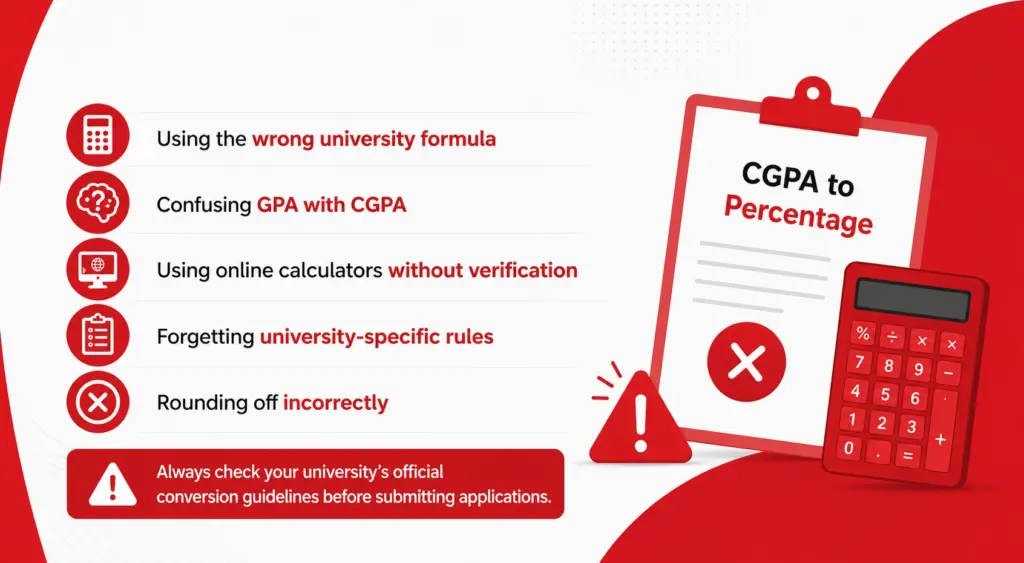
While trying to calculate CGPA to percentage, students often make errors such as:
- Using the wrong university formula
- Confusing GPA with CGPA
- Using online calculators without verification
- Forgetting university-specific rules
- Rounding off incorrectly
Always check your university’s official conversion guidelines before submitting applications.
Your career, our expertise - talk to a counsellor
Conclusion
Understanding how to convert CGPA into percentage is important during job applications, higher education admission and competitive examination processes. Universities, together with employers, choose percentage-based scores even though the CGPA system makes grades easier to understand and reduces stress. Learning proper conversion methods between CGPA and percentage marks protects you from unwanted confusion, leading to lost opportunities. CGPA makes grading easier; however, it introduces possible imprecision to the evaluation process.
The system motivates students to maintain uniform learning, although they tend to prioritize high scores. Both CGPA and percentage grading require comprehension of grading techniques at your institution, as well as proper methods to display your academic accomplishments effectively. Being asked about CGPA conversion to percentage will now become an opportunity to shine with an expert-level explanation. Proceed to your score computation and pursue both academic achievements and career success.
Your academic score is just the beginning. Whether you're applying for jobs, higher studies, or online degree programs, CollegeSathi helps you choose the best online universities and courses tailored to your goals.
Frequently Asked Questions
The cumulative semester performance appears as CGPA but a single semester achievement shows up as GPA.
Yes, every university maintains individual conversion standards for grades and GPA evaluation. Thus, always check the official guidelines.
Some firms accept CGPA instead of percentages however various businesses need students to submit their grades as percentages. The best approach involves providing both formats since certain situations demand the conversion.
Students often consider a CGPA rating above 8.0 as good but this judgment depends on the university’s grading standards.
Your education will succeed if you maintain stable results in every class while asking for assistance when necessary along with effective time management for your studies.



Popular PG Programs
Trending UG Programs
Doctorate Programs
Executive Programs
Trending Online Universities
In Demand MBA Specializations
In Demand MCA Specializations
CollegeSathi aims to provide unbiased and precise information to aspirants, along with comparative guidance on universities and their programs. The content on the CollegeSathi website, including text, graphics, images, blogs, videos, and university logos, is meant for informational purposes only and should not be considered a substitute for official information provided by academic partners. While we make every effort to keep the information accurate and up to date, CollegeSathi does not guarantee the completeness or reliability of the content and is not responsible for any errors, omissions, or losses resulting from its use.
© CollegeSathi 2026. All Rights Reserved.