



PhD Full Form, Eligibility, Fees and Admission 2026: A complete guide

PhD or Doctor of Philosophy is the highest academic degree a student can earn. This doctorate can only be awarded to those who have spent years of original research in the chosen topic. A PhD is not about attending classes or clearing exams, it is about adding something new to the existing body of knowledge through a thesis.
If you’re planning a PhD in 2026, you must know several important factors before applying, from eligibility and entrance exams to duration, fees, and stipend. So, in this blog, we will cover what the PhD degree involves, who can apply, how PhD admissions 2026 work, and whether an Online PhD is valid in India or not.
PhD 2026: Quick Highlights
| Particular | Details |
| Full Form | Doctor of Philosophy |
| Regulating Body | University Grants Commission (UGC) |
| Minimum Eligibility | Master’s degree (55% aggregate) or a 4-year UG with Research Honours (75% aggregate) |
| Accepted Entrance Exams | UGC NET, CSIR NET, GATE, JEST, or University-specific tests |
| Duration | 3 - 6 years |
| Mode | Full-time or part-time (regular, on-campus) |
| Fees | ₹ 10,000 - ₹ 5,00,000 (depends on the university) |
| Common Stipend (JRF) | ₹ 37,000 - ₹ 42,000 per month |
What is PhD full form?
The full form of PhD is Doctor of Philosophy, which is a research degree earned by learners who complete original research in their subject and successfully defend it in front of an academic committee. Unlike a bachelor’s or a master’s degree program, a PhD does not follow a fixed syllabus. It is built around a research problem that a candidate identifies, studies and answers through a thesis.
In India, PhD degrees are regulated by the University Grants Commission (UGC), which sets the rules that every university in India must follow while offering a PhD program, from admission to the final thesis.
PhD Course: What does it involve?
A PhD course follows a different structure from a regular UG or PG degree program. Let’s have a look at some of the factors that are included in the PhD course.
- Coursework: A minimum of one semester of coursework, which covers research methodology and subject-specific topics, as mandated by UGC.
- Research proposal and registration: Formal registration of your research topic, supervised by an approved research guide is included in the course.
- Comprehensive exam or RAC review: Periodic reviews are conducted by the Doctoral Committee or Research Advisory Committee to track your progress.
- Publications: Most universities require at least one or two research papers to be published in recognized journals before you can submit your thesis.
- Thesis submission: You need to submit your final research thesis, followed by evaluation by external examiners.
- Viva Voce: A final oral defence session of your thesis is held in front of an examination committee.
A PhD holder is usually addressed as “Dr.” and is qualified to take up research roles, teaching positions in colleges and universities, or senior research and consulting roles in the industry.
But to get the “Dr.”, you must fulfill the eligibility criteria for a PhD program. So, let’s explore who can apply to PhD course in 2026.

Your career, our expertise - talk to a counsellor
PhD Eligibility 2026: Who can apply?
PhD eligibility is not just about your marks; it also depends on the degree you hold and the exam score you have. You are eligible for PhD admission 2026 if you meet any one of these conditions.
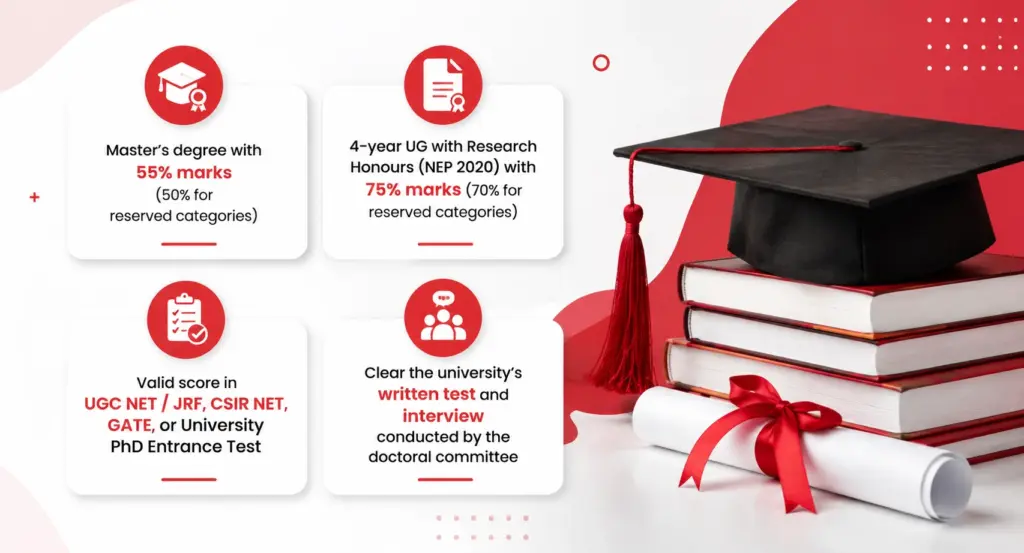
- You hold a master’s degree from a recognized university, with a minimum of 55% marks or equivalent CGPA. For SC, ST, OBC, PwD and EWS candidates, the minimum requirement is 50%.
- You hold a 4-year undergraduate degree with Research Honours, as introduced under NEP 2020, with a minimum of 75% marks. For reserved categories, the requirement is 70%. This option lets you apply for a PhD directly after your bachelor’s degree, without a master’s degree.
- You have a valid score in UGC NET/ JRF, CSIR NET, GATE, or a university-specific PhD entrance test.
- You clear the university’s written test and interview, conducted by the doctoral committee.
However, meeting the minimum eligibility criteria does not guarantee admission. Each university and each department sets its own additional requirements, including the number of open seats, availability of a guide in your chosen research area, and performance in the interview.
Moreover, it is worth noting that the MPhil degree, which candidates used to pursue earlier before a PhD degree, has been discontinued under the 2022 UGC Regulations. So, if you are planning a PhD in 2026, you do not need an MPhil degree, and a recognized master’s degree or a 4-year research honours degree is applicable to apply.
Also Read:
PhD Admission 2026: How to Apply?
PhD admissions follow a standard process across most Indian universities. Here are a few steps you need to follow while applying to a PhD program in India:
- Begin by checking the eligibility criteria and entrance exam requirements for the university and course you are applying to.
- Complete the PhD application form and upload the academic documents.
- Submit a research proposal of 1,000 to 2,000 words in which the research topic and goals will be stated.
- Take the entrance exam applicable to the university, or use a valid UGC NET/CSIR NET/GATE score if the university requires this before you apply.
- Complete the formalities of admission and pay the applicable fee.
As announced by the University Grants Commission (UGC), the scores of NET can be used to replace university-specific PhD entrance exams from the academic year 2026 onwards.
Also Read: https://www.collegesathi.com/news/ugc-net-result-2026-date-cutoff-scorecard
Your career, our expertise - talk to a counsellor
PhD Entrance Exam: Which One Should You Take?
There are several entrance exams that you can take before applying to a PhD program in India. However, the right choice of PhD entrance exam depends on the subject you are aiming to pursue. Here’s the list of entrance exams that are applicable for a PhD course, and who should apply for them:
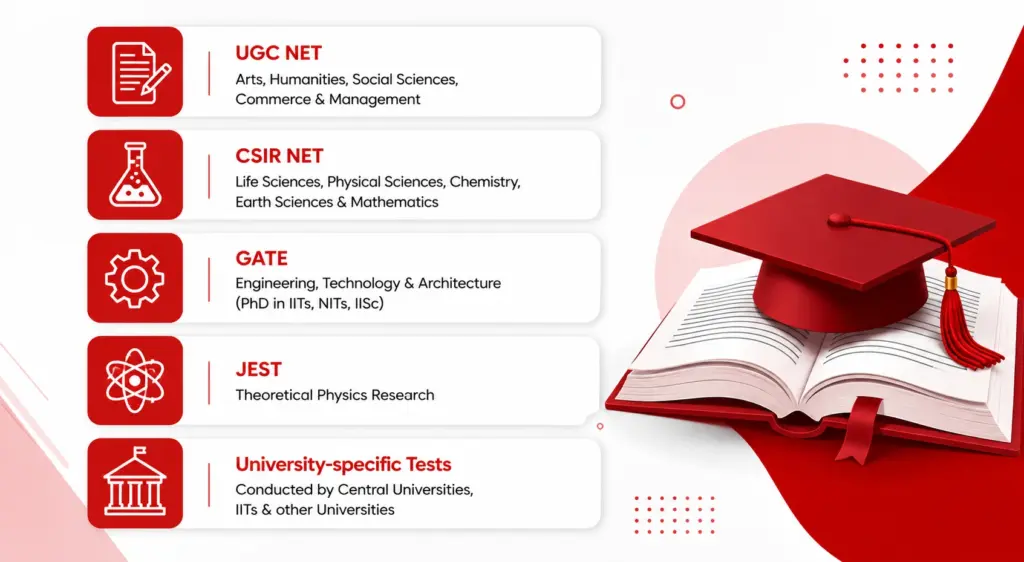
- UGC NET: For candidates in arts, humanities, social sciences, commerce and management. These are conducted twice a year by the National Test Agency (NTA).
- CSIR NET: For learners interested in life sciences, physical sciences, chemistry, earth sciences and mathematics.
- GATE: For those wishing to do research in engineering, technology and architecture. It is widely used for PhD admission at IITs, NITs and IISc.
- JEST: For applicants targeting theoretical physics research specifically.
- University-specific tests: Several universities, including central universities and IITs, also conduct their own PhD entrance tests for individual departments.
PhD Fees in India
The fees for a PhD program in India vary widely, depending on whether you choose a government or private university, and the subject you are studying.
| University Type | Approximate Total Fees |
| Government / Central Universities | ₹ 10,000 - ₹ 1,00,000 |
| State Universities | ₹ 25,000 - ₹ 1,50,000 |
| Private / Deemed-to-be Universities | ₹ 1,00,000 - ₹ 5,00,000 |
The government and central universities of India have more affordable PhD programs as they receive UGC funding and offer more fellowship-backed seats. Private universities charge higher fees but often provide better infrastructure, faster admission cycles and more flexible schedules for part-time candidates.
Your career, our expertise - talk to a counsellor
Is Online PhD Valid In India?
No, a fully online PhD is not valid in India. As per the UGC Regulations, 2020 (ODL Programs and Online Programs), research-based programs like PhD cannot be offered in online distance learning or in completely online mode. A PhD requires in-person supervision, coursework, lab or fieldwork if needed, and finally a viva voce, which cannot be conducted through virtual means.
Thus, a part-time PhD at a UGC-recognized university can be considered as a more appropriate choice, as it enables professionals to work while fulfilling requirements such as supervisor interaction and periodic campus visits.
If you are a working professional looking for a doctoral degree with more flexibility, an Online DBA (Doctor of Business Administration) is worth considering. It is a professional doctorate in business and management, which is offered by top international universities, such as:
What is PhD Duration?
The minimum duration for a full-time PhD in India is 3 years, and the maximum duration to complete a PhD is 6 years, as per the UGC Regulations 2022. Universities can grant an extension of up to 2 additional years in exceptional cases, with approval from the doctoral committee.
A part-time PhD takes longer, typically 4 - 6 years, since candidates balance research with a job. But the exact duration depends on your research area and the pace you work at, and your university’s internal rules.
Also Read: https://www.collegesathi.com/blogs/phd-duration-india-vs-abroad
Your career, our expertise - talk to a counsellor
PhD Scholarships and Stipend in India
In India, there are many scholarships and stipends available to learners to manage their research costs when pursuing their PhDs. The funding can be received from governmental schemes, universities, research institutions, and fellowships. Some of the popular PhD scholarships and stipends are:
| Fellowship | Monthly Stipend |
| UGC NET JRF (Year 1-2) | ₹ 37,000 + HRA (House Rent Allowance) |
| UGC NET SRF (Year 3-5) | ₹ 42,000 + HRA |
| Non-NET Fellowship | ₹ 8,000 |
| PMRF (Prime Minister’s Research Fellowship) | ₹ 70,000 - ₹ 80,000 |
| CSIR / ICMR / DST-INSPIRE | ₹ 37,000 - ₹ 42,000 |
Quick Fact: Apart from the monthly stipend, JRF and SRF scholars also receive an annual contingency grant to cover research-related expenses like books, travel and fieldwork. This is usually higher for science subjects than for humanities and social sciences.
Careers After a PhD Course
A PhD degree opens up several career paths that are simply not available with a bachelor’s or master’s degree. A few industries where you can pursue a career after a PhD are mentioned below.
- Academia: Most PhD holders move into teaching and research roles as Assistant Professors in colleges and universities.
- Research Organizations: Government research bodies like CSIR, ICMR, DRDO and ISRO regularly hire PhD holders for full-time research positions.
- Industry R&D roles: Sectors like pharmaceuticals, biotechnology, data science and core engineering hire PhD holders for specialized research and development roles.
- Consulting and policy work: A PhD in economics, public policy or social sciences can lead to research and advisory roles with think tanks, government bodies and international organizations.
Quick Tip: Your career path after a PhD largely depends on your subject and the kind of research you have done, so think about this before you finalize your research area.
Your career, our expertise - talk to a counsellor
Conclusion
A PhD is a long-term commitment, but it opens multiple career pathways to research, academia and specialized industry roles. If you meet the eligibility criteria, choose the right entrance exam for your subject and understand the fee and stipend structure, then pursuing a PhD becomes a simpler process. Moreover, if flexibility matters more to you, then a part-time PhD or an Online DBA can be worth considering.
For personalized guidance on choosing the right university and program, you can reach out to CollegeSathi and get free career counselling.
Frequently Asked Questions
The full form of PhD is Doctor of Philosophy. It is a research-based doctoral degree awarded after original research and a thesis defence.
You need either a master’s degree with a minimum of 55% marks, or a 4-year undergraduate degree with Research Honours and a minimum of 75% marks, along with a valid score in a relevant entrance exam.
A full-time PhD takes a minimum of 3 years and a maximum of 6 years. A part-time PhD usually takes 4 - 6 years of research.
The main PhD entrance exams in India are UGC NET, CSIR NET, GATE, JEST and university-specific tests, which depend on the subject you are aiming for in your research.
PhD fees range from ₹ 10,000 - ₹ 1,00,000 in government universities, and ₹ 1,00,000 - ₹ 5,00,000 in private universities for the entire program.
UGC NET JRF scholars receive ₹ 37,000 per month for the first 2 years, and ₹ 42,000 per month as SRF from the 3rd year onward. PMRF scholars receive up to ₹ 80,000 per month.
No. UGC does not permit PhD programs to be offered fully online. Working professionals can consider a part-time PhD with periodic campus visits or an Online DBA.
Yes, if you have a 4-year undergraduate degree with Research Honours and a minimum of 75% marks, you can apply for a PhD directly, without a master’s degree.
No. JRF provides financial support during your PhD, but it is not compulsory for admission. You can be eligible for a PhD through NET or CSIR NET without securing JRF.
No. MPhil has been discontinued under the 2022 UGC regulations. A recognized master’s degree or a 4-year Research Honours degree is enough to apply for a PhD directly.
Yes, working professionals can opt for a part-time PhD at a UGC-recognized university. It takes longer than a full-time PhD and requires periodic campus visits.



Popular PG Programs
Trending UG Programs
Doctorate Programs
Executive Programs
Trending Online Universities
In Demand MBA Specializations
In Demand MCA Specializations
CollegeSathi aims to provide unbiased and precise information to aspirants, along with comparative guidance on universities and their programs. The content on the CollegeSathi website, including text, graphics, images, blogs, videos, and university logos, is meant for informational purposes only and should not be considered a substitute for official information provided by academic partners. While we make every effort to keep the information accurate and up to date, CollegeSathi does not guarantee the completeness or reliability of the content and is not responsible for any errors, omissions, or losses resulting from its use.
© CollegeSathi 2026. All Rights Reserved.