



NMIMS Online MBA Specialisations 2026: Which One Should You Choose?
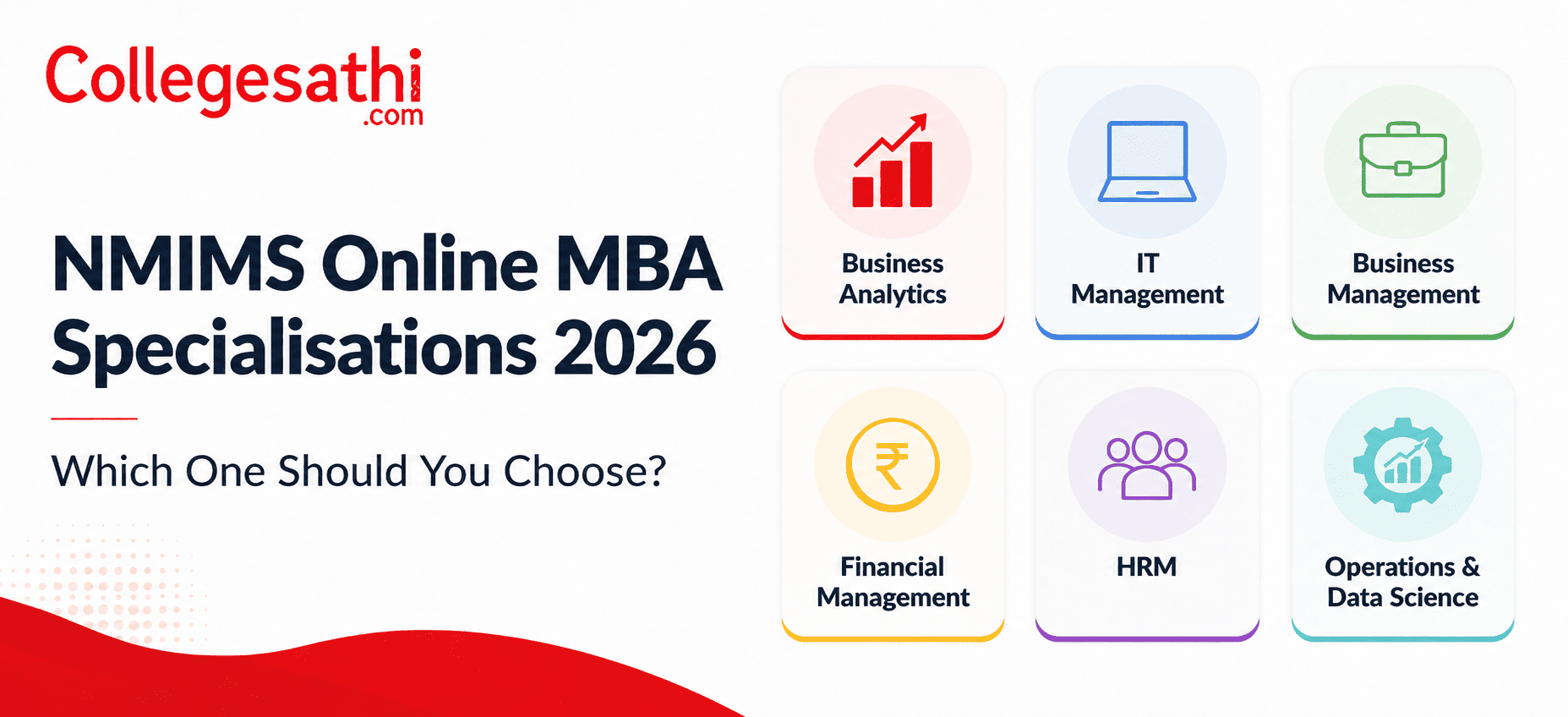

Picking your NMIMS Online MBA specialisation feels like a small decision on the surface — you're choosing a track on a form. But it's actually one of the more consequential choices you'll make in this program, because it shapes your second-year curriculum, the projects you work on, the alumni network you tap into, and the career conversations you're positioned to have once you graduate.
The good news: NMIMS Online offers six well-structured specialisations, each genuinely distinct and each mapped to real hiring demand in the Indian market. The not-so-good news: you can't change your specialisation once you've enrolled, so the decision needs to be made carefully — ideally before you pay the registration fee, not after.
This guide gives you a thorough breakdown of all six NMIMS Online MBA specialisations — what you study, what roles open up, what salaries look like, and which profile of student each track is actually built for. If you're still weighing the overall program decision, the NMIMS Online MBA complete guide covers the full picture including fees, eligibility, and admission.
All 6 NMIMS Online MBA Specialisations at a Glance
Before going deep on each one, here's the high-level view across all six specialisations — same fee structure, same UGC recognition, different career destinations:
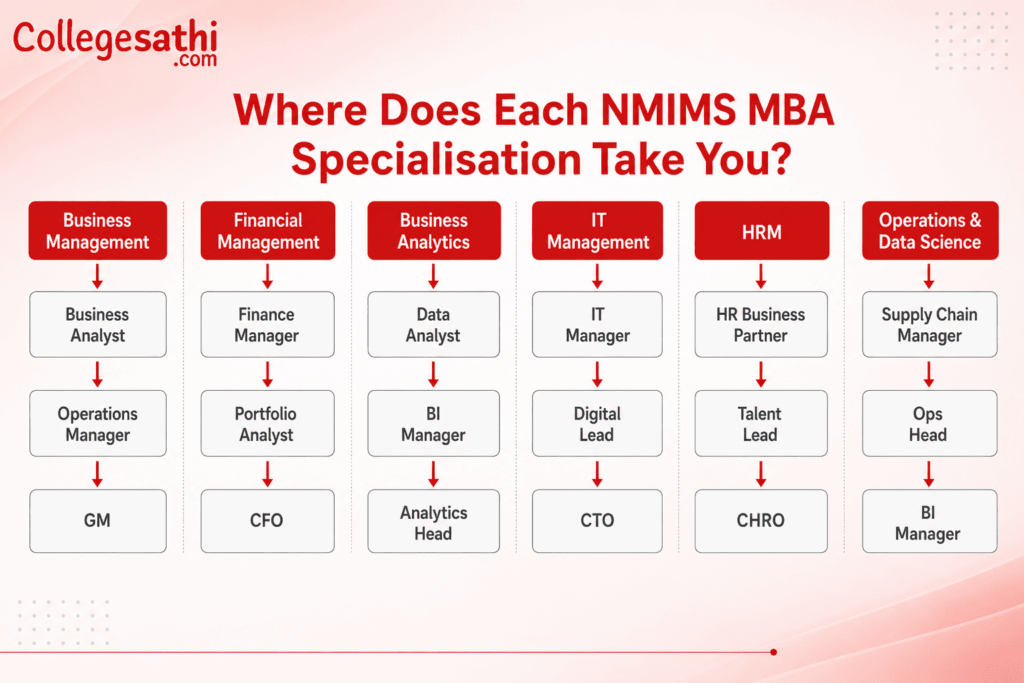
| Specialisation | Best Suited For | Post-MBA Roles | Salary Range (Mid-Level) |
| Business Management | Fresh graduates, generalists | Business Analyst, Operations Manager, GM | Rs.5–9 LPA |
| Financial Management | Finance & banking professionals | Finance Manager, Portfolio Analyst, CFO-track | Rs.7–14 LPA |
| Business Analytics | Data-oriented, tech & commerce grads | Data Analyst, BI Manager, Analytics Consultant | Rs.7–14 LPA |
| IT Management | Software engineers, IT professionals | IT Manager, Digital Transformation Lead, CTO-track | Rs.6–13 LPA |
| HRM | HR executives, people ops professionals | HR Business Partner, Talent Lead, CHRO-track | Rs.6–12 LPA |
| Operations & Data Science | Engineers, ops & logistics professionals | Supply Chain Manager, Ops Head, BI Manager | Rs.7–15 LPA |
One important point worth stating upfront: all six specialisations carry the same Rs. 1,96,000 total fee, and the degree itself is UGC recognised and accredited by NAAC A++ — same across all tracks. No specialisation is 'better' in terms of institutional credibility. The difference is entirely in what you learn and where it takes your career. For a detailed breakdown of fee payment modes, EMI options, and scholarships, our guide on NMIMS Online MBA EMI plans and scholarship options covers all of that.
Breaking Down Each Specialisation
1. Online MBA in Business Management
The most generalist track and the default choice for fresh graduates who haven't yet committed to a specific function. You cover Marketing, Finance, Operations, Business Analytics, and Entrepreneurship across two years — broad by design. That breadth keeps options open early in a career but becomes a limitation once you're a few years in and want a credential that signals domain expertise.
Choose this if: You're a fresh graduate targeting general management, consulting, or entrepreneurship roles.
Avoid this if: You already have 3+ years in a specific function and want the MBA to deepen that expertise, not broaden it.
2. Online MBA in Financial Management
Covers Security Analysis, Portfolio Management, Corporate Finance, Financial Reporting, and Treasury Management. The curriculum moves fast on quantitative concepts — commerce graduates and finance professionals will find it manageable; other backgrounds may need extra effort early on. Salary outcomes are among the strongest of all six tracks for professionals with prior financial services experience.
Choose this if: You're in banking, insurance, or corporate finance and want formal credentials behind your domain knowledge.
Avoid this if: You have little finance background and find quantitative subjects genuinely challenging.
3. Online MBA in Business Analytics
The fastest-growing specialisation by employer demand. The curriculum covers Data Analytics for Business, Machine Learning for Managers, Visual Analytics, and Supply Chain Analytics — technical enough to be practical, not so deep that it requires an engineering background. Every major organisation is building data teams right now, and this track positions you at the intersection of data and business decision-making.
Choose this if: You work with data in some capacity, or come from a tech, science, or commerce background wanting to formalise analytical skills with a management credential.
Avoid this if: You're targeting a people-oriented or relationship-driven career — this track is heavily quantitative.
4. Online MBA in IT Management
Built specifically for technology professionals moving from execution into leadership. The curriculum covers Cybersecurity & Data Privacy, Technology Risk & Compliance, Agile Project Management, Digital Product Design, and AI Concepts in Business. It fills the exact gap most engineering managers hit around year 5–7 — combining management principles with technology governance.
Choose this if: You're in IT, software development, cybersecurity, or product management and targeting leadership within tech functions.
Avoid this if: You have no technology background — the curriculum assumes prior familiarity with tech-governance concepts.
5. Online MBA in HRM
HR management as a function has shifted meaningfully over the last decade. Beyond talent acquisition and labour law, the HRM specialisation now covers HR Analytics, Performance Management Systems, Employee Engagement Strategy, and Digital HR Tools — reflecting the growing expectation that HR leaders work with data, not just instinct. Demand for analytically skilled HR professionals has grown sharply across large enterprises.
Choose this if: You're in HR, L&D, recruitment, or people operations and want to move into a leadership role.
Avoid this if: You're targeting a role outside people management — this curriculum doesn't translate across functions.
6. Online MBA in Operations & Data Science
The most technically demanding of the six. It combines supply chain and operations management with data analytics, ML fundamentals, and AI applications — a pairing that's rare at this price point. The curriculum includes Digital Leadership in Industry 5.0, Supply Chain Analytics, Business Process Modelling, and Predictive Analytics. Salary increments post-completion are consistently among the highest of all six tracks.
Choose this if: You're an engineer, logistics professional, or operations manager targeting data-driven leadership roles.
Avoid this if: You have no quantitative or operations background — this track demands comfort with both simultaneously.

Your career, our expertise - talk to a counsellor
How to Actually Choose: 4 Questions to Ask Yourself
The most common mistake people make when choosing a specialisation is picking what sounds impressive rather than what fits where they are and where they want to go. Here are four questions that cut through the noise:
- What have you been doing for the last 2–3 years? Your current work experience is your strongest asset. A specialisation that deepens that expertise will get you further, faster, than one that starts you over in an unfamiliar domain.
- What role do you want to be in three years from now? Work backwards from the job title you want, not from which specialisation name looks good. Find out what qualifications that role typically requires — then map the specialisation accordingly.
- Are you comfortable with quantitative subjects? Business Analytics, Financial Management, and Operations & Data Science all require comfort with numbers and data. If you struggled with statistics or mathematics in graduation, factor that into the decision honestly.
- Do you want to stay in your current industry or switch? If you're staying, domain-specific specialisations (Finance for banking, HRM for people ops, IT Management for tech) make more sense. If you're switching, Business Management or Business Analytics offer more versatile positioning.
Making the Call
If you're a tech professional, IT Management or Business Analytics will serve you better than Business Management — even though Business Management sounds safer. If you're already in finance, Financial Management gives you formal credentials in the domain you're building a career in. If you're newer to the workforce and genuinely uncertain, Business Management buys you flexibility.
Before locking in a specialisation, it's also worth zooming out and asking the bigger question — does the program's overall ROI justify the two-year commitment? Our detailed NMIMS Online MBA review covering student outcomes, salary growth, and honest ROI analysis walks through that side of the decision.
Take the time to map your choice properly before applying. Once you've figured out which specialisation makes the most sense, explore the full NMIMS Online program catalogue — including BCA, BBA, and other MBA tracks — on the NMIMS Online. When you're ready to apply, the NMIMS Online MBA has specialisation-specific details and the current admission schedule.
Frequently Asked Questions
NMIMS Online MBA currently offers six specialisations: Business Management, Financial Management, Business Analytics, IT Management, HRM (Human Resource Management), and Operations & Data Science. All six carry the same total fee of Rs. 1,96,000, the same UGC recognition, and the same NMIMS degree. The difference lies entirely in the curriculum you follow in Semesters 3 and 4, the electives you study, and the career paths you're positioned for post-graduation.
There's no universally 'best' specialisation — it depends on your background and target role. For salary growth potential, Financial Management (Rs. 7–14 LPA) and Operations & Data Science (Rs. 7–15 LPA) tend to show the sharpest increments at mid-level. For market demand, Business Analytics is currently seeing the fastest hiring growth as organisations build data teams. For career flexibility, Business Management keeps the most doors open. For tech professionals, IT Management is the most targeted. The right answer is the one that maps most closely to where you're coming from and where you want to go.
No. Specialisation selection is final at the time of admission — NMIMS Online does not permit mid-program specialisation changes after enrolment. This makes the decision significantly more important than it might initially appear. If you're genuinely unsure between two options, it's worth spending time researching the curriculum for both before paying the Rs. 1,200 registration fees. Once you've selected and paid, the specialisation is locked for the full two-year program.
Yes. All six specialisations are offered under the same UGC-DEB approved program from NMIMS University, which holds UGC Category 1 status. The degree you receive is a Master of Business Administration from NMIMS — the specialisation is noted on your marksheet but not on the degree certificate itself. For government job applications, PSU recruitment, and further studies, all six specialisations carry identical legal standing.
Yes — particularly for professionals already working with data in some capacity. Business Analytics is the fastest-growing specialisation in terms of employer demand, driven by the sharp increase in data team hiring across banking, FMCG, healthcare, and e-commerce in India. The curriculum is genuinely practical: it covers ML concepts for managers, visual analytics, and supply chain analytics — not just theoretical data science. Salary outcomes at mid-level are competitive with Financial Management, ranging from Rs. 7–14 LPA. For someone with a tech, commerce, or science background who wants to formalise data skills with a management credential, this specialisation has strong ROI in 2026.
It depends on your domain. For IT and software professionals: IT Management. For banking and finance: Financial Management. For HR teams: HRM. For those in supply chain, manufacturing, or logistics: Operations & Data Science. For anyone working across multiple functions or targeting general management: Business Management. The key principle is to choose a specialisation that either deepens your existing domain expertise or directly aligns with the role you're targeting — not one that sounds prestigious but requires you to start learning from scratch in an unfamiliar area.
The degree certificate issued by NMIMS on completing the program reads 'Master of Business Administration' — the specialisation is not printed on the certificate itself. However, it is reflected in your academic transcripts and marksheets. In practical terms, when listing the degree on a resume or LinkedIn, most graduates write 'MBA (Business Analytics)' or 'MBA (Financial Management)' to signal their specialisation — and this is standard practice. Recruiters generally understand the specialisation from context.
NMIMS does not publicly publish seat caps per specialisation for the online MBA. Admissions are first-come-first-served across all six tracks, subject to meeting the minimum eligibility criterion of 50% marks in graduation. That said, popular specialisations like Business Analytics and Financial Management tend to fill earlier in the admission cycle. If you have a specific specialisation in mind, applying early in the July or January admission window — rather than close to the last date — is advisable. For admission dates and the step-by-step process, the NMIMS Online MBA admission process guide has all the current details.



Popular PG Programs
Trending UG Programs
Doctorate Programs
Executive Programs
Trending Online Universities
In Demand MBA Specializations
In Demand MCA Specializations
CollegeSathi aims to provide unbiased and precise information to aspirants, along with comparative guidance on universities and their programs. The content on the CollegeSathi website, including text, graphics, images, blogs, videos, and university logos, is meant for informational purposes only and should not be considered a substitute for official information provided by academic partners. While we make every effort to keep the information accurate and up to date, CollegeSathi does not guarantee the completeness or reliability of the content and is not responsible for any errors, omissions, or losses resulting from its use.
© CollegeSathi 2026. All Rights Reserved.