



UGC Latest Fee Refund Guidelines 2026: Rules, Eligibility & Refund Process

Every year, many learners take admission to a college and later decide to withdraw from it, either because they get a seat in a better institution or their circumstances change. This often raises a common concern about fee refund rules. The University Grants Commission (UGC) has laid down clear rules on this, and every UGC-entitled institute is bound to follow them.
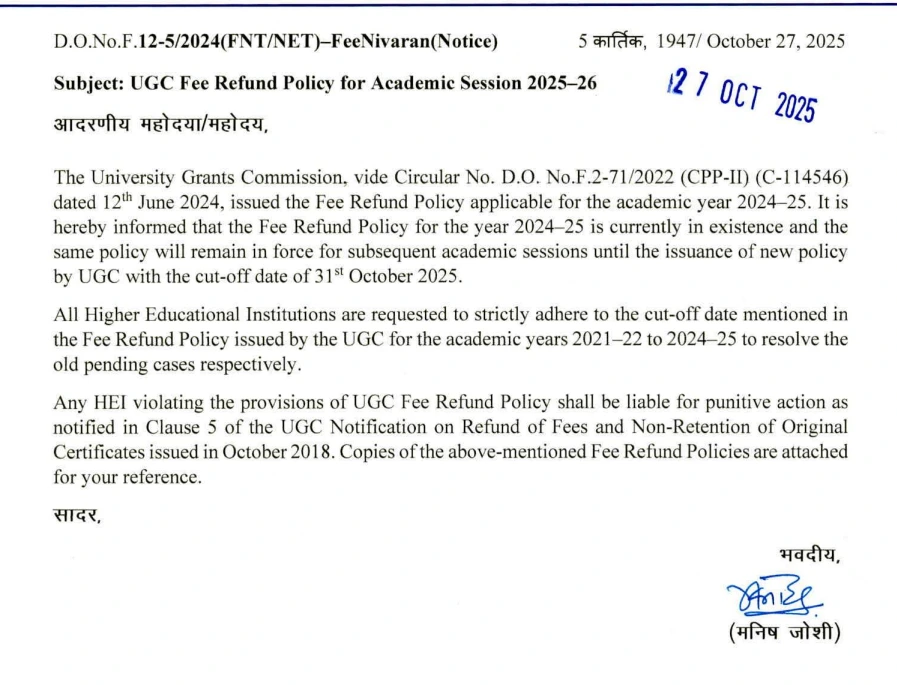
On 27 October 2025, UGC released the fee refund policy for the 2025-26 academic session. This policy will continue to apply to subsequent academic sessions until a new one is released. This article provides the UGC fee refund rules, who they apply to, and the exact process to claim your refund.
What is the UGC Fee Refund Policy?
The UGC fee refund policy exists because many students, over the years, faced difficulty getting their money back after cancelling or withdrawing their admissions. Colleges often relied on their own rules, which sometimes made it difficult for the learners to get a fair refund.
To solve this issue, the UGC issued a notification in October 2018 about “Refund of Fees and Non-Retention of Original Certificates." This notification laid down a standard refund slab that all institutions must follow. Since then, UGC has continued to reissue and reaffirm this policy for each academic session, most recently through its notice dated 27 October 2026 for the 2025-26 session. Any UGC-recognized institution can not ignore this policy or override it with its own rules.
Who Does This Policy Apply to?
This policy applies to most government and private colleges and universities in India, as long as they hold UGC recognition. If a student is admitted to such an institution and later cancels or migrates, the refund rules covered in this article apply to them.
The UGC fee refund policy applies to:
- All higher education institutions recognized under the University Grants Commission Act, 1956.
- Institutions established or incorporated by a Central Act or a State Act
- Every institution recognized by UGC under clause (f) of Section 2 of the Act.
- Deemed universities also fall under this policy.

Your career, our expertise - talk to a counsellor
UGC Fee Refund Rules: Complete Slab
The refund amount a student receives depends on when they submit their withdrawal request compared to the college’s official last date of admission. There are two parts to this rule, including a special early window for the current cycle and the standard slab that applies afterwards.
Early Window (Special Provision)
- If a student cancels or migrates by 30 September, they receive a full refund of fees, with no deduction.
- If a student cancels or migrates between 1 October and 31 October, they receive a full refund, minus a processing fee of no more than ₹1,000.
Standard Slab (Applicable After the Above Window)
If you choose to withdraw from the program, the institution shall follow the following five-tier system for the refund of the fee paid by you.
| S. No. | When a Withdrawal Notice is Received | Refund of Fees (in Percentage) |
| 1 | 15 days or more before the last date of admission | 100% (minus a processing charge of up to 5% of fees, maximum of ₹ 5,000) |
| 2 | Less than 15 days before the last date of admission | 90% |
| 3 | 15 days or less after the last date of admission | 80% |
| 4 | More than 15 days but not more than 30 days after the date of admission | 50% |
| 5 | More than 30 days after the last date of admission | No refund |
Note: All institutes must refund the fee to an eligible student within 15 days from the date of receiving a written application.
What Happens to Caution Money and Security Deposit?
Caution money and security deposit are treated separately from the regular fee structure under UGC rules. These amounts are not considered part of the “fees” that fall under the refund slab discussed above. Regardless of when a student withdraws or cancels their admission, their caution money and security deposit must be refunded in full.
Your career, our expertise - talk to a counsellor
How to Claim a Fee Refund? Check Step-by-Step Process
The process to submit their withdrawal request and claim a fee refund may vary by the institute. The common process to claim a fee refund is outlined below:
Step 1: Submit a Written Withdrawal Request
Write a formal application addressed to the college’s admission office, starting with your name, courses, and reason for withdrawal.
Step 2: Keep Proof of Submission
Submit the request in person and collect an acknowledgement with the date stamped, or send it by email so you have a record of when the institute received it. The application submission date decides which refund percentage category you are eligible for.
Step 3: Wait for the Refund
The institution is required to process and complete the refund within 15 days of receiving the request.
UGC Fee Refund Policy: Other Important Rules
Along with the refund slab, UGC’s notification also outlined a few other rules that protect students during the admission process.
No institution can retain original certificates.
Institutions cannot ask students to submit original academic or personal certificates, such as marksheets, passing certificates, or school leaving certificates, at the time of admission. Only self-attested copies are mandatory. If verification of original documents is required, the institution must verify them in the students’ presence and return them immediately.
The institutes cannot keep the original documents with themselves under any condition. If there is any doubt about a certificate’s authenticity, the institution can verify it with the issuing university or board, but the original certificate itself must not be retained.
Advance Fee Can Only Be Charged for One Semester or Year
Institutions are only allowed to charge fees in advance for the semester or year in which a student is currently studying. No institution can ask students to pay the entire program fee or more than one semester at a time.
Prospectus Purchase is Optional
No institution can make it mandatory for applicants to purchase the institutional prospectus. Students have the right to access the same information from the institution’s official website instead of buying the prospectus.
Disclosure Requirements for Institutions
Every institution must disclose certain information on its website and in its prospectus, including its accreditation status, course-wise sanctioned intake, total fees payable for the entire program, last date of admission, and details of faculty and governing body members. This is intended to help applicants make a fully informed choice before taking admission.
Your career, our expertise - talk to a counsellor
What If a College Does Not Follow the Policy?
If an institution fails to follow the UGC fee refund policy, it can face serious consequences. Under Clause 5 of the UGC notification, non-compliant institutions may face penalties such as withdrawal of their eligibility to receive UGC grants, being declared ineligible for future UGC assistance, and other punitive action as decided by the Commission.
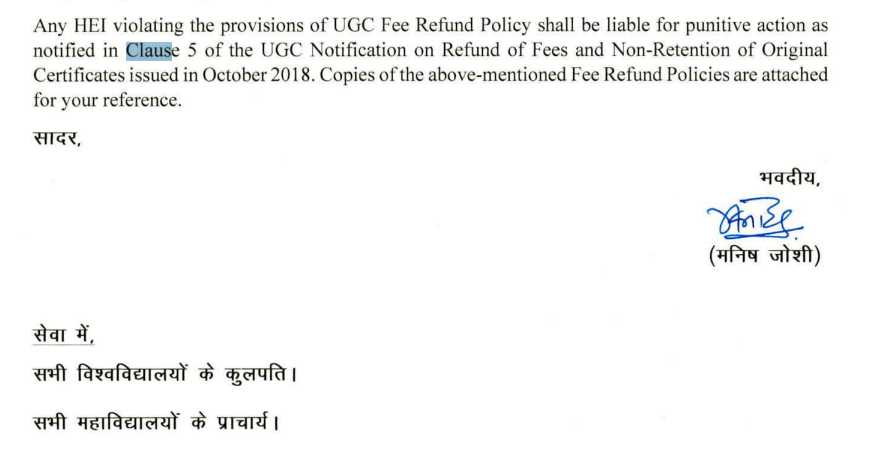
This makes the policy binding rather than just a recommendation, and institutions are expected to follow it strictly for every student who withdraws or cancels their admission.
Conclusion
The UGC fee refund policy protects learners from losing their money when they cancel or withdraw their admission from a recognized institution. The rules cover a clear refund slab based on timing, a full refund of caution money, a 15-working-day processing timeline, and protections around prospectus purchase, fee disclosure, advance fee collection, and certificate retention.
As of now, the policy is in effect as of 27 October 2025 for the 2025-26 academic year, since UGC has stated it will continue until a new policy is issued. Students and parents should keep this in mind and act within the specified timelines to ensure they receive the refund they are eligible for.
Frequently Asked Questions
The UGC fee refund rules for 2026 allow a full refund for withdrawals by 20 September, a refund with a maximum of a ₹ 1,000 deduction for withdrawals between 1 and 31 October, and a five-tier slab (100% to 0%) for withdrawals after that, based on the college’s admission last date.
Yes, you are entitled to a refund if you withdraw from a UGC-recognized institution. The exact amount depends on when you submit your withdrawal request relative to the college’s last date of admission, as per the refund slab.
No, the UGC fee refund policy has not been removed. The policy issued on 27 October 2025 is currently applicable and will continue to apply to the upcoming academic sessions until UGC issues a new circular.
Yes, caution money and security deposit are fully refundable regardless of when a student withdraws or cancels admission. These amounts are treated separately from regular fees and are not subject to the refund slab.
No, institutions are not allowed to keep original academic or personal certificates under any circumstances. Only self-attested copies are required at the time of admission, and originals must be returned immediately after verification.



Popular PG Programs
Trending UG Programs
Doctorate Programs
Executive Programs
Trending Online Universities
In Demand MBA Specializations
In Demand MCA Specializations
CollegeSathi aims to provide unbiased and precise information to aspirants, along with comparative guidance on universities and their programs. The content on the CollegeSathi website, including text, graphics, images, blogs, videos, and university logos, is meant for informational purposes only and should not be considered a substitute for official information provided by academic partners. While we make every effort to keep the information accurate and up to date, CollegeSathi does not guarantee the completeness or reliability of the content and is not responsible for any errors, omissions, or losses resulting from its use.
© CollegeSathi 2026. All Rights Reserved.