



Trending and High-Impact MBA Project Topics You Should Consider


MBA projects not only provide academic knowledge but also offer practical abilities for tackling real-world business questions. The suitable selection of an MBA project focus enables students to learn from practical experience, demonstrate their competence, and discover new career options. However, industry evolution creates overwhelming challenges for students when they select relevant and impactful topics for their projects.
For instance, what field should you investigate between AI marketing approaches, sustainable supply chain optimization, and financial threat evaluation? When selecting your MBA project, you should match the subject to emerging industry patterns and the professional goals you wish to achieve. Each MBA project must showcase critical thinking and analytical skills, regardless of being in tech, finance, marketing, HR operations, or entrepreneurship fields.
If you’re an MBA student, then the selection of a relevant MBA project topic will help you enhance both academic outcomes and create professional advantages in your future career. Hence, the following blog will take you through the major research project for MBA related to various specialties to help you select a topic that enhances both your academic endeavor and professional advancement.
How to Choose the Right MBA Project Topic?
Making the ideal selection regarding your MBA project topic stands as essential since it determines both your learning experience and the potential career direction. You need to evaluate multiple factors when selecting your project according to the following key elements:
Selecting the right MBA project topic is crucial, especially when working on your MBA final year project. Here are some key factors to consider:
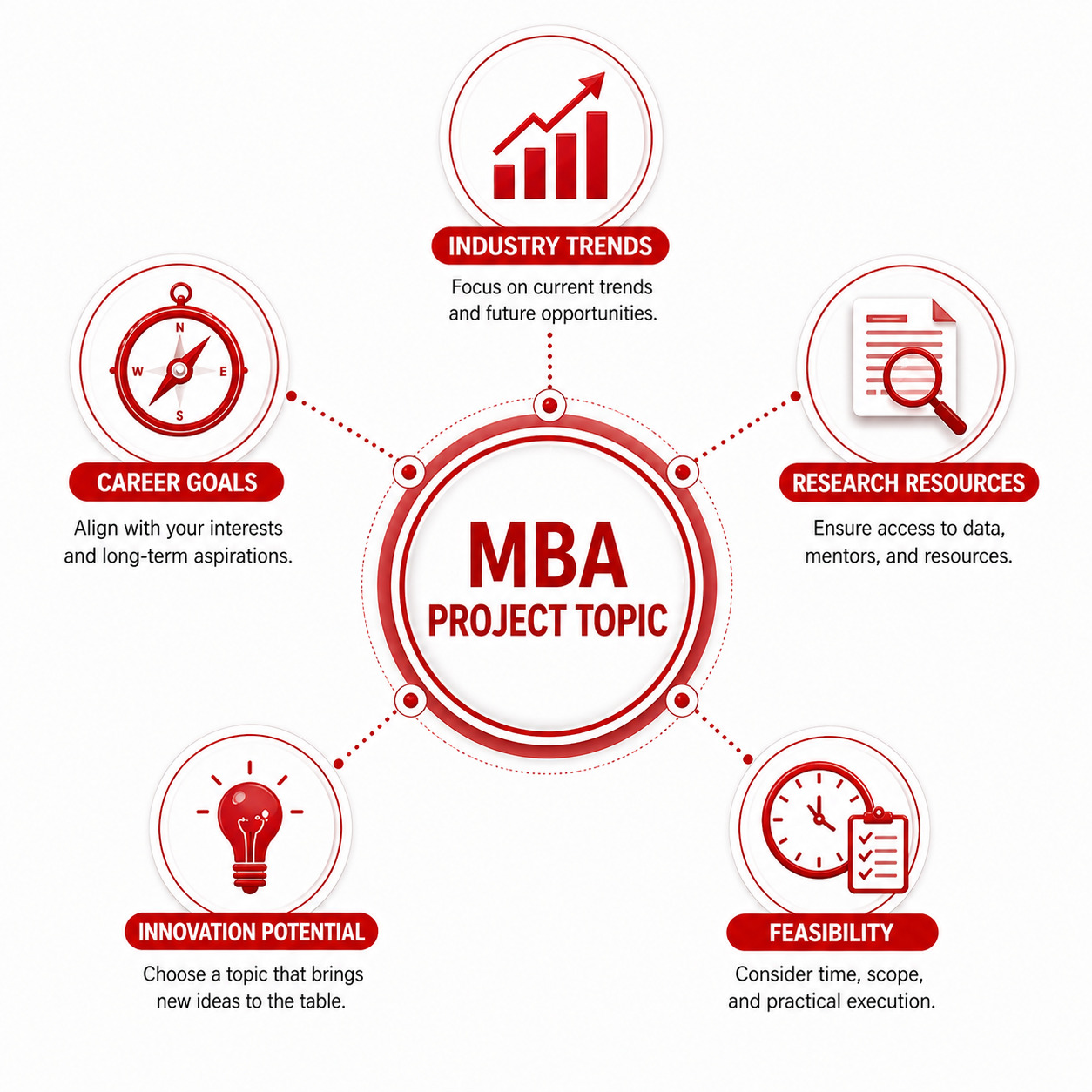
- Align with Your Interests and Career Goals – Your future career development requires picking an engaging topic that matches your professional aims. Investment analysis and risk management project-making ideas will be beneficial if you want to establish a career in finance. Digital branding and consumer behavior trends will suit you if marketing represents your real interest.
- Industry Relevance and Future Trends – Project topics for MBA students related to industrial challenges or upcoming industry trends are a good option. Your project stands to become more impactful by focusing on fields that include AI-driven marketing combined with sustainable business practices, as well as financial technology (FinTech).
- Availability of Data and Research Resources – The success of an MBA final year project topics depends on acquiring concrete research materials, together with actual industry data. Check that your selected MBA topic contains sufficient research materials, such as either firm case studies, published market reports, or academic documents.
- Scope for Innovation and Problem-Solving – Projects that propose innovative solutions or improve existing business strategies stand out. Consider a major research project for an MBA that allows you to apply critical thinking and analytical skills to solve practical business problems.
- Feasibility and Time Constraints – Some projects may be too complex or require resources that are difficult to access. Choose an MBA topic for your project that is manageable within the given timeframe while still offering depth and value.
Trending MBA Project Topics
If you are an MBA student looking for the top trending MBA project ideas, then here is a curated list designed for your online MBA subject needs and requirements.
1. Risk Assessment Models for Startups
Aim: This MBA project topic aims to build risk evaluation frameworks that examine startup financial challenges so investors, alongside business owners, can detect vulnerabilities and establish preventive measures.
Importance: Danger exists for startups mainly because they encounter uncertain markets and must contend with competitors while still facing limitations in resources. Business risk management enhances startup survivability while leading them to achieve better results.
Key Points:
- The first step involves recognizing crucial risk elements, which consist of market fluctuation, financial strength, managerial capabilities, and economic market fluctuations.
- Companies should develop risk models by combining statistical calculations and financial indicators that measure specific risks.
- As part of the study implementation phase, propose specific actions that will reduce identified risks.
2. Cryptocurrency and Its Impact on Global Finance
Aim: The research investigates how cryptocurrency affects conventional financial systems, particularly regarding the areas of investment activities, regulatory frameworks, and market instability.
Importance: This is one of the best MBA final year project topics. The financial world undergoes transformations due to the emerging cryptocurrency market. Business operators alongside investors gain advantages from understanding the cryptocurrency influence to make better decisions within the developing digital financial landscape.
Key Points:
- A market analysis reveals the effects that cryptocurrencies and their operations have on current financial markets.
- Investigate the regulatory issues and challenges surrounding digital currencies.
- Assess the role of cryptocurrencies in investment portfolios and their potential for long-term growth.
3. Consumer Behavior in E-Commerce vs. Traditional Retail
Aim: The MBA project topic aims to understand how purchasing patterns of consumers shift between electronic commerce stores and physical retail outlets.
Importance: It is vital as E-commerce growth requires businesses to understand shifting customer preferences because it determines their market competitiveness. This is one of the major research projects for an MBA if you want to make your career in the retail or E-Commerce field.
Key Points:
- The research investigates the impact that online factors have on consumer buying processes compared to traditional shopping venues.
- Behaviors between these shopping modes differ according to their circulation convenience levels, along with their sensitivity to pricing and their brand loyalties.
- Companies require advice about marketing approaches to succeed with both online and offline consumer groups.
4. AI-Driven Digital Marketing Strategies
Aim: The project on this topic will aim to explore how artificial intelligence is transforming digital marketing strategies, focusing on personalization and customer engagement.
Importance: AI-driven project topics for MBA students are one of the most trending ones these days. Artificial Intelligence increases the value of customer experiences, combined with marketing return on investment. The project makes it possible for organizations to understand AI utilization approaches that create targeted marketing campaigns based on data.
Key Points:
- Businesses should analyze the three main AI tools, composed of chatbots, predictive analytics, and automated content generation methods.
- The article describes how AI technology allows users to receive customized product recommendations followed by specifically directed ads.
- Research organizations that implemented effective AI-based marketing practices by examining their achievement in the field.
5. Diversity and Inclusion Strategies for Multinational Corporations
Aim: This project topic for MBA students explores multinational company D&I strategy implementation approaches in relation to their workplace cultural changes and performance results.
Importance: If you want to work in a non-tech field, then inclusion and diversity can act as a major research project for an MBA. Employee satisfaction, along with creativity and performance quality, improves through the implementation of workforce diversity alongside inclusive values. The studied project provides insights into how well discrimination and inclusion policies perform.
Key Points:
- An examination of what leads to successful D&I initiatives should be conducted by studying top companies.
- An examination should evaluate how Diversity and Inclusion programs create alignment between organizational objectives, employee satisfaction, retention, and productivity.
- The proposal includes multiple recommended D&I strategies that companies should implement.
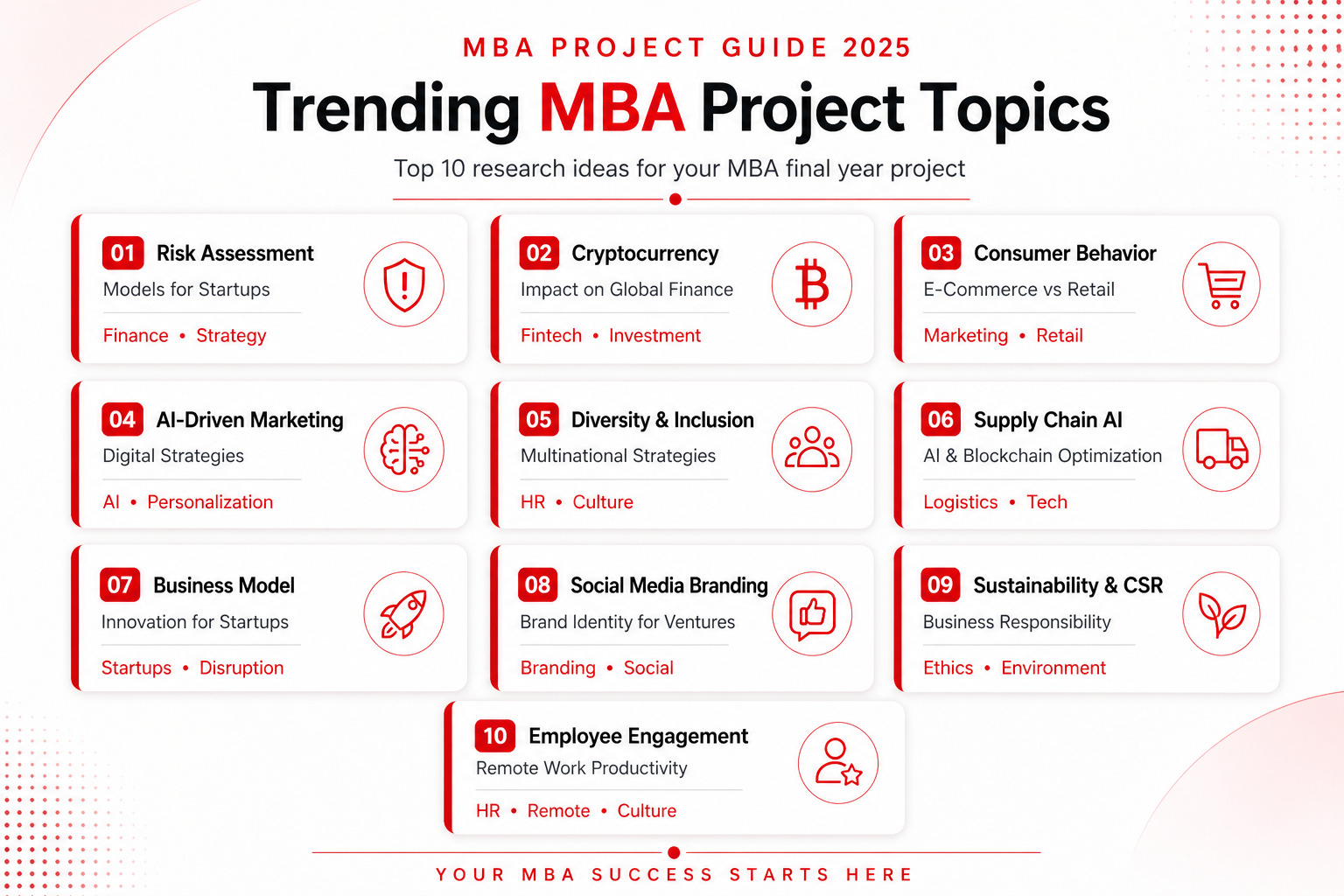
6. Supply Chain Optimisation Using AI and Blockchain
Aim: The main goal of this MBA project topic is to analyze the combination of AI with blockchain technology because it enhances supply chain management with improved transparency while reducing costs, along with higher efficiency.
Importance: The worldwide supply chain encounters several operational issues, such as delivery delays, together with both fraudulent activities and performance problems. The project presents ground-breaking approaches that increase supply chain operational effectiveness.
Key Points:
- The investigation evaluates AI candidates for their capacity to anticipate product requirements, direct delivery systems, and streamline stock management systems.
- Analyze how blockchain systems establish total transparency throughout supply chain orders through end-to-end traceability.
- Through analysis, identify ways to decrease costs with these technologies.
7. Business Model Innovation for Startups
Aim: This research aims to study contemporary startup business models to determine how disruptive approaches lead to successful challenges of traditional marketplace sectors.
Importance: If you are looking for a business innovation-related project making ideas, then this is one of the best among MBA final year project topics. Not only that, this project could be a good Business model innovation that serves as a fundamental requirement for startups to create market leadership and obtain success in competitive markets.
Key Points:
- An analysis of different business models must include the subscription-based model, freemium, and platform-based approaches.
- The examination of how startups challenge traditional industries takes place through the assessment of the fintech and healthtech sectors.
- Detailed success elements should be researched that lead to effective business model innovation.
8. The Role of Social Media in Building Brand Identity for New Ventures
Aim: The project making ideas aims to understand the methods through which startups develop brand identification on social platforms while interacting with their intended customers.
Importance: Social media presents startups with a strong medium to boost their brand recognition while promoting growth through sales and maintaining customer unwavering support.
Key Points:
- The selection of appropriate social media platforms requires an assessment of industrial needs and target market demographics for startups.
- Social media startups need to examine the approaches for developing original and genuine vocal expressions that will reflect their brand identity.
- The team should develop methods for engaging more customers while establishing brand communities.
9. Sustainable Business Practices and Corporate Social Responsibility (CSR)
Aim: This MBA project topic aims to discover methods which allow businesses to embed sustainability alongside CSR principles within their core operational strategies regardless of financial objectives.
Importance: In today's market, consumers, along with investors, expect ethical business behavior; companies need to implement sustainable practices to enhance their marketplace position as well as reputation.
Key Points:
- Business CSR Strategies explore company approaches of incorporating social responsibility practices that include environmental programs, local community outreach, and responsible sourcing.
- Companies should measure the extended effects that CSR programs create on customer retention and brand reputation, together with fiscal outcomes.
- How businesses should implement effective, measurable CSR strategies forms the core of this recommendation section.
10. Employee Engagement and Productivity in Remote Work Environments
Aim: The research aims to investigate remote work's influence on worker involvement levels, together with production output and organizational atmosphere, while suggesting measures to enhance these aspects.
Importance: The increase in remote work requires organizations to establish methods that maintain engaged employees who deliver productive work outside established office locations.
Key Points:
- Engagement Tools: Investigate tools and techniques for fostering employee engagement in a virtual setting, such as virtual team-building activities and communication platforms.
- Productivity Metrics: Productivity Metrics requires examination of remote work environment metrics for productivity measurement and identification of enhancement methods.
- Organizational Culture: Examine the challenges and solutions for maintaining a strong company culture in a remote work setup.

Your career, our expertise - talk to a counsellor
Key Steps to Execute Your MBA Project Effectively
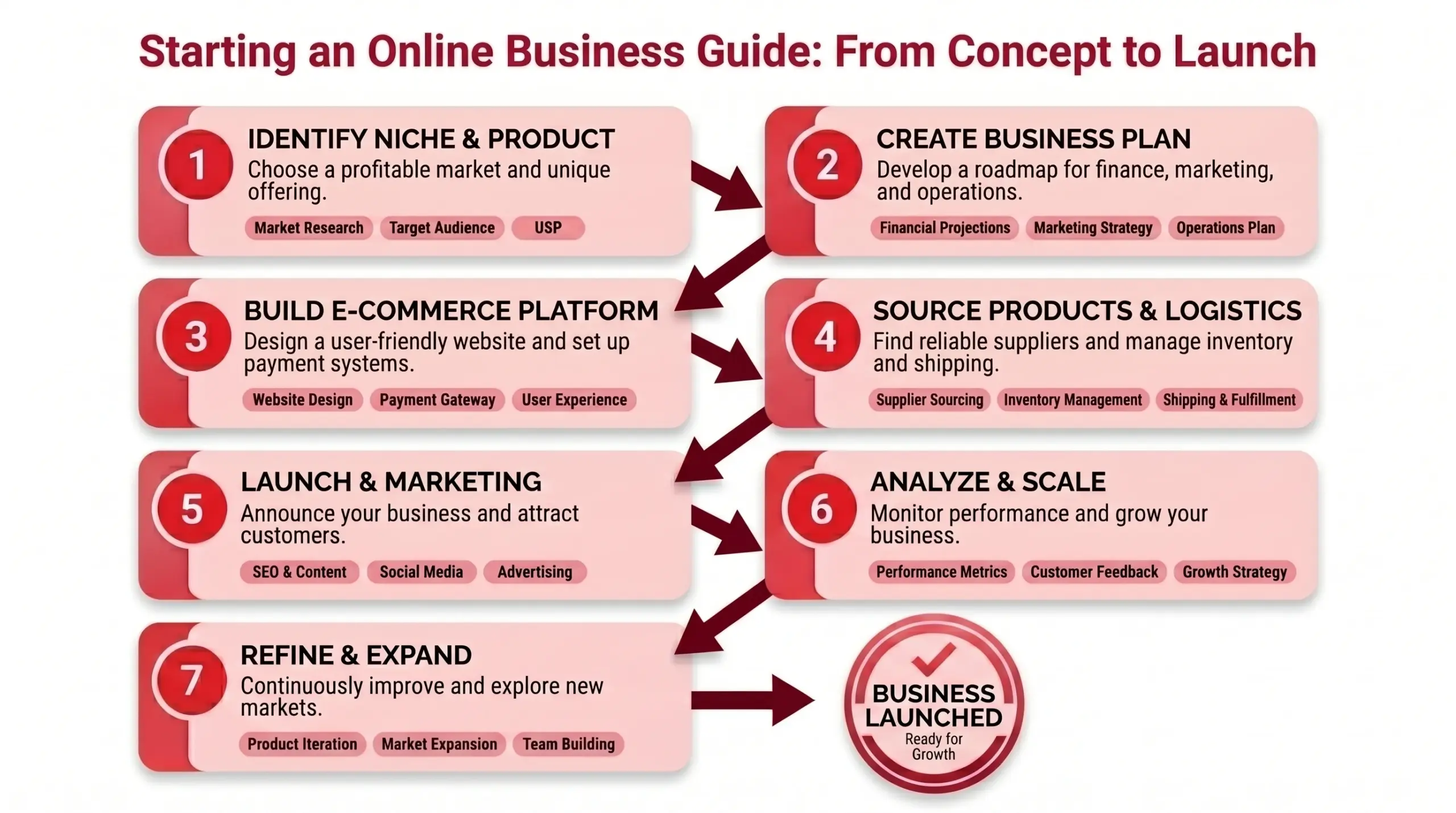
Strategic planning, combined with research and critical thinking, makes up the key requirements for executing an MBA project. The following step-by-step instructions will direct you through the entire project process.
- Select a Relevant Topic: The ideal MBA project topic unites your present academic interests with targets for your professional future. The topic must be applicable while providing opportunities for both academic research and practical applications. The topic must tackle modern business trends or challenges that exist in the present while addressing concrete opportunities. The project will achieve greater impact through a detailed selection of a specific research area rather than using broad subject matter.
- Conduct Thorough Research: The foundation of a successful MBA project requires adequate research at its starting point. Your research must encompass academic papers, together with industry reports and professional interviews, and case studies that supply quantitative and qualitative information. The systematic organization of your research requires creating a research log and results categorization alongside theme identification for project focus. The depth and credibility of your project depend heavily on this step, which must be implemented properly.
- Create a Clearer Research Question or Hypothesis: Your research enables you to formulate one definitive research question or hypothesis, which will direct the entire project. The central theme functions as your guiding principle to maintain direction throughout your work effort. The development of a good research question or hypothesis requires specific measurable traits, field relevance, and industry relevance for your subject of study. Your project’s achievable timeframe and available resources should support the feasibility of this goal.
- Develop Your Methodology: When you think about how you will collect, analyze, and interpret data, you are in the range of methodology. You need to select a research method for your topic (qualitative, quantitative, or mixed method), and think carefully about your methods because you want them to be rigorous and appropriate for your research question. You will need to determine if you are going to use summons, interviews, case studies, or secondary data analysis. You want to choose an approach that is aligned with ethical methods.
- Data Collection and Analysis: Data collection follows your methodology, outlining a process that, namely, will ensure it is valid and reliable. You want to take care to collect valid and useful data to help answer your research question. After data is collected, in order to analyze your data, you will want to systematically probe for patterns, trends, and insight into your topic. If necessary, formal statistical tools, software, or manual techniques can be employed as the analysis within this analysis stage. This is where the majority of your project becomes live evidence for your findings and conclusions.
- Draft the Report & Conclusions: After the data is analyzed, draft the report. It will tell, or show, information in a logical format that is easy to follow (introduction, methodology, analysis, results, conclusions). When drafting and writing the report make sure your arguments are informed and clear enough to connect the references from yesterday to the research question while being meaningful. Talk about the collections made from your research and produce conclusions, and make recommendations based on your research conclusions. Finally, reflect on the research findings and areas for research.
- Review and Revise: When you have finished your first draft, you will want to give yourself time to review and revise it. You will want to look for clarity, coherence, and logical progression. In addition, it is essential to see if there are gaps in the argument or research and address them. Once this is done, proofread for grammar, spelling, and format. It is also useful to receive feedback from colleagues, professors, or industry experts to ensure you have created the best possible project before it is due.
Common Challenges and How to Overcome Them
While you are working on your MBA project, you will likely run into some challenges. If you can identify and address any challenges early, it will allow you to stay on track with your project.
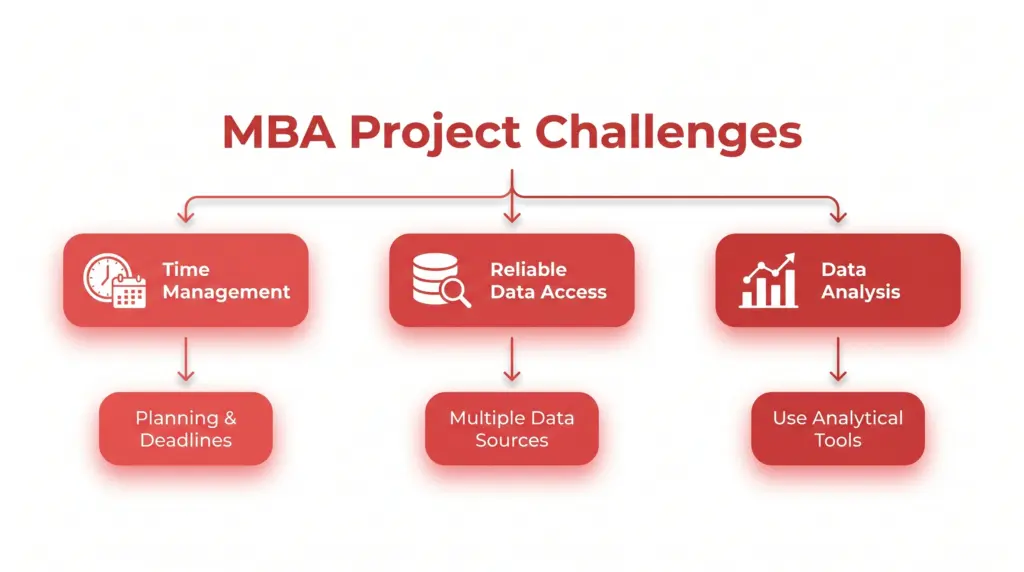
Here are some common challenges and suggestions about how to avoid or lessen their impact:
- Time Management: While you are working on your MBA project, the combination of your MBA project and personal responsibilities can become overwhelming or hectic. To reduce the amount of possible overwhelm, be specific about deadlines for each part of your project, such as research, analysis, writing, and revision, and try your best to stick to those deadlines. Also, try to break your work down into smaller tasks that are more manageable for you, and prioritize your tasks to achieve an effective balance between your school and personal responsibilities.
- Accessing Reliable Data: Finding reliable data can be challenging and time-consuming, especially for niche topics. Do not be afraid to speak to industry experts or, if applicable, complete interviews, although remember to be respectful of respondents' time. Moreover, if you feel that your academic database is not providing you with credible data, you might need to look at alternative data sources. Examples may include surveys, case studies, or observational studies.
- Challenges in Data Analysis: Data analysis is complicated, especially with large data sets. If you're struggling with data analysis, try using software tools like SPSS, Excel, or Tableau, or reach out to your professor or a data analyst for help.
Your career, our expertise - talk to a counsellor
Conclusion
To conclude, a good MBA project topic is essential to make the best use of your time while enrolled in your program. Whether you intend to explore finance, marketing, human resources, or an entrepreneurship pathway, all will offer the opportunity to develop new thoughts on current business trends and practical issues. The topics mentioned here examine a diverse array of industries while considering how you can transfer theory into practice.
If your final project captures your interests and work ambitions, you can take pleasure and value in your effort. Keep in mind, this is not simply about completing an assignment; it is about producing an interesting piece to demonstrate your critical thinking, problem-solving, and contributions to the industry based on your learning.
When performed with sincerity and authentic multifaceted learning, an MBA project can be a launching pad for a successful career. Hence, think wisely, plan to organize, and complete with certainty. For more expert guidance and support in choosing the right MBA path, you can rely on Collegesathi to help you make informed decisions for your future.
Frequently Asked Questions



Popular PG Programs
Trending UG Programs
Doctorate Programs
Executive Programs
Trending Online Universities
In Demand MBA Specializations
In Demand MCA Specializations
CollegeSathi aims to provide unbiased and precise information to aspirants, along with comparative guidance on universities and their programs. The content on the CollegeSathi website, including text, graphics, images, blogs, videos, and university logos, is meant for informational purposes only and should not be considered a substitute for official information provided by academic partners. While we make every effort to keep the information accurate and up to date, CollegeSathi does not guarantee the completeness or reliability of the content and is not responsible for any errors, omissions, or losses resulting from its use.
© CollegeSathi 2026. All Rights Reserved.