



Top 30 Most Common MBA Interview Questions & Answers 2026


The real reason is that most MBA candidates struggle in the interview room. It's not nervousness; it's the lack of preparation that turns into a problem.
They memorise generic answers. They rehearse scripts. And the moment an interviewer goes slightly off-script, the individual gets stuck.
This guide demonstrates the 30 most common MBA interview questions. With honest answers, you can figure out your path to your dream MBA college smoothly.
Before You Start: What MBA Interviewers Actually Want
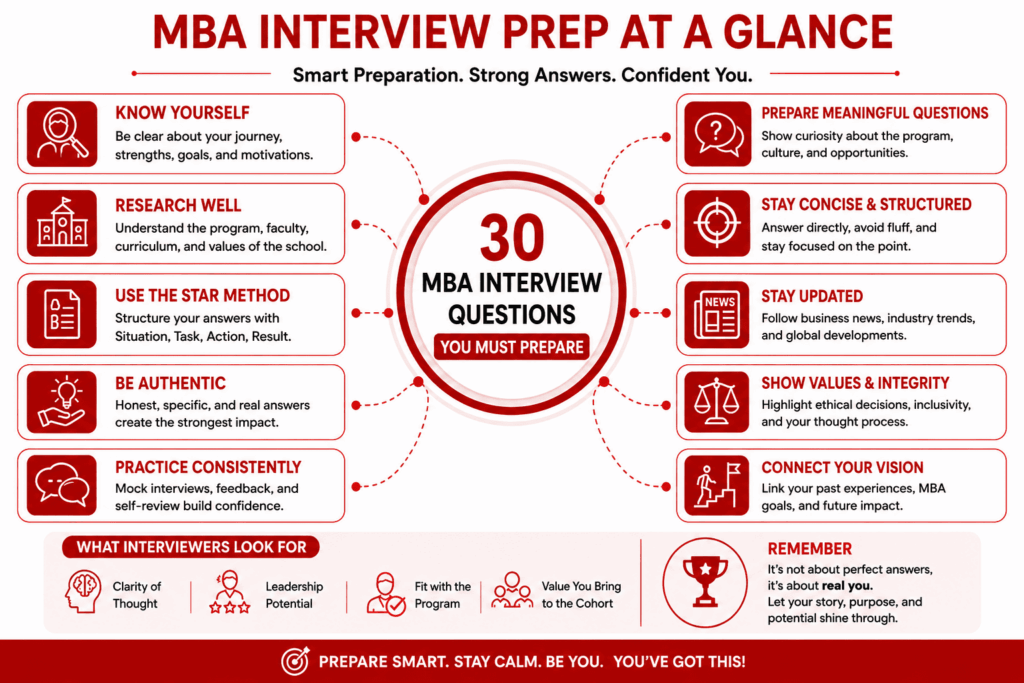
MBA interviewers aren't just evaluating your answers. They're assessing how you think.
Every question - whether it's about your strengths, your career goals, or a leadership experience is really asking: Can this person add intellectual and professional value to our university?
The best answers aren't the most impressive-sounding ones. They're the most authentic, specific, and structured ones. Use the STAR method - Situation, Task, Action, Result - for any story-based answer.
Section 1 - Expected MBA Interview Questions: (Questions 1-6)
These are the questions every MBA interview begins with. They seem easy at once, but don't underestimate them; they set the tone for everything that follows.
1. Tell Me About Yourself
What they're really asking: Can you tell your story in a systematic and logical way that leads naturally toward why you're sitting here?
How to answer: Think of this as your 2-minute pitch, not your autobiography. A strong structure looks like:
For example: "I grew up in [city], completed my [degree] from [college], and spent the last [X] years working in [industry]. In that time, I [specific achievement]. What drew me to pursue an MBA now is [reason for choosing MBA]. And I believe [this program] is the right place because [specific reason]."
What most people get wrong: They either go too far back ("I was born in Rajasthan...") or go too vague ("I've always been passionate about business"). Neither does it work; keep it clear; every sentence must become a point where the interviewer understands you better.
For MBA freshers specifically: If you don't have significant work experience, lean into your academic projects, internships, leadership roles in college, and what they revealed about your interests. Interviewers know you're a fresher; they want to see self-awareness, not a fake experience.
2. Why Do You Want to Pursue an MBA?
What they're really asking: Is this a meaningful decision, or are you just following the crowd?
How to answer: Follow this structured path for a better answer:
- The gap: What skills, knowledge, or network do you currently lack that's limiting your growth?
- The bridge: How does an MBA specifically fill that gap?
- The destination: Where does this take you - and why does it matter?
A satisfactory answer may look like:
"In my current role as a product manager, I've seen how business decisions are made from a technical lens, but I keep struggling when it comes to financial strategy and cross-functional leadership. An MBA will help me close that gap, specifically the ability to think in P&L terms and lead teams across functions. My goal is to eventually build products that are the combination of technology and healthcare, and I need that broader business knowledge to do it properly."
Common trap to avoid: Saying "I want to grow my network" or "for better career prospects." These are not wrong - they're common and weak. Explain your actual motive clearly.
Pro Tip - First explore the Online MBA program properly, so that you can identify your reason for pursuing this course.
3. Why Did You Choose This School/Program Specifically?
What they're really asking: Did you research us, or is this just your backup?
The golden rule here- Be specific.
Don't say: "Your faculty is world-class and the alumni network is strong."
Do say: "I specifically looked into your MBA's focus on sustainable business. Professor [Name]'s research on ESG investing aligns directly with what I'm working toward. And the [specific club or initiative] on campus is exactly the community I want to contribute to."
Spend real time exploring the university and its features -If you're still shortlisting, check the guide on Top Online MBA Colleges in India 2026, which breaks down programs by specialisation and placement record.
4. Walk Me Through Your Resume
What they're really asking: Can you connect the dots of your career into a reasonable narrative? Have you meant what you have listed in the resume?
This is different from "tell me about yourself." Here, they want you to own every line on that resume- not just recite it. Interviewers want to see if you really have those skills or experience, or if it’s just listed on the resume.
What works: Highlighting transitions. Why did you move from role A to role B? What did each step teach you, and how does it all lead logically to an MBA?
What doesn't work: Reading your resume aloud chronologically. They have it in front of them.
5. What Are Your Short-Term and Long-Term Career Goals?
What they're really asking: Have you thought seriously about your future, and does this MBA fit into that plan?
A framework that works:
Short-term (2–3 years post-MBA): "I want to move into [specific role] at a [specific type of company], where I can apply [specific skills from the MBA]." Long-term (5–10 years): "I aspire to [broader ambition- a leadership role, an entrepreneurial venture, a social impact mission]."
For MBA freshers: It's okay if your long-term goal feels ambitious or even uncertain. Admissions committees appreciate intellectual honesty. Say: "My long-term vision is still evolving, but what I'm certain about is [your clear goal]. The MBA is what will help me discover and refine that path."
6. What Are Your Strengths and Weaknesses?
This is the classic question. And still one of the most mishandled ones.
Strengths: Don't just list adjectives. Give a specific example for each of your strengths. "I'm a strong communicator" means nothing without the story to prove it.
Weaknesses - it’s the real approach: This is where most people fumble. They either go fake ("I'm a perfectionist!" - no one is impressed) or go dangerously honest ("I struggle with deadlines").
The right move: choose an actual weakness that isn't core to the MBA or your chosen career, show self-awareness about it, and demonstrate that you're actively working on it.
"I've struggled with delegating tasks, especially on high-stakes projects. I tend to want to manage things myself because I care deeply about quality. But I've been actively working on this - I recently led a team of five for a product launch where I had to force myself to step back, set clear expectations, and trust my teammates. It was a shift in mindset, and I'm still working on that."

Your career, our expertise - talk to a counsellor
Section 2 - Behavioural Questions (Questions 7–14)
These questions show how you can handle different situations at different points in time.
7. Tell Me About a Time You Showed Leadership
Leadership doesn't require a title or a senior position. It requires initiative, influence, and accountability.
What to avoid: Generic claims like "I'm a natural leader." Tell a story.
Use a STAR structure here: Describe a moment when your team was directionless, underperforming, or facing a tough challenge. What did you specifically do - not what the team did? What was the measurable result?
Extra credit: Show that your leadership style is adaptive. Did you lead through persuasion, through structure, through empathy? The best leaders know which tool to use when.
8. Describe a Time You Worked in a Team Under Pressure
What they're evaluating: How do you perform when conditions aren't ideal?
The best answers here show collaboration under stress – how you actively helped the team to cope with the situation.
What to Mention - what made it stressful, your specific contribution, how you navigated disagreement or resolved bottlenecks, and what the outcome was.
9. Tell Me About a Conflict You Had With a Colleague — And How You Resolved It
The trap: Saying you've never had a conflict (unbelievable) or making the other person the villain (red flag).
What works: A story where you show that you can hold your ground and remain open to the other person's perspective. The resolution should come through proper communication, not through one-sided action.
10. Give Me an Example of a Time You Failed
This question makes you unique from those who have just learned the scripts.
What interviewers want: Not that you failed, everyone does, but what you learned from it and how you applied that learning.
Share an honest incident here. Don’t try to show the non-failure story to a failure story.
11. How Would Your Manager or Colleagues Describe You?
Pro tip for MBA interview preparation: Think about what your recommendation letters say. Your answer here should be consistent with what you've asked others to say about you. If there's a gap, acknowledge it; interviewers appreciate self-awareness over a perfect image.
12. Have You Ever Had to Influence Someone Without Direct Authority?
This is a test of your leadership skills - critical in MBA environments and post-MBA careers.
Tell a story where you convinced a peer, a senior colleague, or a stakeholder without being able to simply instruct them. What was your approach? Data? Relationship? Framing?
13. Tell Me About a Time You Took a Risk
What they're evaluating: Are you someone who always plays it safe - or can you analyse uncertainty and act decisively?
The risk doesn't have to be enormous. What matters is showing that you calculated the consequences, made a judgment call, and owned the outcome - whether it paid off or not.
14. Describe a Situation Where You Had to Adapt Quickly to Change
Adapting is now becoming a necessity in the workplace. Especially after the pandemic, when everyone must adapt to technology and different work environments.
If you experienced a meaningful change during COVID-19 - a business model shift, a sudden role, or remote leadership challenges. You can mention it in this question.
Section 3 - Insight Questions (Questions 15–20)
Your answers reflect whether you researched your goals or are just guessing.
15. What's Happening in the Industry You Want to Work In?
Don't walk into any MBA interview without being able to speak fluently about current trends in your target industry.
In 2026, themes cutting across industries include: AI adoption and workforce disruption, ESG and sustainability mandates, supply chain resilience post-pandemic, geopolitical tensions affecting global trade, and the rise of creator and platform economies.
Know at least two or three specific developments in your industry and have a point of view on them.
16. How Do You Stay Current With Business Trends?
Have an honest answer. Mention specific publications, podcasts, newsletters, or communities. The Economic Times, Harvard Business Review, Bloomberg, Mint, Finshots, and specific industry reports are all fair games.
But don't stop at listing sources - share something you recently read and what you took away from it. That's what shows your curiosity.
17. Tell Me About a Business You Admire and Why
Go beyond the obvious answers (Amazon, Apple, Tesla). Pick a company you've thought about seriously - ideally one connected to your career goals.
Break it down: business model, competitive moat, culture, recent strategic move you found smart or surprising. Validate your answer with at least two specific and verifiable facts about your company. Show your analytical thinking.
18. What Are the Biggest Challenges Facing Business Leaders Today?
Many people start listing problems here. The interviewer does not want that; he just wants to know how aware you are and how broadly you think.
You can mention one of these issues which resonates with your area of business:
- Managing AI integration while protecting jobs and culture
- Navigating ESG pressures from investors and regulators
- Leading diverse, hybrid, or remote-first teams
- Building trust in an era of data privacy concerns
Pick one or two you care about and offer a perspective. You must show a clear point of view, not a mere definition.
19. How Would You Handle Making a High-Stakes Decision With Limited Information?
This evaluates your comfort with ambiguity, which is a core MBA competency.
The answer that works describes a framework (gather available data, identify the key unknowns, assess risk of inaction vs action, make a time-bound call, remain open to course correction). Then illustrate with a real or hypothetical scenario.
20. What Does Success Look Like to You?
Your answer reflects how you make small achievements and failures.
Weak answer: "Success means making a lot of money and being at the top."
Stronger answers: "Success for me means building something - a team, a product, or a policy, which improves how people work or live. Financial stability matters, and I don't want to underestimate that, but I'll be proudest when I’m able to influence and build an effective team.”
Your career, our expertise - talk to a counsellor
Section 4: Motivations, Values, and Self-Awareness (Questions 21–26)
21. Why Do You Want an MBA Now - Rather Than Later?
The question is asked to know whether you've thought seriously about the opportunity cost of two years out of the workforce.
Good answer: "I've spent three years building hands-on skills in [field] and reached the point where I know what I can’t do without the formal training, strategic perspective, and network that an MBA offers. Waiting longer means delaying the kind of leadership roles I want to be in by 35."
22. Where Do You See Yourself in 5 Years?
Give a realistic answer. The interviewer isn't holding you to this - they're evaluating your ambition, direction, and self-awareness.
Good answer: “I’m currently working as [Job Position], and this MBA program will help me gain advanced skills in this niche. In the coming 5 years, I see myself working at [Company Name] in a senior role.”
23. What Will You Contribute to This MBA Program?
Think about: your unique industry background, cultural or geographic perspective, specific skill set, leadership experience, or passion that the cohort doesn't already have enough of. What gap do you fill?
24. Tell Me About a Passion Outside of Work
MBA programs want well-rounded human beings, not one-dimensional career aspirants. Tell your real interests like - a sport, a creative pursuit, a community involvement, a side project.
The best answer would be connecting your passion to a value or quality that makes you a better professional.
25. What's the Most Impactful Book, Course, or Experience That Shaped Your Thinking?
A good answer includes a specific name which helped you in reflecting. Don't say "The 7 Habits of Highly Effective People" unless you have something meaningful to say about it.
26. How Do You Handle Stress and Work-Life Balance?
Especially relevant in 2026, when burnout is openly discussed, and MBA programs increasingly care about student mental health.
Be honest. Describe what works for you - exercise, boundaries, a creative outlet, a support system.
For Example, I used to work hard and still missed my deadlines. I wasn't sleeping well, I was making small errors I'd normally catch, and I was irritable in meetings. That was the point when I acknowledged it. Now, I've learned to recognise when I'm working hard versus just staying busy. I go for a run three times a week, no matter how busy things get and prioritise my mental health. I’ve not mastered it, but I’m still working.
Section 5: Ethics, Diversity, and Forward-Looking Questions (Questions 27–30)
27. Describe a Time You Faced an Ethical Dilemma at Work
This question requires an honest answer, where you face an ethical dilemma at work, and how you get over it.
Pick a situation where the right path was clear in but difficult in the moment. Show that you can identify ethical stakes, consult the right people, and act with integrity even when it's costly.
28. What Does Diversity and Inclusion Mean to You?
This isn't a politically correct checkbox question. Admissions committees, especially at global programs, genuinely care about whether you'll contribute to and benefit from a diverse learning environment.
Speak from experience: a team where different perspectives changed your thinking, a bias you've had to unlearn, or a community you've worked to make more inclusive.
For example -
“During a college project, I was paired with a northeast girl whose approach to problem-solving was different from mine. She prefers researching and talking to people, whereas I prefer to work fast and individually to meet the deadline. First, I thought she was not as interested as me but later her approach helped us to deliver a better project. This incident clearly taught me that I need to think that my approach is the only right one and not neglect others. Since then, I started discussing things with the team and tried to understand everyone’s approach.”
29. How Do You Think AI and Technology Will Impact Your Industry in the Next Decade?
This shows whether you’ve researched properly and are ready to implement change when required.
Pick your industry, identify two or three specific ways AI is already reshaping it, and emphasise where human value is still needed. Show that you're not afraid of the disruption - you're actively thinking about how to navigate and lead through it.
30. Do You Have Any Questions for Us?
Many people mistake it for the end of the interview. This question plays a huge role in your overall performance.
Asking no questions signals low interest. Asking generic questions shows fake curiosity.
Ask things you want to know about the cohort culture, a specific professor's research, how alumni are navigating a particular industry shift, or how the program is evolving in response to the changing job market.
Examples of strong questions:
- “How are students from different work backgrounds changing MBA classrooms in the university?”
- "What does the school do to support students who want to start their own ventures during or immediately after the program?"
● "How are faculty engaging with AI in the curriculum - both as a tool and as a topic of study?"
Your career, our expertise - talk to a counsellor
Tips for MBA Interview Preparation
Before we wrap up, here's a checklist to prepare you within minutes:
For preparation:
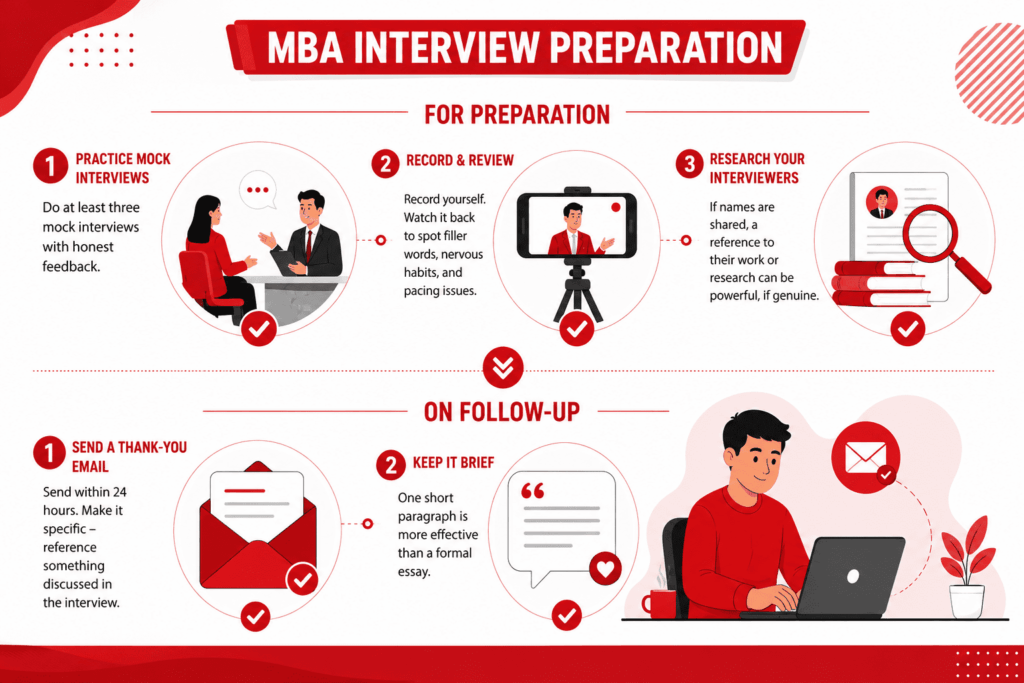
- Mock interview at least three times before the real one - with someone who'll give you honest feedback
- Record yourself. Watch it back. You'll spot filler words, nervous habits, and pacing issues you can't notice in the moment.
- Research your interviewers; if their names are shared, a reference to their work or research can be powerful, if genuine.
On follow-up:
- Send a thank-you email within 24 hours. Make it specific - reference something discussed in the interview
- Keep it brief. One short paragraph is more effective than a formal essay
Final Verdict: What Separates Good Answers From Great Ones
Every person walking into that room has a resume. Many have impressive ones.
The candidates who stand out aren't the ones with the most rehearsed answers. They're the ones who've done the inner work - who can tell the story of their journey with clarity, own their failures without flinching, and articulate a vision for their future that feels earned rather than performed.
Use this guide not as a script, but as a mirror. The best MBA interview questions and answers aren't the ones you copy. They're the ones that emerge from an actual reflection on your own experience, values, and direction.
Frequently Asked Questions
To pass the MBA interview, one must have clarity of mind and must be honest in his/her replies. Interviewers need to know about a candidate's career goals, personality, communication skills, and rationale behind choosing an MBA program. Rather than trying to remember answers, try to think of practical experiences, which may be related to an academic field, a professional field, or even personal life.
To prepare for MBA interviews, you first need to have a proper knowledge of yourself. This includes your resume and other aspects such as educational background, achievements, and career goals. Research MBA programs in detail and try to frame answers for various interview questions.
The toughest MBA interview questions are usually behavioural and self-awareness-based. Questions like “What is your weakness?” “Tell me about a failure,” “Why MBA?” or “Why should we select you?” to test your honesty, maturity, and ability to reflect on your experiences.
Avoid speaking negatively about former employers, blaming others for failures, giving extremely vague answers, or saying “I don’t have any weaknesses.” Also, never end the interview by saying “I don’t have any questions,” as it can make you appear uninterested.
The common MBA interview questions are "Tell me about yourself", "Why MBA? Why this school?", "Tell me about a failure or leadership experience," and the important closing question - Do you have any questions for us?"



Popular PG Programs
Trending UG Programs
Doctorate Programs
Executive Programs
Trending Online Universities
In Demand MBA Specializations
In Demand MCA Specializations
CollegeSathi aims to provide unbiased and precise information to aspirants, along with comparative guidance on universities and their programs. The content on the CollegeSathi website, including text, graphics, images, blogs, videos, and university logos, is meant for informational purposes only and should not be considered a substitute for official information provided by academic partners. While we make every effort to keep the information accurate and up to date, CollegeSathi does not guarantee the completeness or reliability of the content and is not responsible for any errors, omissions, or losses resulting from its use.
© CollegeSathi 2026. All Rights Reserved.