



Top Courses for Global Opportunities and Career Advancement after an MBA


One of the most significant career milestones is earning an MBA degree. However, the question is what comes next? Individuals are continuously searching for the best professional courses, best courses after an MBA in human resources or finance. These specialized programs can help them stand out in the competitive job market of today. Additionally, candidates with advanced skills in fields of operations, financial analytics, digital leadership, and global strategy are in high demand by employers.
Post-MBA programs increase earning potential and career prospects in addition to improving expertise. These courses are extremely valuable because those who pursue the best programs after earning an MBA frequently receive high-income roles. Choosing the right highly paid MBA programs will allow you to hone your abilities and grab opportunities that fit your professional objectives.
In this blog, we will discuss the top ten courses after an MBA that can help you advance your career and stay ahead in a business environment that is changing quickly.
Why pursue a professional program after an MBA?
Leadership and strategic skills are no longer the only criteria that are to define management roles in the quickly changing business environment of today. The use of technologies like automation and AI in business sectors has increased the demand for managers who can handle both business and technological challenges. Although an MBA gives professionals a general grasp of business operations, it frequently leaves gaps in specific technical or domain knowledge.
This gap is filled by enrolling in a certification program of MBA. This allows individuals to learn more in-depth information about topics like financial modeling, supply chain optimization, and data analytics. These professional courses after an MBA allow you to switch between fields without having to start from scratch, such as switching from finance to business analytics. The program helps people make better decisions and stay competitive in a global marketplace, and advance to leadership positions more quickly.

How to choose the right professional course after an MBA?
The professional program after an MBA should be in line with your long-term career objectives. Therefore, choose a program that suits your professional goals rather than just the ongoing trend. Here are some of the important factors before pursuing a highly paid program after an MBA:
- Career Alignment: Determine your goal, whether you are looking to advance into leadership positions or change to a different field. The decision to pursue a professional program after an MBA should align with your career objectives.
- Industry Relevance: Employers are seeking professionals equipped with in-demand industry skills like AI, finance, consulting, etc. Hence, choose professional programs that provide hands-on experience with in-demand industry skills.
- Program Format: Before selecting a program, check out whether a program is being delivered in online, offline, or hybrid format. This allows you to pursue a highly paid MBA program without putting your commitments on hold.
- Accreditation: Recognitions of the platforms symbolize the credibility of the program, leading to better career outcomes. Therefore, always check for the accreditations of the university or Edtech platform you are about to pursue a program from.
- Learning Style: Determine if you are more interested in practical certifications that emphasize hands-on skills, like PMP, CFA, or Six Sigma, or in structured academic learning, like a doctorate in business administration or an MBA specialization.

Your career, our expertise - talk to a counsellor
Top 10 highly paid programs after an MBA
There are a number of options that can improve your profile, lead to international opportunities, and develop domain-specific skills. You can choose from these programs depending on your career goals, be it in the academic, corporate, or entrepreneurial sector. Some of the most popular programs from different sectors are listed below for you:
Programs for Finance and Investment Professionals
1. Chartered Financial Analyst (CFA)
The Chartered Financial Analyst (CFA) program is among the most prestigious online certifications in finance. It is recognized globally by investment banks, asset management firms, and consulting companies. This professional course, after an MBA in finance, is especially suited for professionals aiming for roles in equity research, portfolio management, and investment strategy.
The CFA curriculum covers a wide range of financial topics like ethical standards, quantitative methods, and economics. It also focuses on key areas of financial reporting and portfolio management. The CFA can be completed in two to three years after an MBA in finance, and requires commitment as it offers enormous career benefits. Depending on their role and level of experience, CFA professionals in India can earn between ₹10 and ₹20 LPA or more. In addition to financial savvy, it also equips individuals with the analytical accuracy and moral self-discipline that are crucial in international finance.

2. Financial Risk Manager (FRM)
This is one of the most demanded and prestigious online certification programs for risk management professionals and is granted by GARP. It is beneficial for people who wish to become proficient in identifying and reducing financial risks in corporations, banks, and investment firms. The key areas of focus for this high-paying program post-MBA include quantitative analysis, operational risk, credit risk, and market risk.
It can be finished in one to two years and consists of two exam levels. Professionals with an FRM certification are highly valued across industriesand can choose to work as financial consultants, treasury managers, or risk analysts. This professional course, after an MBA in finance, offers the most profitable career paths for graduates interested in risk and compliance. The demand for FRM-certified professionals is constantly growing due to increased regulatory scrutiny and market volatility.

3. Certified Management Accountant (CMA)
The Institute of Management Accountants (IMA, USA) offers the Certified Management Accountant (CMA) online certification program. It is designed for professionals who want to integrate managerial decision-making with their knowledge of finance. The program emphasizes internal auditing, cost control, performance management, and financial planning. These skills are essential for senior positions such as business analyst, finance controller, or CFO.
The online certification post-MBA can be completed in 12 to 18 months by qualifying for two tests. The CMA certification is widely accepted and provides access to corporate finance and strategic planning departments in multinational firms. It is especially beneficial for MBA finance graduates looking for a combination of strategic insight and accounting accuracy for leadership positions.

4. Certificate Program in Business Analytics (CBA)
In today's decision-making process, business analytics has become an essential criterion. MBA professionals interested in learning data-driven business insights can enroll in an Online Certificate Program in Business Analytics. This professional, high-paying course is provided by organizations such as international universities and IIMs. They give you training in predictive modeling, machine learning, and data visualization.
The curriculum of the program combines case-based applications in finance and operations. After earning this online certification, MBA professionals can promote evidence-based strategies in organizations and develop their analytical thinking. This online certification after MBA operations increases opportunities across industries, as data analytics is becoming essential to all business operations.

Academic and Research Programs
1. Doctor of Business Administration (DBA)
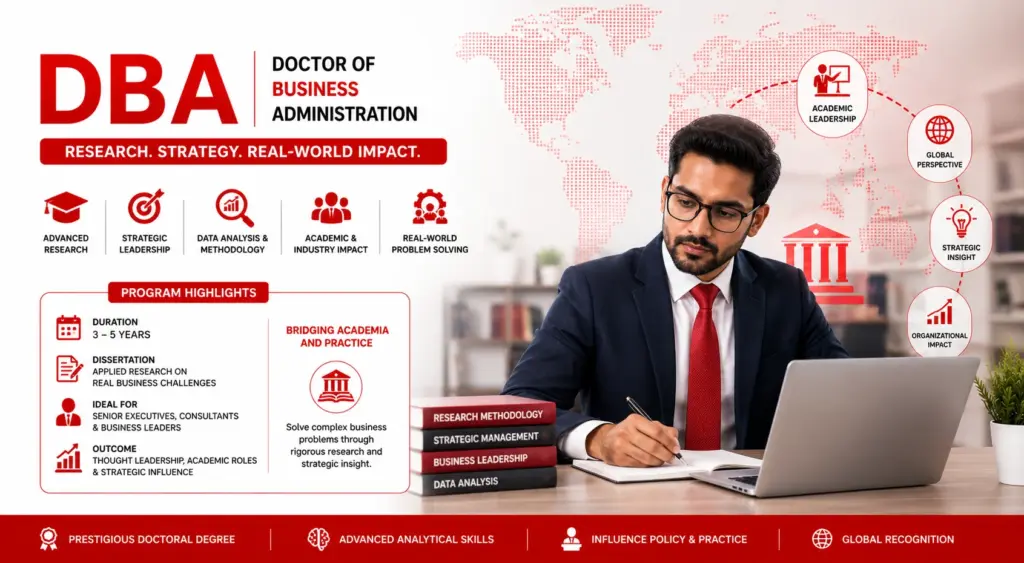
This top program post-MBA is for professionals who want to combine academic research with management practice. A Doctor of Business Administration places more emphasis on using applied research to solve real-world business problems than a traditional Ph.D., which is solely focused on theory and publication. The highly paid post-MBA program is especially good for senior executives or corporate strategists who wish to teach at prestigious universities or influence organizational policy.
Students study research methodology, data analysis, and leadership strategy over the course of three to five years, which ends in a dissertation that tackles current business issues. Graduates of the DBA program are positioned as thought leaders who can bridge the gap between academia and practice while improving their analytical and decision-making skills.
2. Doctor of Philosophy (PhD) in Management
This course, after an MBA, is beneficial for students who wish to work in academia or research. It emphasizes original research, publications, and theoretical contributions to business and management science and is extremely meticulous. You’ll gain the skills necessary to carry out independent research by exploring topics such as economics, organizational behavior, quantitative methods, and much more.
The program after an MBA lasts four to six years, and prepares you for high-paying jobs such as professors, policy advisors, or researchers in international organizations and think tanks. Unlike an MBA's managerial focus, a Ph.D. in management prepares inquiry and evidence-based thinkers who influence management theory and have a high impact on educational frameworks.

3. Post Graduate Diploma in Management (PGDM)
This high-paying professional program after an MBA is good for graduates looking to hone their abilities in a particular field, like marketing, human resources, operations, or finance. It is offered by many autonomous institutions approved by AICTE. PGDM programs are flexible and align with in-demand industry skills and trends.
Unlike traditional degrees, these highly paid programs incorporate more industry-based projects, case studies, and internships to give students real-world experience. If you are looking to gain advanced knowledge or specialize in a new field without committing to long-term academic research, PGDM is your calling.

Programs for Project and Operations Management
1. Project Management Professional (PMP)
One of the most highly regarded online certifications for project managers worldwide is the Project Management Professional, which is offered by the Project Management Institute. This high-paying course after an MBA program validates your proficiency in managing and steering projects in a variety of sectors. These sectors include manufacturing, healthcare, IT, and construction. PMP online certification focuses on key areas of business operations such as planning, budgeting, quality control, and stakeholders’ communication.
This online certification can be completed in a few months and gives you hands-on experience in project management. PMP-certified professionals are highly valued across the management industry because of their ability to complete projects on schedule and within budget. They can earn salaries between ₹12 and 25 LPA. PMP offers a structured route to excellence for MBA graduates who want to lead in operations or consulting.
2. Lean Six Sigma Certification (Black Belt/Green Belt)
Lean sigma six online certifications, especially Green Belt and black Belt, are designed to improve the process and operational efficiency. Six Sigma teaches individuals about the data-driven approaches that assist businesses in cutting waste, minimizing mistakes, and increasing output. Black Belt certification is for individuals overseeing quality initiatives or managing intricate improvement projects, while Green Belt certification is appropriate for mid-level professionals.
This certification, after MBA, equips individuals with performance measurement methods, statistical tools, and DMAIC (Define, Measure, Analyze, Improve, Control) frameworks. Professionals with Six Sigma certification are in high demand in the logistics, IT, healthcare, and manufacturing industries. Gaining proficiency in Six Sigma enhances an MBA graduate's analytical and leadership skills as well as their qualifications for positions involving operations and process excellence.
Program for Global Business & Entrepreneurial Roles
1. Executive MBA
This specialized program, after an MBA, is for professionals, at the mid-level or senior-level, who want to improve their leadership and global management skills. These programs are offered by well-known B-schools like INSEAD, ISB, and include executive coaching, cross-border projects, and international residencies. You’ll gain knowledge of innovation leadership, digital transformation, and cross-cultural negotiation.
Executives pursuing this online MBA programcan continue working while enrolled, and it can be completed in 12 to 18 months. A Global Executive MBA is more than just a degree; it's a life-changing experience that broadens perspectives and builds networks, preparing graduates for global consulting or C-suite positions.
Comparison at a glance
| Program | Duration | Ideal For Candidates | Average Salary |
| Chartered Financial Analyst | 2-3 years | Those having an MBA in finance & wanting to work in investment banking or portfolio management | ₹10–20 LPA+ |
| Financial Risk Manager | 1-2 years | Graduates of MBA programs aiming for positions in risk, compliance, or treasury | ₹12–22 LPA |
| Certified Management Accountant | 1-2 years | Professionals hoping to work as CFOs or finance controllers | ₹10–18 LPA |
| Certificate Program in Business Analytics | 6-12 months | Operations and marketing MBA graduates looking for positions requiring data-driven decision-making | ₹9–20 LPA |
| Doctor of Business Administration | 3-5 years | Senior executives or strategists making the move to academia or policymaking | ₹20–35 LPA |
| PhD in Management | 3-5 years | MBA graduates with an academic bent who want to teach or conduct research | ₹12–25 LPA |
| PGDM | 1-2 years | MBA graduates who want to focus on marketing, finance, or human resources | ₹8–15 LPA |
| Project Management Professional | 3-9 months | Large-scale project management by operations or consulting experts | ₹12–25 LPA |
| Lean Six Sigma Certification | 6-12 months | MBA specialists in quality assurance, logistics, or manufacturing | ₹10–22 LPA |
| Executive MBA | 1-2 years | Professionals in their mid-senior years who want to work in the C-suite or abroad | ₹10–22 LPA |
Your career, our expertise - talk to a counsellor
Career Opportunities after an MBA
After pursuing an MBA, enrolling in prestigious programs enables professionals to access profitable and well-known career pathways. The top certification programs in finance following an MBA include CFA, FRM, and CMA, which prepare graduates for positions as risk managers, investment bankers, and financial analysts. Depending on experience and the type of organization, these jobs frequently pay between ₹12 and ₹35 LPA, which are among the highest after an MBA.
Programs in analytics like Business, which rank in the top 10 after MBA finance and operations, provide access to positions like Product Strategist, BI Analyst, and Data Scientist, which pay between ₹10 and ₹30 LPA.
Programs like PMP and Lean Six Sigma help those with operations backgrounds qualify for jobs as Supply Chain Specialists or Project Leads, which pay between ₹12 and ₹28 LPA.After earning an MBA, research-focused professionals who pursue a DBA or PhD can advance to the highest positions in the education and policy sectors as professors, consultants, or academic authors.
Conclusion
After pursuing an MBA, certification programs can help professionals increase their expertise and broaden their global opportunities while landing in some of the highest-paying roles. Regardless of your area of expertise, be it finance, analytics, human resources, operations, or research, these post-MBA professional certification programs give you in-demand industry skills that employers value. Every program, whether it's an Executive MBA, PMP, or CFA, enhances your profile strategically and speeds up your professional development. Selecting the best post-MBA course is essential for attaining long-term success and leadership excellence in a business environment that is becoming more digital and competitive.
Frequently Asked Questions
CFA, FRM, PMP, Lean Six Sigma, CMA, and Executive MBA are a few of the best post-MBA programs that provide high-paying opportunities. With salaries varying from ₹12 to 45 LPA, these internationally recognized certifications prepare professionals for leadership roles.
Yes, with the availability of online, hybrid, and weekend post-MBA programs, working professionals can acquire advanced skills without taking a break from their careers.
Top B-schools offer internationally recognized programs like CFA, FRM, PMP, Lean Six Sigma, CMA, and Executive MBA. These certifications are highly valued by employers across different industries.
Yes, an Executive MBA helps mid-to-senior professionals move into C-suite or international consulting roles by emphasizing global leadership and international exposure.
Take into account elements like course costs, chances for career progression, and international recognition. ROI increases if the program results in higher-paying positions or quicker promotions.



Popular PG Programs
Trending UG Programs
Doctorate Programs
Executive Programs
Trending Online Universities
In Demand MBA Specializations
In Demand MCA Specializations
CollegeSathi aims to provide unbiased and precise information to aspirants, along with comparative guidance on universities and their programs. The content on the CollegeSathi website, including text, graphics, images, blogs, videos, and university logos, is meant for informational purposes only and should not be considered a substitute for official information provided by academic partners. While we make every effort to keep the information accurate and up to date, CollegeSathi does not guarantee the completeness or reliability of the content and is not responsible for any errors, omissions, or losses resulting from its use.
© CollegeSathi 2026. All Rights Reserved.