



Online MBA vs Regular MBA: Which Is Better in 2026?


The business and management industry is now witnessing a big change. In response to this rapid change, management and the education system are adopting digitalisation. The online format has helped many professionals to gain advanced skills along with their jobs. In 2026, an Online MBA aligns with the AI-driven economy and your specific career stage. If you are planning to pursue management studies, understanding what an MBA is and its career value can help you make a smarter decision.
If you want to gain advanced management and business skills, an MBA has a significant scope. Whether you are a fresher looking for higher studies or a professional aiming for a promotion, the choice between an Online MBA vs a regular MBA will define your financial and professional journey for the next decade.
Quick Answer: Online MBA or Regular MBA, Which Should You Choose?
In 2026, the better choice depends entirely on your career goals.
- Choose a Regular MBA if you are a fresher or someone looking to switch into high-stakes industries like Investment Banking or Management Consulting, where campus placements and physical networking are critical.
- Choose an Online MBA if you are a working professional and want to upgrade your skills. It offers superior ROI, allows you to keep your salary, and carries the same validity as a regular degree according to the latest UGC equivalence rules.
Let’s understand this on a deeper level:
Choose a regular MBA if you are a fresher
For freshers, the campus plays a major role. The Regular MBA remains the gold standard for those without professional experience. It provides a structured environment for campus placements as well as exposure. If you have the budget to pursue an MBA from a top-tier university, choosing a regular program can provide more exposure to placement services.
Choose an online MBA if you are already working
If you already have a stable income, quitting to pursue a degree is not a smart decision. You already have industry exposure and experience. An Online MBA allows for career continuity. You can apply management theories to your job in real-time. In 2026, employers value the "learn-while-you-earn" approach, especially when it involves mastering AI tools and business analytics alongside your daily responsibilities.
Online MBA vs Regular MBA: Key Differences in 2026
The gap between these two formats is not wider, but the learning experience is different.
Learning format and class schedule
- Regular MBA: You will attend regular classes and maintain 75% attendance. You will enjoy face-to-face interactions, group discussions, and library sessions.
- Online MBA: You can access live and recorded lectures from anywhere with a stable internet connection. You can also attend online webinars and discussions for better interaction. In 2026, most top online programs use hybrid models, offering optional campus immersions and VR-enabled virtual classrooms for a better experience.
Fees and hidden costs
While the sticker price of a Regular MBA is higher, the hidden costs can actually increase your cost.
- Regular MBA: Tuition (₹5 Lakhs–₹30 Lakhs) + Hostel (₹1 Lakhs–₹5 Lakhs) + Relocation + Exam prep (CAT/GMAT) + Loan interest (if taken).
- Online MBA: Tuition (₹50,000–₹5 Lakhs). There are no relocation or hostel costs. The biggest saving is the lack of tech-infrastructure fees.
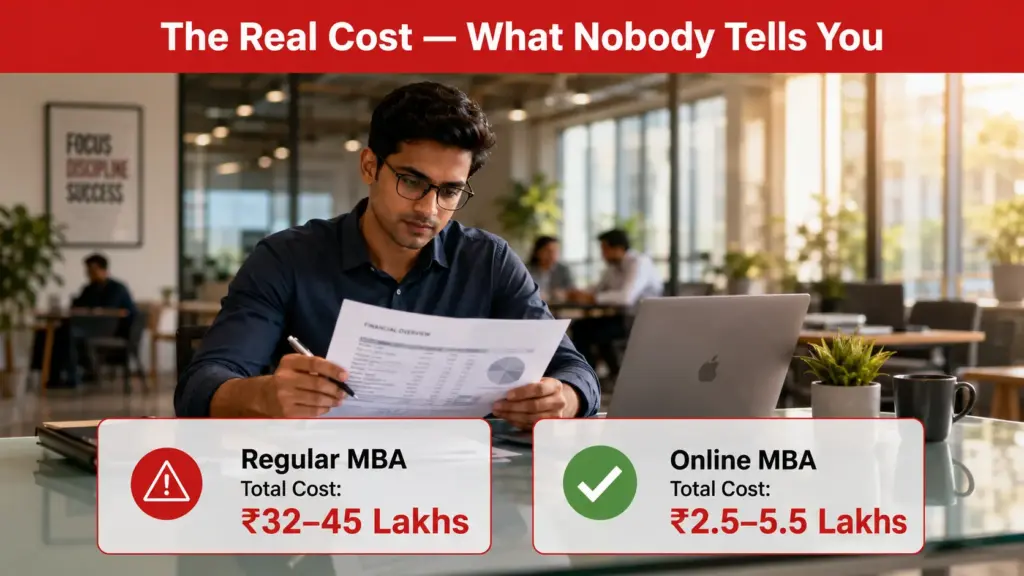
Pro Tip: Comparing the complete Online MBA fee structure can help students understand the real investment, including tuition and additional costs
Placement support and internships
Do not confuse placement assistance with campus placement. These two are completely different things.
- Regular MBA: Companies come to the campus; you are their primary focus for that week. You can give interviews and connect with the recruiters face-to-face.
- Online MBA: You usually get access to a job portal, interview prep, and career coaching. While some premium online MBAs now offer placement drives like Amity, Manipal, Chandigarh Online, etc.
Networking and alumni access
Online degrees provide no networking is a complete myth in 2026. You can connect with peers and professionals with the power of the internet.
- Regular MBA: You can network with peers and professors, and alumni on a personal level (who are available within the campus reach).
- Online MBA: Networking is wide. You can connect with 500 professionals from 20 different countries. In 2026, the use of AI-driven networking platforms within online MBAs helps find mentors and peers based on your specific career goals.
Is an Online MBA Valid in India in 2026?
Yes, an online MBA is valid in India, but on one condition. The UGC-DEB recognition is the only thing standing between a valid degree and a piece of paper.
What UGC-DEB approval means
The University Grants Commission (UGC) and the Distance Education Bureau (DEB) are the governing bodies. As per the UGC guidelines, an online degree from a recognised university is legally equivalent to a regular degree for all government jobs and higher education.
Why session-wise approval matters
This is a critical 2026 update: Approval is not permanent. An institution may have approval for the 2025 session but not for 2026. Always check the UGC-DEB website for the specific academic session (e.g., August 2026) before paying your fees.
DEB-ID and ABC-ID requirements
For 2026 admissions, students must generate a DEB-ID on the UGC portal. This requires an ABC-ID (Academic Bank of Credits), which tracks your credits across different modes of study. Without a DEB-ID, your admission to an online/ODL program is technically invalid.
Before applying, students should understand the complete Online MBA admission process, including eligibility, approvals, and important deadlines.
Online MBA vs Regular MBA Cost: What Is the Real Price?
Understanding the real cost requires a proper understanding of the total and hidden costs associated with an MBA program.
Regular MBA cost breakdown
- Tuition: ₹15,00,000 - ₹30,00,000+ (Tier 1)
- Living/Hostel: ₹5,00,000 - ₹8,00,000 (2 years)
- Opportunity Cost: ₹12,00,000 (assuming a pre-MBA salary of ₹6 LPA)
- Total Real Cost:₹32,00,000 - ₹45,00,000+
Online MBA cost breakdown
- Tuition: ₹2,00,000 - ₹5,00,000
- Tech/Books: ₹50,000
- Opportunity Cost:₹0 (You keep earning)
- Total Real Cost:₹2,50,000 - ₹5,50,000
The opportunity cost most students ignore
Most students only look at the loan amount. They forget that by taking a 2-year break for a regular MBA, they lose 24 months of salary, 2 years of work experience, and 2 years of investments. For a mid-career professional, the real price of a regular MBA is often 10x higher than an online one.
ROI Calculator: Which MBA Pays Back Faster?
The Return on Investment (ROI) is the return you get on your investment. In simple words, the time in which you take in recovering your expenses can indicate ROI.
ROI formula for MBA students
ROI = [(Post-MBA Salary - Pre-MBA Salary) / Total MBA Cost] × 100
Example 1: Fresher choosing a regular MBA
- Cost: ₹20 Lakhs.
- Post-MBA Salary: ₹12 LPA.
- Payback Period: ~2-3 years.
- Verdict: High long-term upside due to the "Tier-1 Brand" jump.
Example 2: Working professional choosing an online MBA
- Cost: ₹3 Lakhs.
- Salary Increase (Promotion): From ₹8 LPA to ₹11 LPA (₹3 Lakh increment).
- Payback Period:1 year.
- Verdict: Instant ROI with zero financial risk.
Example 3: High-salary professional taking a career break
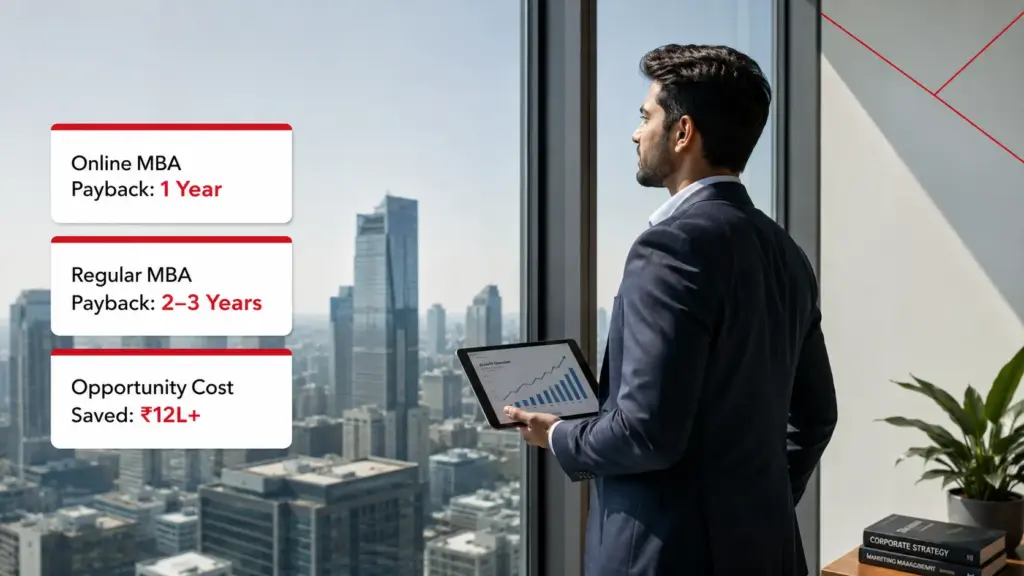
If you earn ₹20 LPA and take a break for a ₹25 LPA Regular MBA, your opportunity cost is ₹40 Lakhs. It will cost you more than staying in your job and doing an Online MBA.
Salary After Online MBA vs Regular MBA in 2026
The India Skills Report 2026 shows MBA graduate employability at 72.76%, with the salary-employment gap closing for those with in-demand skills like AI/digital.
Why regular MBA salaries look higher on paper
Regular MBA average salary increases because of campus placements at top-tier schools (IIMs, ISB). These schools provide the highest placement to those who pay a premium for the rigorous selection process, not just the degree.
Why online MBA salary growth depends on your current experience
For online MBA graduates, salary growth is usually dependent on the current experience of the individual. You don't necessarily get a "new job" at a higher pay; you get promoted within your current company or use the degree to qualify for senior roles in your industry.
The following graph shows the increase in the salaries of an individual after pursuing an Online MBA.
For Graph:
| Time Period | Average Salary (₹ LPA) | Source Notes careers360+1 |
| Pre-MBA | 5 | Typical mid-career baseline |
| Year 1 Post-MBA | 7 | 40% hike; Manipal avg 5.5L adjusted |
| Year 3 Post-MBA | 11 | Cumulative 50-100% growth |
| Year 5 Post-MBA | 16 | Top 18LPA; promotions to senior roles |
Note: The average salary depends on various factors like skills and experience, city, scale of the company, and the position of the individual.
⇒ To understand career growth better, students should also compare the average Online MBA salary across different industries and experience levels.
Specialisations with stronger 2026 demand
With the increase in the demand for experienced professionals, the demand for MBA specialisations is also increasing. The following are the most trending and popular specialisations in India:
- Business Analytics & AI Management: Highest demand due to the AI wave.
- FinTech: High growth in the Indian BFSI sector.
- Operations & Supply Chain: Driven by the Make in India logistics push.
Students should also explore different Online MBA specialisations before choosing a program, as specialisation plays a major role in career growth and salary potential.
The 2026 AI Hiring Reality: The MBA Alone Is Not Enough
According to the World Economic Forum (WEF), AI and Big Data are the fastest-growing skill requirements for managers. A General MBA has become a common degree.
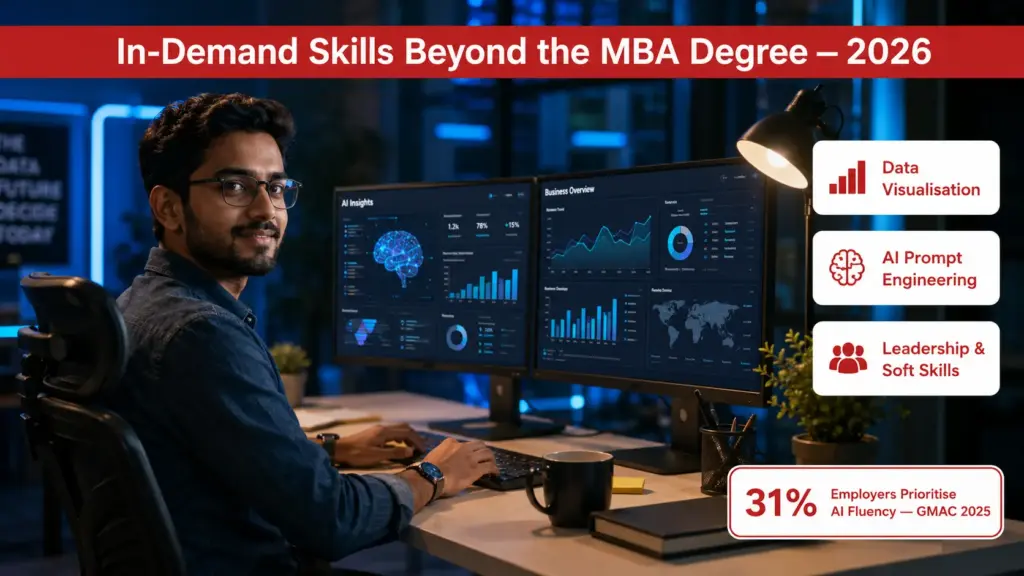
Why AI, analytics, and digital fluency matter now
Recruiters in 2026 are not looking for people who can manage; they are looking for people who can manage AI agents and interpret data models.
As per the GMAC Corporate Recruiters Survey 2025, 31% of employers (up from 26% in 2024) consider AI tool fluency an important hiring skill for business graduates. It is the fastest-growing priority, while 54% globally view online and in-person degrees as equally valuable.
Skills recruiters will test beyond the degree
To get the job, having the degree is not enough. You must have the most demanding skills to manage the AI adaptability within the businesses.
- Data Visualisation: The art of explaining findings from a Tableau dashboard to a CEO and stakeholders.
- Prompt Engineering: The use of LLMs and AI to automate business workflows for better productivity.
- Soft Skills: Skills like teamwork, leadership, and conflict resolution, which AI can't replace.
Networking: Is a Regular MBA Still Better Than an Online MBA?
Where regular MBA networking wins
The coffee chats and late-night case studies build a bond that is hard to replace. You get access to the main group of the campus of alumni who are from the same campus.
Where online MBA networking can work
In 2026, networking is wpurely depend on digitalisation. Online MBAs offer the opportunity of global networking. As the Online MBA welcomes different people from different countries, you will get the chance to exchange knowledge with global peers and faculty.
Who Should Choose a Regular MBA in 2026?
- Freshers: If you have no work experience, you need the campus placement ecosystem.
- Brand Seekers: If your goal is a "Top 10" brand on your resume (IIM, FMS, XLRI).
- Structured Learners: If you struggle with self-discipline and need a classroom to focus.
Who Should Choose an Online MBA in 2026?
- Working Professionals: If you cannot afford to lose 2 years of seniority and salary.
- Budget-Conscious: If you want a master’s degree within budget.
- Non-Metro Learners: If you want a degree from a top university without relocating.

Online MBA vs Regular MBA: The Final Decision
If you are still confused between these two modes, then the following might help you:
- Do you have work experience?
- Yes → Consider Online MBA.
- No → Regular MBA is safer.
- Is your target role in Management Consulting or Investment Banking?
- Yes → Regular MBA (Tier 1 only).
- No → Online MBA is perfectly fine.
- Can you afford to be unemployed for 2 years?
- Yes → Regular MBA.
- No → Online MBA.
If this still doesn’t clear your doubts, then talking to an expert career counsellor is best for you. Connect with CollegeSathi experts who are helping hundreds of learners to make informed decisions.
Final Verdict: Which MBA Is Better in 2026?
The Regular MBA remains the winner for prestige and entry-level career paths. However, the Online MBA is the clear winner for ROI and career progression for the modern workforce.
In 2026, the employer doesn't care how you have learned; they care what you can do with AI, data, and people. Choose the format that lets you gain those skills without breaking your bank account.
Frequently Asked Questions
Yes, as per the UGC-DEB, degrees earned through online mode from recognised HEIs are treated as equivalent to those through traditional mode.
According to the GMAC Corporate Recruiters Survey, global recruiters are looking for skilled employees. It doesn’t matter whether they have learned through an online or offline mode.
Yes, an online MBA can help the freshers to gain advanced knowledge without relocating and compromising their responsibilities. However, a regular MBA might be more beneficial in terms of placement opportunities.
Regular MBAs from Tier-1 schools have higher starting salaries. However, an Online MBA graduate who stays in the workforce often reaches a similar salary level with much lower debt.
Visit the official UGC-DEB website (deb.ugc.ac.in) and search for the university name in the "Recognised HEIs" list for the specific academic year 2026-27. You can also verify with CollegeSathi, as it only mentions the recognised universities.



Popular PG Programs
Trending UG Programs
Doctorate Programs
Executive Programs
Trending Online Universities
In Demand MBA Specializations
In Demand MCA Specializations
CollegeSathi aims to provide unbiased and precise information to aspirants, along with comparative guidance on universities and their programs. The content on the CollegeSathi website, including text, graphics, images, blogs, videos, and university logos, is meant for informational purposes only and should not be considered a substitute for official information provided by academic partners. While we make every effort to keep the information accurate and up to date, CollegeSathi does not guarantee the completeness or reliability of the content and is not responsible for any errors, omissions, or losses resulting from its use.
© CollegeSathi 2026. All Rights Reserved.