



Mastering Online Exams in India: A Comprehensive Guide to Procedures, Benefits, and Preparation

Owing to the growing need for online education in India, there has been an increase in the number of institutes offering various online degree courses. Most universities in the country have started providing such courses, which are on par with regular degrees and are considered valid with the right accreditations and recognition. The qualifications obtained in these programs are also accepted by businesses and higher education institutes for candidates.
These changes have made online courses common in India for the active workforce as well as for aspiring learners. However, there’s still one question ringing in their minds: How are the exams conducted in online universities in India, and how are students able to prepare for them? In this blog post, we cover all aspects of online exams, how universities conduct them, the advantages of the programs, the necessary arrangements you need, and more.
What is an Online Examination System?
The concept of online exams, also referred to as e-exams, changes the traditional methods of assessment in universities. Such exams allow candidates to take their tests online via the internet or through a secure company intranet-supported infrastructure. Once the exam commences, participants are given a limited duration in which they must finish the exam.
This time limit cannot be exceeded and ends automatically once the allocated time runs out, which is when the relevant institutions receive their reports. Automatic systems aid in processing objective questions at the end of the examination, and scores are available as soon as students finish the test. However, online exams must be carried out manually by the instructor for other types of assessments, such as essay questions.
These answers are graded by individuals after the exam. Fast and efficient performance in evaluations during examinations also assures a good level of reliability for more complex assessments, which must be evaluated by people. Individuals are involved accordingly in two domains.
Types of Online Exams in India
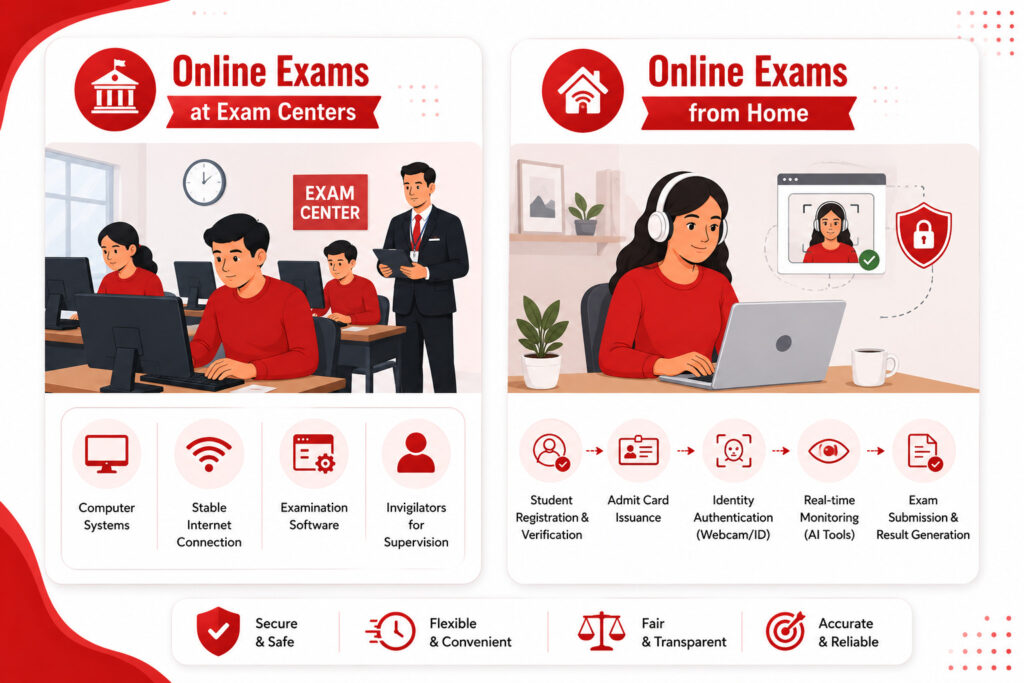
Online Exams at Exam Centers
In this format, students appear for exams at designated centers equipped with:
- Computer systems
- Stable internet connection
- Examination software
- Invigilators for supervision
This method ensures a controlled environment while still using a digital examination system.
Online Exams from Home (Remote Proctored Exams)
Remote exams are becoming increasingly popular in India. Students can take exams from home using AI-powered proctored exam software.
Key Steps in Remote Online Exams:
- Student registration and verification
- Admit card issuance
- Identity authentication (via webcam/ID)
- Real-time monitoring using AI tools
- Exam submission and result generation
These proctored online exams ensure fairness while offering flexibility.
Benefits of Online Examinations
At least in recent years, these forms of assessment, also known as computer-based testing or e-assessments, have gained much popularity compared to traditional paper-and-pencil exams. The following are some of the prominent benefits associated with the use of online examinations:
| Benefits | Description |
| Convenience and Flexibility | If one has an internet connection, they can take online exams from any location, eliminating the need for physical presence during the exam. This is particularly advantageous for those studying through distance learning programs, as well as for individuals with disabilities. |
| Cost-effectiveness | Some processes that are eliminated when using online exams include the printing of paper exams, distributing paper exams to students, and grading. Additionally, it reduces costs associated with organizing physical testing locations or hiring supervisors. |
| Immediate Results and Feedback | Many online examination applications automatically score an exam and allow the participant to view those scores immediately upon completion of the test. This helps the participant identify areas that need improvement. |
| Enhanced Security | Other security features can also be included in such exams, such as randomizing the order of questions, setting time limits within which learners must complete their exam, and using special computer browsers to restrict access to examination content. |
| Multimedia Integration | Furthermore, online examinations offer optional features such as images, videos, and simulations, making the assessment process more engaging and allowing for a deeper, broader and more relevant evaluation of learners. |
| Environmental Sustainability | The online examination system promotes paperless testing, which contributes to environmental conservation by reducing paper pollution and related carbon footprints. |
| Data Collection and Analysis | Online exam systems can gather and analyze data regarding student performance, which is extremely beneficial for educators and educational institutions in enhancing curriculum as well as teaching methods. |
| Accessibility Features | For students with disabilities and special needs, the examination process can be improved through online exams since various accommodations can be made. |
| Avoiding Human Errors | There is minimized exposure to human errors and bias in administering and calculating the results of online examinations, which helps ensure valid examination outcomes for students. |
Challenges of Online Exams in India
Even though it is widely acknowledged that there are many advantages associated with the use of online examinations, there are, however, a few disadvantages. Some of these disadvantages are outlined here:
| Challenges | Description |
| Lack of Technology and Access | Most online exams require students to have a stable internet connection, an operating computer or other devices with particular software or browsers.
This places a significant burden on students who lack these facilities or reside in areas with limited internet access. |
| Security and Cheating Concerns | While various precautions have been implemented to address this issue, cheating remains a considerable possibility in the context of online examinations.
Unauthorized use of resources, impersonation, and technical circumvention measures are among the issues at hand. |
| Technical Issues and Disruptions | Like any activities dependent on technology, online assessments are prone to technical problems such as freezing, internet disruptions, or software issues that may interfere with the entire assessment process. |
| Limited Assessment Types | Certain aspects of examinations cannot be offered in an online mode.
Assessments that include practical elements, hands-on activities, or physical demonstrations cannot be conducted online and require test cases. |
| Digital Literacy and Understanding | Some population groups are not accustomed to operating any form of computer.
Less familiar with this testing method, some students may waste time stressing out and ultimately fail to perform to their potential, which could lead to further complications later. |
| Limitations in Accessibility | Despite the availability of beneficial features in online exams, some students may still face challenges with certain aspects of online examinations. |
| No Human or Face-to-Face Interaction | Another factor that differentiates traditional testing from online evaluations is the absence of personal interaction with the test administrator, along with the lack of timely feedback after the exam.
Consequently, such tests may render the assessment frameworks for education more passive. |
| Assurance of Identity | The primary issue is ensuring the identity of the person taking the exam and preventing impersonation when sitting for an exam in a virtual classroom.
Additional arrangements or systems for verifying the candidates' identities may be necessary. |
How Online Exams Prevent Cheating
Universities use several methods and systems to prevent students from cheating in online exams. In addition to utilizing robust online examination tools and examination management solutions, universities have defined protocols that students must follow. Here are a few methods to stop malpractices in online exams:
- Using Proctored Software Solutions: The heart of any online examination is proctored software. It not only helps conduct and manage the examination but also prevents students from engaging in malpractice during the exam. Most proctoring software solutions utilize technologies powered by Artificial Intelligence and Machine Learning to monitor the movements of the student. It tracks both the on-screen and physical movements of the student to detect any malpractices at play. Proctoring software solutions play a significant role in ensuring safe, fair, and secure online examinations.
- Using a Secured Browser: As online exams are susceptible to malpractices, a secured browser is employed for the exam. The browser can alert the proctor if any cheating or attempts to cheat occur during the exam. A secure browser can prevent students from:
- Opening new tabs or windows
- Accessing third-party apps during the test
- Using keywords in objective-type online tests
- Auditing the Login Process: One of the most common measures that universities adopt to prevent malpractices is login auditing. Universities use webcams and other tools to ensure that the actual student logs into the system. These webcams allow proctors to verify the identity of the student when they log in. Auditing the login process also enables universities to assess the location of the student using geotagging of the IP address and the software.
- Implementing Authorization Practices: Universities use examination management software to conduct online assessments. These tools have various authorization techniques to link the examination software to the location of the candidate using their IP address. This ensures that no one other than the candidate can log into the examination software.
- Utilizing Data Encryption: Gaining access to online question banks before the examination is another malpractice that online exams face. The institutes that conduct the exam thwart such efforts by encrypting the question bank. Additionally, the communication between the system that a student uses for examination and the server is also encrypted to prevent any malpractices. Most examination software solutions employ high-end algorithms and multi-layered encryption to secure the answers submitted by students.
How Does a Proctor Software Solution Work?
The base of a proctored examination is the software used to conduct the assessment. The software solution is responsible for verifying the students and their conduct throughout the examination. Here are a few critical functions that a proctoring software solution carries out.
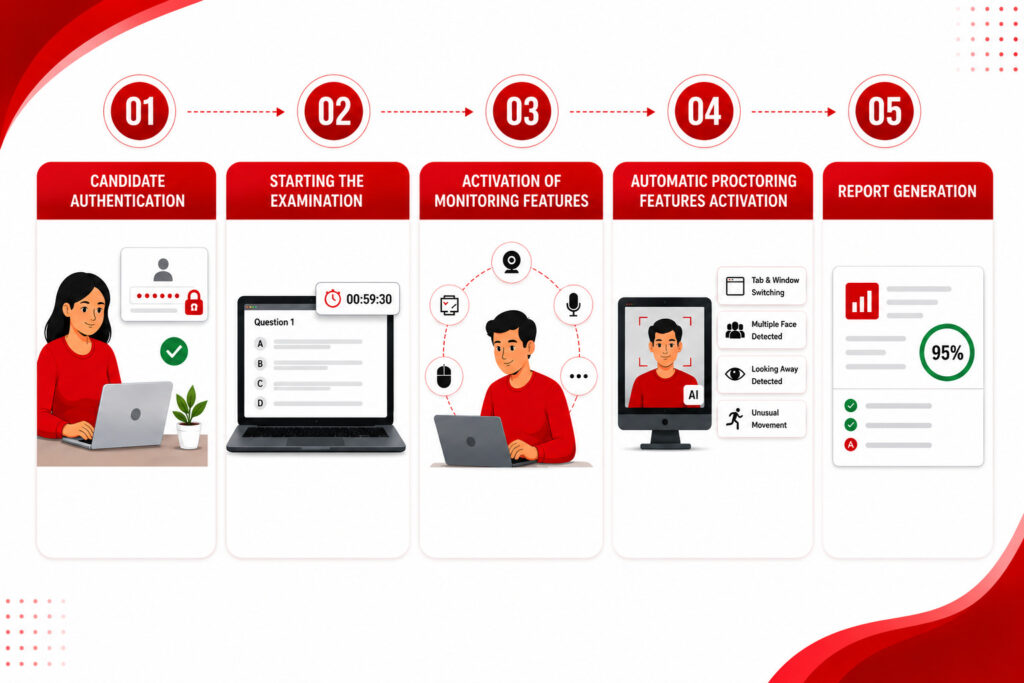
- Candidate Authentication: This is the starting point of the examination and where the software begins its operations. Using pre-designated access codes or login credentials, the software ensures the identity of the candidate. Identifying the candidate is also one of the most important tasks of a proctoring software solution, as it helps prevent malpractices.
- Starting the Examination: In the event of successful authentication by the system or the proctor, the software begins the examination by presenting a screen with questions. Depending on the software, the user interface will change. Most of the time, one question is presented on the screen. The candidate can also view a timer running on the screen to keep track of the time. If the login fails, the student must try using the assigned logins again.
- Activation of Monitoring Features: As soon as the examination starts, the monitoring features of the software are activated. Some of them include:
- The webcam will start recording the candidates and their movements.
- The system will begin recording audio from the candidates.
- The system will track mouse movements on the screen.
- The feature for sharing the screen will also be activated.
- Other monitoring systems will also be activated.
- Automatic Proctoring Features Activation: Most online exam proctoring software solutions come with AI-powered monitoring features. These features make the assessment environment safer and fairer for everyone taking the examination. The AI-powered features help the software track the following during the exam:
- How the candidates move across tabs, windows, etc.
- Changes in the video and audio feed from the test environment.
- Physical movements, facial expressions, eye movements, etc.
- Report Generation: This is the last stage of the examination. Here, the software generates the result of the examination for both the candidate and the person administering the exam. Usually, the report includes the overall test score, percentage, and section-wise scores. Along with the results, a proctoring report is also generated, detailing unusual activities, red flags, etc.
Tips to Prepare for Online Examinations
Taking an online examination need not be challenging or intimidating. With the right preparation, you can excel in your exam. Here are some of the best tips to ace your online examination:
- Understand Exam Format: Make sure you are familiar with the exam’s guidelines, including time constraints, open or closed book exam rules, and the structure of the exam (MCQs, essays, etc.).
- Build Strong Study Habits: Make studying a habit and start preparing ahead of the exam. Ensure you study in parts, trying to stay focused on each section while taking breaks. Also, consider trying some active learning approaches, such as constructing a synopsis of the material, recounting it to a friend, or designing a set of flashcards.
- Check Technical Setup: Check your computer and related peripherals, installed software, and internet connection to ensure they comply with the examination requirements. Undertake any system tests that the examination center may require from participants. Moreover, have a proper contingency plan in case of technical problems. A backup internet connection or a phone to contact tech support is advisable.
- On Exam Day: Enter the examination site early to troubleshoot any equipment failure that may occur or to complete equipment installation before starting to answer the questions. Spend some time reviewing the introduction of each question to ensure that there are no remaining queries while answering.
Conclusion
Without online examinations, students may not be able to enjoy the convenience of online courses as they do now. Hence, it is fair to say that online examinations make online courses easier for students. While convenience is a major advantage, several other benefits to online examinations exist. However, this does not mean that they are without limitations.
Online exams also have several constraints that universities strive to overcome as much as possible. Understanding how universities conduct online exams, what to expect from such an exam, and how to prepare for online exams is important for students to perform well. We have discussed all of this in this blog, and we hope it clarifies any doubts you may have regarding online examinations conducted by top online universities in India. With Collegesathi, you can compare top online universities, get expert counseling, and secure your admission hassle-free. Take the first step today!
Frequently Asked Questions
Yes, with online examinations, you can take tests remotely from your home. Most institutes that offer online courses also allow you to take online exams from the comfort of your home.
A proctor software solution is a program that monitors your computer, webcam, and activity during an online exam to ensure academic integrity. This not only helps maintain the high value of the course but also makes the exams fair for everyone taking them.
While cheating is possible in any exam setting, proctor software makes it very difficult to cheat undetected in online exams. In addition to the software, the universities that conduct the examinations have several measures in place to prevent cheating and other malpractices.
Proctor software uses AI to track eye movements, detect prohibited resources or additional people in view, and identify other potential cheating behaviors. It locks down the test environment and records video for review. Many proctor software solutions also use machine learning technologies to analyze students’ physical movements and behavior during the exams to detect misconduct.
Since tests can be taken at home, there is convenience for learners. It also reduces costs for institutions and allows for easier scheduling. Universities can utilize exam management tools that ensure automated examination assessment and scoring. When everything is integrated, this results in better and quicker outcomes for online assessments.
Yes, limitations do exist regarding online examinations. Some of these include technical issues such as internet connectivity problems, a scarcity of computers, accessibility challenges for students with disabilities, and the necessity of human proctors, among other limitations.



Popular PG Programs
Trending UG Programs
Doctorate Programs
Executive Programs
Trending Online Universities
In Demand MBA Specializations
In Demand MCA Specializations
CollegeSathi aims to provide unbiased and precise information to aspirants, along with comparative guidance on universities and their programs. The content on the CollegeSathi website, including text, graphics, images, blogs, videos, and university logos, is meant for informational purposes only and should not be considered a substitute for official information provided by academic partners. While we make every effort to keep the information accurate and up to date, CollegeSathi does not guarantee the completeness or reliability of the content and is not responsible for any errors, omissions, or losses resulting from its use.
© CollegeSathi 2026. All Rights Reserved.