



Online BBA in Finance vs Online BBA in Business Analytics: Salary Comparison 2026


Choosing between Finance and Business Analytics today isn’t about picking the “better” option; it’s about understanding what suits you best. Both fields offer strong career opportunities, but they focus on very different skill sets and ways of thinking.
In India’s 2026 job market, these two specializations have become top choices for learners who want a good return on their degree. While Finance builds expertise in managing money, investments, and financial systems, Business Analytics focuses on using data to make smarter business decisions.
This blog breaks down the Online BBA in Finance vs Online BBA in Business Analytics debate in a simple, practical way, so you can figure out which path aligns better with your interests, strengths, and future goals.
Quick Answer: Which one wins?
Finance is all about playing with numbers and analyzing the financial position of the organization. It has very clear career options in banking, insurance, and corporate finance. If you like structure and clear progression, Finance is your winner.
Business Analytics is all about analyzing the business function and making strategies for growth. It can actually help you earn more in the early years if you are strong in SQL, Power BI, and problem-solving. However, it requires you to learn technical tools.
The "winner" isn't about which degree is better. It depends on your interests, skills, and whether you want to work in a traditional boardroom or a fast-paced data lab.
Difference between Online BBA in Finance and Online BBA in Business Analytics
When looking at the difference between an online BBA in finance and an online BBA in business analytics, a quick comparison helps clear the confusion. This comparison covers how each degree will help your career in 2026 and beyond.
| Aspect | Online BBA in Finance | Online BBA in Business Analytics |
| Core Focus | Money management, investments, and financial systems | Data analysis, business insights, decision-making |
| What You Study | Accounting, financial markets, corporate finance, banking | Statistics, data analysis, Python/SQL, data visualization |
| Key Skills | Financial analysis, budgeting, risk assessment | Data interpretation, analytical thinking, problem-solving |
| Tools Used | Excel, financial modeling tools | Excel, Python, SQL, Tableau, Power BI |
| Career Roles | Financial Analyst, Investment Banker, Accountant, Finance Manager | Data Analyst, Business Analyst, Data Consultant, Analytics Manager |
| Industry Demand (2026) | Stable and consistent across banking & finance sectors | Rapidly growing across all industries (tech, retail, healthcare, finance) |
| Starting Salary (India) | ₹3–6 LPA (can grow higher with experience/Certifications like CFA, MBA) | ₹4–8 LPA (higher if you have strong technical skills) |
| Best For Students Who | Are interested in money, markets, and finance concepts | Enjoy working with data, patterns, and technology |
| Career Growth Path | MBA Finance, CFA, Banking leadership roles | MBA Analytics, Data Science, AI/ML roles |

Your career, our expertise - talk to a counsellor
What you actually study
These degrees focus on building expertise in these two different domains. It offers you foundational knowledge related to the industry.
Online BBA in Finance Focus
In this track, your world revolves around money: how to get it, how to save it, and how to grow it. You will dive deep into:
- Accounting & Taxation: Understanding the taxes and maintaining accounts of the business.
- Corporate Finance: How companies manage capital.
- Risk Management: Identifying what could go wrong financially.
- Valuation Basics: Learning how much a company or a stock is actually worth.
Online BBA in Business Analytics Focus
This is about using data to identify gaps and make solutions. You will focus on:
- Business Problem Framing: Learning how to ask the right questions before looking at data.
- KPIs & Metrics: Understanding what numbers actually matter for growth.
- Data Interpretation: Looking at a messy spreadsheet and finding a trend.
- Dashboards: Creating visual reports that managers can actually understand.
2026 Demand Drivers: Why both are in demand
You might ask, which has a better scope- online BBA in finance or business analytics? The truth is, they emphasize different factors in 2026.
Analytics growth is driven by the fact that every company is now a data company. From a local grocery delivery app to a massive steel plant, everyone needs someone to explain why sales dropped last Tuesday.
Finance remains a top-paying specialization because money is the life of the economy. With India’s stock market reaching new highs and the rise of digital lending, the need for people who understand "credit" and "risk" has never been higher.
Your career, our expertise - talk to a counsellor
Salary Breakdown in India (2026): Role + Stage Comparison
This is the core of the online BBA in finance salary vs business analytics salary debate. Let's look at the numbers.
Entry Level (0–2 years)
At this stage, the online BBA in business analytics salary in India 2026 often starts slightly higher because the skill set is more specialized.
| Job Roles in Business Analytics | Average Salary Per Annum | Job Roles in Finance | Average Salary Per Annum |
| Junior Business Analyst | ₹3.7 L/yr – ₹4.1 L/yr | Junior Financial Analyst | ₹2.6 L/yr - ₹3.1 L/yr |
| Associate Marketing Analyst | ₹2.9 L/yr - ₹3.2 L/yr | Banking Associate | ₹2.5 L/yr – ₹2.8 L/yr |
| Business Intelligence (BI) Executive | ₹2.9 L/yr - ₹3.2 L/yr | Accounts Executive and Audit Assistant | ₹2.8 L/yr – ₹3.1 L/yr |
| Business Development Executive | ₹3.3 L/yr – ₹3.6 L/yr | Junior Portfolio Manager | ₹1.7 L/yr – ₹1.9 L/yr |
| Data Analyst | ₹3.5 L/yr – ₹5.2 L/yr | Junior Credit Analyst | ₹4.3 L/yr – ₹4.7 L/yr |
Mid Level (3–6 years)
This is where the online BBA in finance salary in India 2026 starts to catch up as you specialize.
Finance: Pay grows as you move into specialized roles like Treasury, Risk, or FP&A (Financial Planning & Analysis).
Analytics: Pay grows through "Impact Ownership." If your analysis saved the company ₹50 Lakhs in waste, your salary will reflect that.
| Job Roles in Business Analytics | Average Salary Per Annum | Job Roles in Finance | Average Salary Per Annum |
| Business Analyst | ₹6.8 L/yr – ₹7.5 L/yr | Financial Analyst | ₹4.3 L/yr - ₹5.5 L/yr |
| Associate Marketing Analyst | ₹4.3 L/yr - ₹4.7 L/yr | Banking Associate | ₹2.8 L/yr – ₹3.1 L/yr |
| Business Intelligence (BI) Executive | ₹4.7 L/yr – ₹5.2 L/yr | Accounts Executive and Audit Assistant | ₹3.4 L/yr – ₹3.7 L/yr |
| Business Development Executive | ₹3.4 L/yr – ₹3.8 L/yr | Portfolio Manager | ₹5.9 L/yr – ₹6.5 L/yr |
| Data Analyst | ₹5.2 L/yr – ₹5.8 L/yr | Junior Credit Analyst | ₹4.9 L/yr – ₹5.4 L/yr |
Senior Level (7+ years)
At this stage, titles change to "Manager" or "Lead."
- Finance: Paths lead to the Finance Manager, Risk Lead, or Portfolio Manager roles.
- Analytics: Paths lead to Analytics Lead, Product Analytics Head, or Strategy Ops.
| Job Roles in Business Analytics | Average Salary Per Annum | Job Roles in Finance | Average Salary Per Annum |
| Business Analyst | ₹11.2 L/yr – ₹12.3 L/yr | Financial Analyst | ₹7.5 L/yr – ₹11.2 L/yr |
| Marketing Analyst | ₹9.5 L/yr - ₹10.5 L/yr | Banking Associate | ₹4.1 L/yr – ₹5.8 L/yr |
| Business Intelligence (BI) Executive | ₹5.5 L/yr – ₹6 L/yr | Accounts Executive and Audit Assistant | ₹3.8 L/yr – ₹4.2 L/yr |
| Business Development Executive | ₹4.7 L/yr – ₹5.2 L/yr | Portfolio Manager | ₹8.3 L/yr – ₹9.2 L/yr |
| Data Analyst | ₹7.5 L/yr – ₹11.2 L/yr | Credit Analyst | ₹9.6 L/yr – ₹12.8 L/yr |
Essential Tools: What You Need to Master
To get hired, you need more than a degree. You need a toolkit. In the modern business world, recruiters are not just looking for degrees. They are seeking professionals who have expertise and familiarity with the tools that matter in 2026.
Online BBA in Finance Toolkit
If you want to win in finance, don't just "know" Excel - master it.
- Advanced Excel: Pivot Tables, VLOOKUP/XLOOKUP, basic macros
- Financial Modeling (Basics to Intermediate): Understanding and building simple financial models, including a 3-statement model (Income Statement, Balance Sheet, Cash Flow)
- Accounting Software: Basic working knowledge of tools like Tally or SAP (especially for roles in accounting, audit, and SMEs)
- Financial Analysis & Reporting Tools: Ratio analysis, budgeting sheets, and forecasting models (these are the core skills, not optional)
- Value-Add Tools: Power BI or Excel dashboards for financial reporting
Online BBA in Business Analytics Toolkit
If you want to establish a strong place in the business analytics world, then winning over with these skills is very important.
- SQL (Core Skill): Learning how to extract, filter, and manage data from databases (this is often the most practical, job-ready skill)
- Data Visualization Tools: Tools like Power BI or Tableau to create dashboards and reports
- Advanced Excel: Data cleaning, Pivot Tables, basic analytics, and dashboarding (widely used in companies)
- Python (Basics): Using libraries like Pandas and NumPy for data analysis
- Statistics & Data Analysis (Core Concept): Understanding trends, correlations, and basic predictive analysis
Your career, our expertise - talk to a counsellor
Career Paths: What You Need to Know in 2026
When deciding between an online BBA in business analytics vs an online BBA in finance which to choose, look at the career opportunities which will help you to move forward.
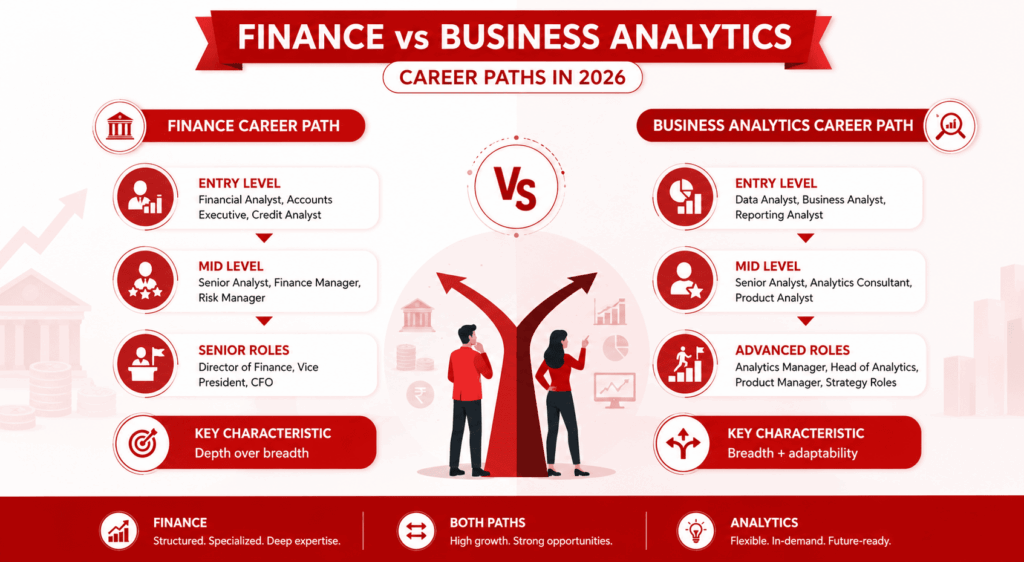
Finance Career Path: Structured and Domain-Driven
A career in finance typically follows a clear, hierarchical path, especially in traditional sectors like banking, corporate finance, and consulting.
- Entry-level: Financial Analyst, Accounts Executive, Credit Analyst
- Mid-level: Senior Analyst, Finance Manager, Risk Manager
- Senior roles: Director of Finance, Vice President, CFO
As you grow, you usually specialize in a domain- such as investments, corporate finance, risk management, or treasury. Progression depends heavily on experience, certifications (like CFA, MBA), and domain expertise.
The key characteristic: Depth over breadth. You go deeper into one area and build authority over time.
According to IBEF, India’s BFSI sector is one of the fastest-growing industries, driven by digital payments, fintech expansion, and increasing financial inclusion. This automatically increases the demand for finance professionals in India.
Business Analytics Career Path: Flexible and Skill-Driven
Analytics careers are less linear and more flexible, with multiple directions based on your skills and interests.
- Entry-level: Data Analyst, Business Analyst, Reporting Analyst
- Mid-level: Senior Analyst, Analytics Consultant, Product Analyst
- Advanced roles: Analytics Manager, Head of Analytics, Product Manager, Strategy roles
Early roles often focus on data reporting and dashboards, but growth comes from moving into problem-solving, decision-making, and influencing business strategy.
The key characteristic: Breadth + adaptability. You can move across functions like marketing, product, operations, or even transition into leadership roles faster.
The growth of analytics careers isn’t just hype. According to NASSCOM, India may require over 11 million data professionals by 2026. At the same time, LinkedIn continues to rank roles like Data Analyst among the fastest-growing jobs - showing a clear shift toward data-driven careers.
Your career, our expertise - talk to a counsellor
Which should you choose? (5-minute framework)
Still stuck on online BBA in finance vs business analytics, which is better? Use this 5-minute decision framework:
Choose Finance if:
- You like structure and "the right answer."
- You are interested in the stock market, banking, or how money moves.
- You prefer working in regulated, stable sectors.
Choose Business Analytics if:
- You like to identify gaps and problems within the business organizations.
- You enjoy using technology and learning new software.
- You want to work in fast-paced industries like E-commerce or Tech.
The Golden Rule: If you are totally confused, pick based on the role you want to do every day, not just the "interest." Do you want to create balance sheets or a data dashboard? As experts at CollegeSathi often advise students, focusing on your preferred day-to-day responsibilities can make the decision much clearer than chasing salary trends alone. The right specialization is the one that aligns with your strengths, work style, and long-term career goals.
Can you switch later?
Yes! You are never stuck with one specific specialization. You can switch and build skills whenever you like.
Finance → Analytics: Learn SQL and a BI tool. Your understanding of financial data will make you a great "Financial Data Analyst."
Analytics → Finance: This is a difficult transition, but not impossible. You will need to take a certification in accounting and financial modeling to prove you understand the "rules" of money.
Conclusion
It’s never about which is a better degree; it’s all about what suits you the most. Online BBA in Finance vs Online BBA in Business Analytics are important domains. Both are important to make a business successful and growing.
An Online BBA in Finance mainly focuses on cash inflows and outflows, which shape the liquidity of the business. This helps in assessing the financial position of the business in the industry.
On the other hand, an Online BBA in Business Analytics focuses on analyzing business operations and establishing productivity. These analysts play a crucial role in managing change and making strategies to stand strong in the business industry.
The best Online BBA degree totally depends on your interests and goals. So, after 3 years, where do you see yourself - managing finances or analyzing business functions?
Frequently Asked Questions
Neither is "better" in general, as it depends on your interests. Choose Finance if you are keen on markets, investments, and finance in general. Go for Business Analytics if you enjoy working with data.
Both finance and business analytics are growing industries. So, finance and business analytics both have a broad future scope. While selecting between these two, focus on your goals and pick a suitable degree.
Finance is easier if you prefer the theoretical side of things. Business Analytics may seem challenging at first since you need to work with data and software.
The answer depends on what kind of profession you seek. If you want to focus on business-related courses and get into management, then yes, an Online BBA in Finance is better.
Both types of professionals make about the same salary if you are a fresher, but eventually, business analysts are expected to earn more.
AI will take care of the basic tasks, such as data processing, whereas financial analysts specializing in strategy, decision-making, and understanding clients will be required in the industry.
AI cannot totally replace business analysts since it will only handle basic report generation, while the business analysts who understand data and make decisions will still have good career prospects.
Yes. Finance students have moved from the field of finance to business analytics using the skills in Microsoft Excel, SQL, and Power BI.
Yes. An online BBA in Finance provides ample career opportunities, such as financial analyst, account executive, banker, and more.



Popular PG Programs
Trending UG Programs
Doctorate Programs
Executive Programs
Trending Online Universities
In Demand MBA Specializations
In Demand MCA Specializations
CollegeSathi aims to provide unbiased and precise information to aspirants, along with comparative guidance on universities and their programs. The content on the CollegeSathi website, including text, graphics, images, blogs, videos, and university logos, is meant for informational purposes only and should not be considered a substitute for official information provided by academic partners. While we make every effort to keep the information accurate and up to date, CollegeSathi does not guarantee the completeness or reliability of the content and is not responsible for any errors, omissions, or losses resulting from its use.
© CollegeSathi 2026. All Rights Reserved.