



Most In-Demand DBA Concentration Areas in India (2026 Guide)

You have invested 10, perhaps even 15 years, into developing yourself professionally. You have gained insights about the market, you have had success, managed teams, and were most likely sought out for advice by other people.
But at the same time, there is a question in the back of your mind, one that comes to you regularly. What happens next? What distinguishes me from those who reach the top?
That is exactly the moment most DBA seekers are in when they start researching specialisations. Before choosing a specialisation, you must understand the full form of DBA and what the degree actually involves, especially if you are comparing it with an MBA or PhD.
The degree itself is not the hard part. The hard part is picking the right concentration, because choosing the wrong one means spending 2 to 3 years and 10 to 25 lakh on a qualification that does not actually position you where you want to go.
In this blog, you will learn about the specialisation that suits you based on your background, the industries in need of professionals with such a specialisation, and what your professional future may hold.
The 7 Most In-Demand DBA Concentration Areas in India Right Now
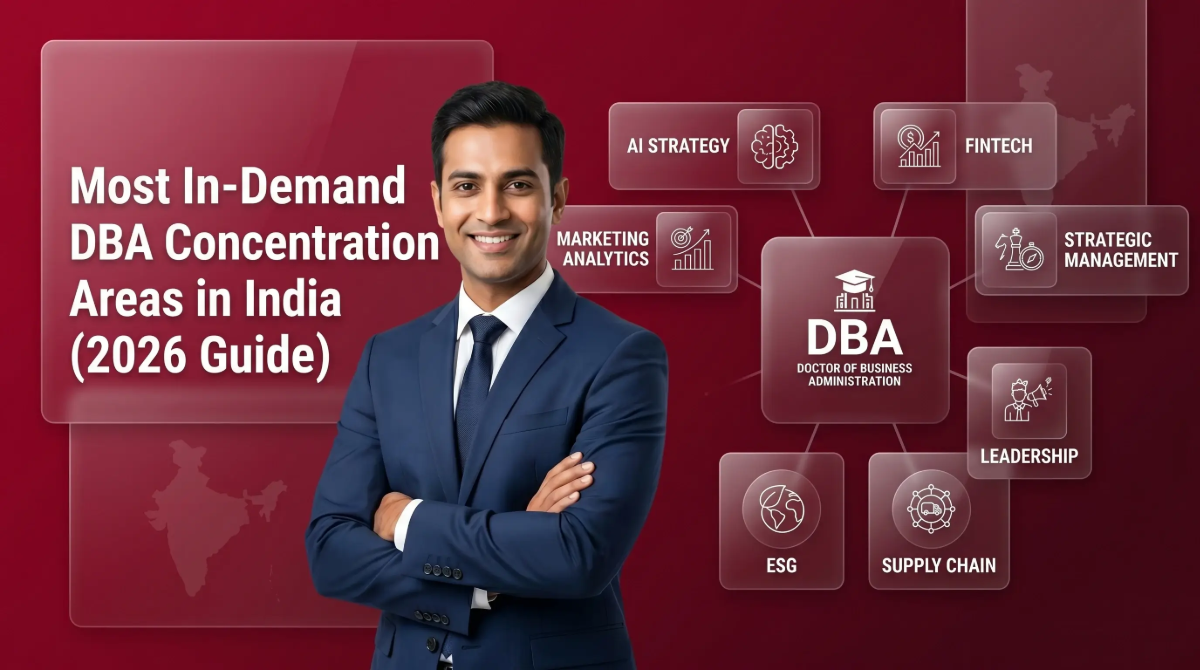
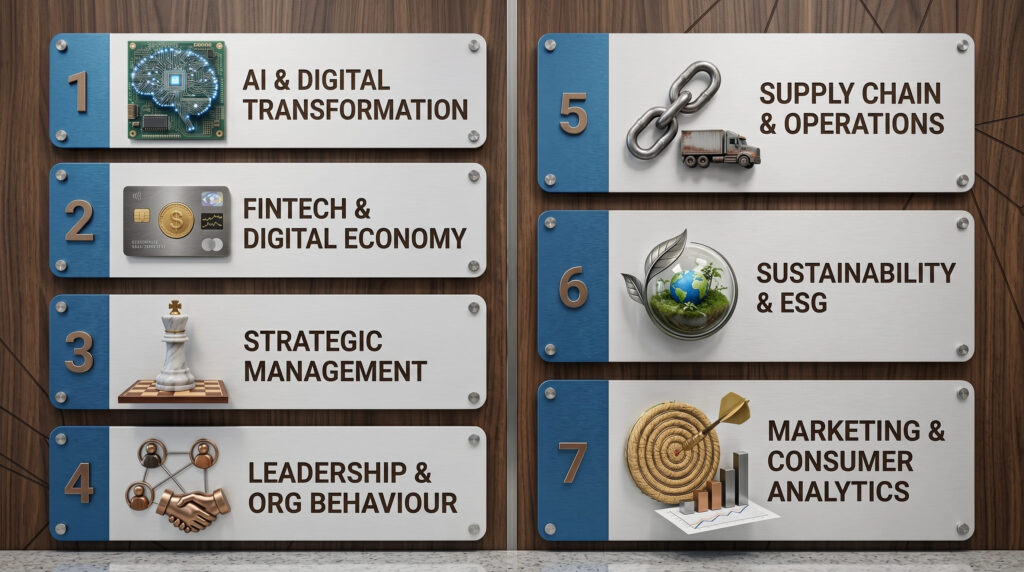
Before we go further, here is the direct answer: the most in-demand DBA concentration areas in India in 2026 are AI and Digital Transformation, FinTech and Financial Innovation, Strategic Management, Leadership and Organisational Behaviour, Supply Chain and Operations Strategy, Sustainability and ESG Strategy, and Marketing and Consumer Analytics.
If you are comparing the DBA with an MBA, our DBA vs MBA career growth comparison breaks down which degree delivers more for your specific career stage. This is not about trends, because they do not describe the current problem Indian companies face when looking for leaders with relevant expertise and research knowledge. This is precisely the combination a DBA offers.
So, which one is yours? Find out now.
What Is a DBA Concentration and Why Does Choosing It Matter More Than You Think?
A DBA concentration is the specific domain you will spend your entire doctoral program studying, researching, and building expertise in.
This is an important factor as your chosen specialisation becomes your professional identity.
Not your designation. Not your company name. Your research area. When you publish, when you consult, when you walk into a boardroom as Dr. [Your Name], the question people will ask is "what do you specialise in?"
The Difference Between a Specialisation and a Research Topic
Many people confuse these. Here is the clean version:
Your specialisation is a broad field, like AI and Digital Transformation, for example.
Your research topic is the specific problem you investigate. For example: "How Indian mid-size manufacturing firms are failing at AI adoption, and what makes the difference between those industries that are successfully adopting AI.
The specialisation acts as your address. Whereas the research topic tells what you actually do there.
The Real Reason to Choose Carefully
Here is what nobody tells you directly: your specialisation shapes every year of your DBA. It determines your research methodology, your data sources, your dissertation committee, your industry partnerships, and most critically, which doors open for you when you complete your program.
Each specialisation opens a door to specific career opportunities that you have researched. For example, A FinTech specialisation positions you very differently from a Leadership specialisation, even though both are legitimate.
Choose the one that actually takes you where you want to go, not the one that sounds premium and impressive.

Your career, our expertise - talk to a counsellor
Top Specialisations: Overview, Scope, and Career Outcomes
Choosing an appropriate specialisation is an important choice you make. To achieve your career goals, you must research and work on the concentration that leads you toward your desired outcome.
1. AI and Digital Transformation
This is not about learning to code. This is about understanding how to lead organisations through AI adoption, and that is a far harder problem than the technology itself.
Indian companies are spending heavily on AI infrastructure, and the majority of those implementations are underperforming. Why? Because the technology is there, but the leadership is not.
Most AI projects fail not due to bad algorithms but due to poor change management, unclear ROI frameworks, and executives who cannot have informed conversations about what AI can and cannot do.
That is the gap a DBA with this specialisation fills.
This is suitable for you if: You are in IT, consulting, product, or a technology-heavy industry. You already understand AI at an implementation level, and you want to lead the strategy and not just execute it.
Research Examples:
- AI adoption barriers in Indian SMEs
- Ethical AI governance frameworks
- Measuring ROI on machine learning investments
- Human and AI collaboration models in service industries.
Career outcomes: Chief Digital Officer, Head of AI Strategy, Digital Transformation Consultant, VP Technology.
Salary range post-DBA: ₹28 to ₹45 LPA (senior leadership track in IT and consulting).
2. FinTech and Financial Innovation
India is the world’s largest real-time payments market, with UPI emerging as the leading retail real-time payment system. In FY 2024–25, UPI processed approximately 185.8 billion (18,580 crore) transactions, according to RBI data.
This specialisation is not about banking operations. It is about the future architecture of money, covering digital inclusion, regulatory frameworks, embedded finance, and what happens when traditional banks meet the startups trying to disrupt them.
This is suitable for you if: You are in banking, financial services, insurance, or a fintech startup, and you have seen firsthand how fast things are changing. You feel like most of the senior people around you are still operating with a 2015 handbook.
Research Examples:
- Digital Financial Inclusion in Rural India
- Cybersecurity Risk in Payment Ecosystems
- Regulatory Frameworks for Crypto-assets
- BNPL Adoption and Risk in Indian Consumer Markets.
Career outcomes: Chief Risk Officer, FinTech Strategy Head, Digital Banking Director, Head of Innovation at a traditional bank.
Salary range post-DBA: ₹25 to ₹40 LPA.
3. Strategic Management and Business Transformation
This is the specialisation for people who already think like executives but want the research rigour to back it up.
If you’re someone who can walk into a struggling division and quickly understand what’s going wrong and what needs to change, or if you’re a consultant whose instincts are often right but you want clear, proven frameworks to support your recommendations, then this specialisation is designed for you.
Strategic Management research is not about writing case studies. It is about producing original evidence on how organisations win, survive, or fail under pressure. If that research is conducted properly, it becomes consulting collateral, publication material, and a professional reputation.
This is suitable for you if: You are in consulting, a corporate strategy role, or a business leadership position where your value is your judgment, and you want that judgment to be underpinned by something more rigorous than experience alone.
Research Examples:
- Digital Transformation in Legacy Indian Enterprises
- M&A Integration Failures in Indian Mid-Caps
- Competitive Strategy in D2C Markets
- Market Entry Strategy for Indian Conglomerates Going Global.
Career outcomes: Chief Strategy Officer, Business Transformation Head, Senior Management Consultant, Business Unit Head.
Salary range post-DBA: ₹30 to ₹50 LPA (highest potential among all specialisations).
4. Leadership and Organisational Behaviour
This is the specialisation that gets underestimated, and it should not be.
Post-pandemic, every large Indian organisation is dealing with the same set of problems: attrition, hybrid work dysfunction, middle management breakdown, and leadership pipelines that are not producing the next generation fast enough. These are not HR problems. They are strategic crises.
Professionals in India who can research, diagnose, and solve such problems using structured methodologies, rather than relying only on intuition, are scarce, especially at the doctoral level.
This is suitable for you if: You lead large teams, you work in HR or organisational development, or you are a general manager who has noticed that the people problems in your organisation are actually the most expensive ones, and you want to address them with research and not just intuition.
Research Examples:
- Leadership Effectiveness in Hybrid Indian Workplaces
- Attrition Drivers in IT Mid-Management
- Gender Diversity in Indian Boardrooms
- Psychological Safety in High-Performing Indian Teams
Career outcomes: Chief People Officer, Head of Organisational Development, HR Strategy Director, VP Human Resources at a large enterprise.
Salary range post-DBA: ₹22 to ₹38 LPA.
5. Supply Chain and Operations Strategy
India's manufacturing ambition, including Make in India, PLI schemes, and the push to become a global supply chain. It has been generating enormous demand for leaders who understand operations at a research level.
This is not just a logistics degree, it’s a strategic one. It’s meant for professionals who have seen supply chain problems closely, like COVID disruptions, port delays, or raw material shortages. And now want to build systems that can handle such challenges better in the future. This specialisation helps you think clearly and create supply chains that are stronger and more reliable.
This is suitable for you if: You are in manufacturing, retail, FMCG, pharma, or e-commerce, and you have spent years optimising systems that you know can be built better, if only you had the time, data, and framework to prove it.
Research Examples:
- Supply Chain Resilience Frameworks for Indian Manufacturers
- IoT Adoption in Warehouse Management
- Last-mile Delivery Cost Optimisation
- Sustainable Sourcing in FMCG Supply Chains
Career outcomes: Chief Supply Chain Officer, Head of Operations, VP Manufacturing, Supply Chain Strategy Consultant.
Salary range post-DBA: ₹22 to ₹35 LPA.
6. Sustainability and ESG Strategy
ESG is no longer optional; it has become a requirement. With SEBI mandating BRSR for the top 1,000 listed companies, many organisations are still trying to figure out how to respond without a clear plan.
This creates a real opportunity. Companies need leaders who see sustainability not as a PR activity, but as something that affects strategy and financial performance. A DBA in ESG prepares you to lead these conversations confidently at the board level.
This is suitable for you if: You work in CSR, compliance, sustainability, risk management, or finance at a large organisation, and you can see that ESG is rapidly moving from the periphery to the centre of corporate strategy, but the people in charge of it still do not have the credibility to influence the C-suite.
Research Examples:
- ESG Disclosure Quality in Indian Listed Companies
- Sustainable Supply Chain Implementation in the MSME Sector
- Impact of BRSR Compliance on Investor Behaviour
- Carbon-Neutrality Strategies in Energy-Intensive Indian Industries.
Career outcomes: Chief Sustainability Officer, ESG Strategy Director, Corporate Governance Advisor, Sustainability Consultant to PE/VC firms.
Salary range post-DBA: ₹20 to ₹35 LPA (growing fast as regulatory pressure increases).
7. Marketing and Consumer Analytics
India's digital consumer base crossed 900 million internet users in 2025. The brands winning in this market are not the ones with the biggest budgets. They are the ones that understand their customer at a data level that most competitors cannot match.
This specialisation is for marketing leaders who have moved beyond instinct-based campaigns and want to build organisations that make decisions on evidence. The research gap here in India is significant, as there is very little doctoral-level work on Indian digital consumer behaviour specifically, and the field is wide open for original contributions.
This is suitable for you if: You are in marketing, brand management, D2C, or digital strategy, and you are tired of campaigns that cannot be measured and strategies that cannot be defended. You want to become the person who brings research-grade consumer intelligence to your organisation.
Research Examples:
- Personalisation Effectiveness in Indian D2C Brands
- AI in Programmatic Advertising ROI
- Customer Lifetime Value Modelling in Subscription Businesses
- Social Commerce Behaviour Patterns in Tier 2 Indian Cities.
Career outcomes: Chief Marketing Officer, Head of Consumer Insights, Marketing Analytics Director, D2C Strategy Lead.
Salary range post-DBA: ₹20-₹32 LPA.
For average salary figures by specialisation and seniority level, see our online DBA salary in India guide - covering post-DBA pay across consulting, corporate, and academic tracks.
Stop second-guessing. With the detailed comparison below, you can make a decision which is better for you.
| Your Background | Right Specialisation | Why |
| IT / Technology | AI and Digital Transformation | You understand the implementation, and the DBA teaches you to lead the strategy. |
| Banking / Finance | FinTech and Financial Innovation | You are inside the disruption, and research gives you the framework to lead it. |
| Consulting / Corporate Strategy | Strategic Management | Your instincts are already strong, and research makes them defensible. |
| HR / People Management | Leadership and Organisational Behaviour | People problems are the most expensive ones, and doctoral research fixes them at scale. |
| Operations / Manufacturing | Supply Chain and Operations | India's manufacturing scale-up needs leaders who can build resilient systems. |
| CSR / Compliance / Risk | Sustainability and ESG | Regulatory pressure is turning this from optional to strategic, so get ahead of it. |
| Marketing / Brand / D2C | Marketing and Consumer Analytics | India's digital consumer market is under-researched, and your work can define the field. |
Which DBA Specialisation Is Best for Your Background?
Answer the following question, and you will understand what is best for you and what is not. Here is the framework that cuts through all the noise:
Five years from now, what problem do you want to be the expert on?
Not the topic that simply sounds impressive. Not the one chosen just to please your boss. Choose the one that, if you spend three years working on it, will create something truly useful for your industry, and leave you with a sharper, more credible professional identity than any promotion could offer.
That is your specialisation.
Here’s something most DBA aspirants aren’t told early enough: the degree isn’t just about the qualification at the end. The real value lies in the research process itself. Three years of deep, industry-focused work where your thinking becomes clearer and more structured. The “Dr.” title is simply the visible proof of that transformation.
Once you have identified your specialisation, check what the DBA demand looks like in your target industry before committing to a program.
Your career, our expertise - talk to a counsellor
Emerging Research Trends in India (2026 to 2030): What Is Being Funded and Studied
If you want your research to stay relevant and future-focused, these five areas are where doctoral work in India is gaining the most traction right now:
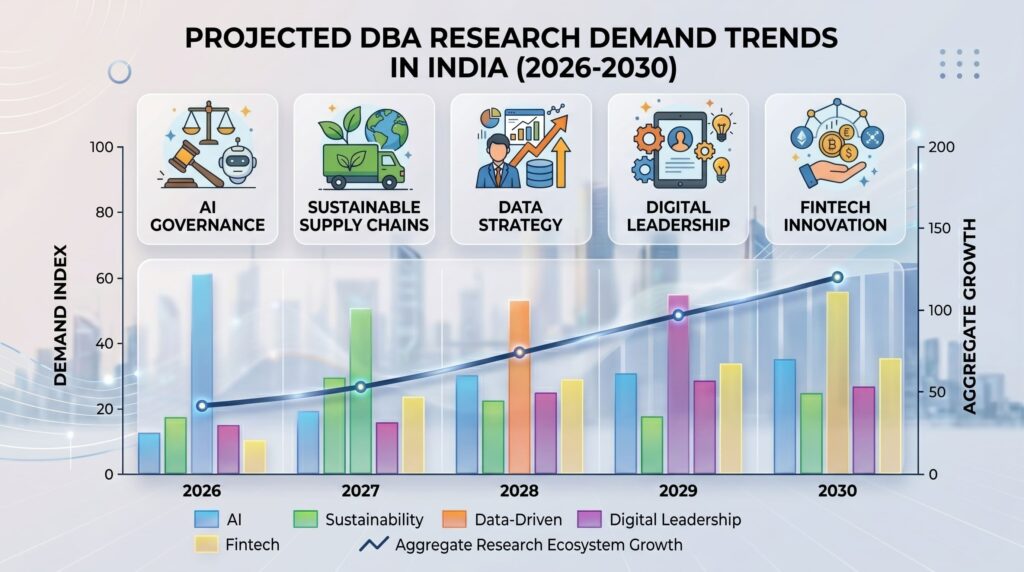
AI Governance and Ethics: As AI is used in critical decisions like credit, hiring, and healthcare, there is a growing need for clear governance frameworks, which have not been sufficiently researched to support them yet.
Sustainable Supply Chains: With SEBI introducing Scope 3 emission reporting, companies now need to rethink sourcing and sustainability at scale. This space still needs growth and research, and is still evolving.
Data-Driven Leadership: Organisations are moving away from intuition-based decisions to evidence-based thinking. But there’s a clear gap in research on how leaders actually do this effectively.
Digital Leadership in Hybrid Organisations: Managing teams across countries and cities are now common. But it is not properly researched on what effective leadership need to be established, especially in India.
Platform Economics and FinTech Ecosystems: India’s fast-growing digital payments and e-commerce space is creating new business models. But the frameworks to fully understand and guide them are still developing.
If your specialisation intersects with any of these trends, your dissertation has a stronger chance of being cited, published, and converted into consulting or speaking opportunities.
Top Institutions Offering DBA Specialisations (With Accreditation)
| University | Country | Key Accreditations | Fees (INR) |
| Rushford Business School | Switzerland | AACSB, ACBSP, EduQua | ₹6,50,000 |
| ESGCI Paris | France | ACBSP, IACBE | ₹7,15,000 |
| Edgewood University | USA | AACSB, WES | ₹9,50,000 |
| Golden Gate University | USA | AACSB, WASC, WES | ₹10,65,000 |
| Swiss School of Business and Management | Switzerland | AACSB, ACBSP, CHEA | ₹10,63,438 |
| EIMT | Europe | ACBSP, EAI, EURASHE, AQS QAHE, USDLA | ₹4,50,000 |
Already know your specialisation? Read our step-by-step online DBA admission guide to understand how to apply, what documents you need, and how to write a research proposal that gets accepted.
Your career, our expertise - talk to a counsellor
Conclusion
The most in-demand DBA concentration areas in India in 2026 are not a mystery. They are a direct reflection of where Indian organisations are struggling, in AI leadership, financial innovation, strategic transformation, and sustainability governance.
What is harder than knowing the list is picking the right one for you, and then committing to it?
The professionals who get the most out of a DBA are not the ones who chose the most impressive sounding specialisation. They are the ones who chose the area where their existing experience gave their research credibility, and where their research opened doors their experience alone could not.
If you are ready to take that step, start with understanding the full admission process. Our step-by-step online DBA admission guide for 2026 walks you through eligibility, documents, research proposal requirements, and what to expect at the faculty interview, so you can apply with clarity rather than just hope.
And if you are still deciding whether a DBA is the right investment, our guide on how a DBA leads towards career growth covers the ROI case in full.
Frequently Asked Questions
Strategic Management and Leadership and Organisational Behaviour are one of the best concentrations for executives who are already in senior positions. Strategic Management helps you lead large-scale transformation with research credibility, and Leadership. Organisational Behaviour gives you doctoral-level expertise on the people and culture problems that cost organisations the most. Both command post-DBA salaries in the ₹25 to ₹45 LPA range.
AI and Digital Transformation, FinTech, and Strategic Management lead demand, based on senior-level hiring trends on LinkedIn and enrollment patterns. Industries need AI strategy to clear the shortage of leaders with deep, research-based expertise, making it a strong career potential.
Yes, and that’s exactly what a DBA is designed for. You’re expected to work on real business problems from your own industry. Your role, your organisation’s data, and the challenges you deal with can all shape your research. This makes your dissertation not just academically sound, but directly useful in your professional work.
Your specialisation defines the senior roles you can target. For example, AI can lead to digital or AI strategy roles, ESG to sustainability leadership, and FinTech to roles in digital banking or regulation. It gives you an edge to get hired above someone with a general background.
Yes, especially for those with 8–15 years of experience aiming for C-suite roles or consulting. It adds strong research credibility and can speed up that transition, often with a salary uplift in the ₹20–45 LPA range depending on the field.
Most online DBA programmes from internationally accredited universities, including Rushford, Golden Gate, SSBM, and EIMT, do not require GMAT. Admission is assessed through work experience (5 to 7 years minimum), academic transcripts, and the research proposal. The quality of your proposal matters far more than a standardised test score at the doctoral level.
AI is an effective specialization that is rapidly growing in Indian market. India’s IT sector has over 5 million professionals (NASSCOM). A DBA in AI and Digital Transformation prepares you for senior roles in digital transformation and AI strategy, with the salary range of ₹28–45 LPA, often higher with consulting or advisory work.



Popular PG Programs
Trending UG Programs
Doctorate Programs
Executive Programs
Trending Online Universities
In Demand MBA Specializations
In Demand MCA Specializations
CollegeSathi aims to provide unbiased and precise information to aspirants, along with comparative guidance on universities and their programs. The content on the CollegeSathi website, including text, graphics, images, blogs, videos, and university logos, is meant for informational purposes only and should not be considered a substitute for official information provided by academic partners. While we make every effort to keep the information accurate and up to date, CollegeSathi does not guarantee the completeness or reliability of the content and is not responsible for any errors, omissions, or losses resulting from its use.
© CollegeSathi 2026. All Rights Reserved.