



DU SOL vs IGNOU: Which One Should You Choose?

If you have spent even a little time looking for a distance or online degree in India, chances are that you have come across two names again and again: DU SOL University and IGNOU. Both allow you to study without sitting in a regular classroom each day. Both are far more affordable than a private college. Both of them give you a degree in the end, which is UGC-recognized and government-backed. So why do students take weeks going back and forth between the two?
Since the two universities are not really built the same way, the "better" one changes depending on the candidate's preference. A working professional in Mumbai has different needs than a fresher living 2 hours away from Delhi. This article takes you through what each university’s courses, fees, and study format are and what alumni are saying about their experience. So that you can match the details to your particular needs rather than choose a name because it sounds familiar.
About DU SOL University
DU SOL full form is Delhi University School of Open Learning and is the distance-education branch of the University of Delhi. It has been established since 1962 and is one of the country's pioneering open learning institutions. It is administered under DU so a degree from SOL still has “University of Delhi” on it, and that name leads to various opportunities, especially in Delhi and the NCR belt.
SOL majorly offers undergraduate education, although it has introduced a few postgraduate and professional programs over the years. Those who don't clear the CUET cutoffs for regular DU colleges or simply can't dedicate themselves to daily classes often opt for SOL to pursue a Delhi University degree. There are weekend classes at study centers all over Delhi along with recorded lectures and online material for anyone who cannot make it for regular classes.
DU SOL Courses at a Glance
Here's a snapshot of the main DU SOL University courses students apply for, along with roughly what each one costs per year (fees vary a little by category and elective choice, so treat these as ballpark figures):
| DU SOL Course | Level | Duration | Approx. Annual Fee (Category A, first year) |
| Online BA (Programme) | UG | 3 years | ₹8,000 – ₹10,000 |
| Online BA (Hons.) — English, History, Political Science, Economics | UG | 3 years | ₹9,000 – ₹13,000 |
| Online B.Com | UG | 3 years | ₹9,000 - ₹10,500 |
| Online B.Com (Hons.) | UG | 3 years | ₹10,000 - ₹13,000 |
| Online BBA / BMS | UG | 3 years | ₹18,000 - ₹22,000 |
| Online BLISc | UG | 1 year | ₹8,000 - ₹10,000 |
| Online MA (various subjects) | PG | 2 years | ₹5,500 - ₹8,000 |
| Online M.Com | PG | 2 years | ₹6,000 - ₹8,500 |
| Online MBA | PG | 2 years | ₹25,000 - ₹35,000 |
| Online MCA | PG | 3 years | ₹18,000 - ₹22,000 |
A couple of things stand out here. DU SOL courses lean heavily toward arts and commerce, and management or computer programs cost noticeably more than the general BA or B.Com stream. SC, ST, EWS, and PwBD students get fee concessions too, so the actual amount many students pay ends up lower than the table above.

Your career, our expertise - talk to a counsellor
About IGNOU
Indira Gandhi National Open University, or IGNOU, was established up by the central government in 1985 and since then has grown to become the world’s largest open university by enrollment. Unlike SOL, it is not restricted to a single city. IGNOU has study and regional centers across the country and even supports students from abroad.
While SOL generally offers a smaller number of courses, IGNOU Online has a much wider range of courses. You will find almost every field represented somewhere in IGNOU's certificates, diplomas, bachelor's, master's, and even PhD-level research. Its online courses, which are not just printed booklets but a proper learning management system, have also grown rapidly in the last few years. A large number of students pursue an entire IGNOU online degree without going to any physical classes ever.
IGNOU Courses at a Glance
IGNOU's list runs much longer, so this table only covers the programs students ask about most:
| Course | Level | Duration | IGNOU Course Fees |
| Online BAG (BA General) | UG | 3 years | ₹4,200 – ₹4,400 |
| Online BCOMG (B.Com General) | UG | 3 years | ₹4,200 – ₹4,800 |
| Online BSCG (B.Sc General) | UG | 3 years | ₹5,700 – ₹5,900 |
| Online BCA | UG | 3 years | ₹5,000 – ₹6,000 |
| Online BSW | UG | 3 years | ₹4,500 – ₹5,000 |
| Online MA (English, Hindi, Sociology, etc.) | PG | 2 years | ₹5,500 – ₹9,000 |
| Online M.Com | PG | 2 years | ₹5,700 – ₹6,600 |
| Online MCA | PG | 2 years | ₹22,000 – ₹28,000 |
| Online MBA | PG | 2 years | ₹25,000 – ₹32,000 |
| Online PG Diplomas (various) | PG | 1 year | ₹5,000 – ₹15,000 |
There are many more IGNOU online courses outside this table too, for example journalism, tourism, rural development, translation studies, and dozens of short certificate programmes. If you are more interested in multidesciplinary subjects than choosing direct arts-commerce-management then you can opt for IGNOU as it can offer courses like that.
Your career, our expertise - talk to a counsellor
Mode of Study and Flexibility
DU SOL is still primarily a semi-offline model. Weekend classes are held at centers across Delhi, and many students really enjoy this, a chance to ask a teacher a question face-to-face instead of typing it into a forum. If you are outside Delhi, however, you will mostly rely on printed material and whatever online lectures SOL has added in recent years. The assistance has improved, but it is still not as extensive as IGNOU's.
IGNOU, on the other hand, was designed for distance learning from the very beginning. The online mode programs feature a proper LMS, recorded and live sessions, digital assignment submission, and study material accessible from a phone. For someone with a job, family, or who lives far from a major city, that structure tends to matter more than an occasional weekend class.
Both the methods are not “wrong”, it really depends on whether you'd prefer some regular classes or the freedom to log in whenever you're free.
Degree Recognition and Value
Both universities are recognized by the University Grants Commission, so on paper employers will accept degrees from either one. Practically speaking, a DU SOL degree still carries the name of the University of Delhi, which still holds value in the real world of jobs and Delhi NCR-centric government examinations. IGNOU's reputation travels a little further nationally and holds an NAAC A++ grade, and its degrees are accepted by the majority of companies and institutions across India and abroad.
There are no straightforward answers to it. Ultimately, it comes down to where you want to work and what specialization you want to take. In some cases, a DU degree may be more recognized in Delhi, but there are some courses that IGNOU has that DU SOL does not have. If your preferred field is one of those courses, then IGNOU is the natural choice.
Your career, our expertise - talk to a counsellor
How Admission Actually Works at Each University
Both the admission processes look similar; both are online, both ask for scanned documents and a fee payment, but the logic behind them is a bit different.
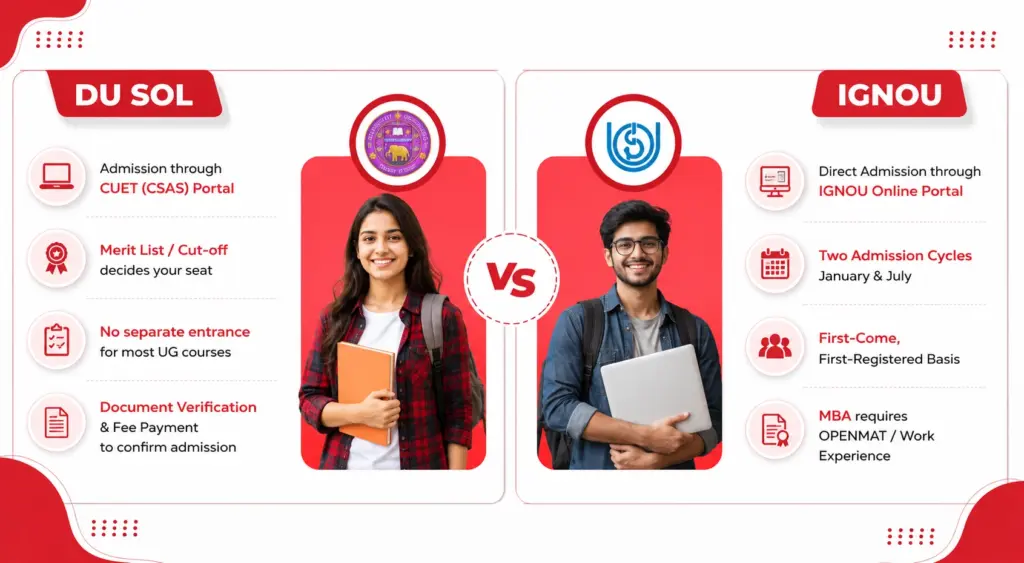
Most of DU SOL undergraduate courses are done through the Delhi University Common Seat Allocation System (CSAS), the same CUET portal that regular DU colleges use. You register, submit what you want to pursue, and a merit list or cut-off decides your seat. There is no separate entrance test for general BA or B.Com courses, but a few specialized or post-graduation programs may require entrace tests result. Once you get a seat, you do documentation verification and pay the fee to secure it.
Most UG and PG programs are offered to candidates on a first-come, first-registered basis through the online admission portal of the university. There are two main registration cycles every year, one around January and another around July. General courses don’t have a cut-off list to worry about, which is why so many working professionals prefer IGNOU once they’ve missed a college admission window elsewhere. An MBA is one of the postgraduate degrees that requires an entrance exam (OPENMAT) or a minimum work experience.
Career Support and Placement Assistance
This is where the two universities really differ, and it is something you should know before you enroll, not after.
IGNOU has a dedicated placement cell that conducts campus drives, job fairs, and skill-building workshops for its distance learners. It has also been building out an online training-and-placement portal to connect students with recruiters directly. And it layers in soft-skill and employability modules along with the academic coursework so that students get some career-readiness support even without setting foot on a physical campus.
DU SOL students are also part of the larger placement and training mechanism of Delhi University, including the Centre for Innovative Skill-Based Courses (CISBC) for job-oriented add-on skills. That said, placement support for distance mode SOL students still remains quite limited when compared to the regular DU college students, and most SOL graduates still find work through their own networking, internships, or further exams and not through a formal campus placement drive.
Your career, our expertise - talk to a counsellor
DU SOL vs IGNOU: Which One Should You Choose?
If you are confused about which institute is better, then here is an overview of all the major points about DU SOL and IGNOU that you must remember.
| Particulars | DU SOL | IGNOU |
| Brand Advantage | University of Delhi brand recognition | IGNOU is one of the tier 1 distance learning institutes |
| Affordability | It is on the higher side | Lower fees |
| Wide Programme Choice | A smaller range of courses is offered | More than 300 courses are offered |
| Placement Support | Limited placement support for the learners | Good placement support |
Before taking admission to any university, connect with CollegeSathi experts for the latest DU SOL and IGNOU online course fee details, and go through a few recent student reviews too. Both universities have lakhs of seats available for students; whether they are working or running a family, it is comfortable for all types of students to pursue the course easily. Here, the correct choice is less about the brand name and more about your budget and the subject you actually want to study.
Frequently Asked Questions
DU SOL and IGNOU both are UGC-approved and provide education through hybrid mode. Students who want the Delhi University name and live close enough to attend weekend classes, while IGNOU suits students who want a wider subject choice, lower fees, or a degree they can complete from any part of the country. The right answer really depends on what you are studying for and where you are planning to use the degree.
Both DU SOL and IGNOU are UGC-approved and provide education through hybrid mode. For students who want the Delhi University name and live close enough to attend weekend classes, IGNOU is suited for students who want a wider choice of subjects, lower fees, or a degree they can complete from any part of the country. The right answer really depends on what you are studying for and where you are planning to use the degree.
Most bachelor’s programs at both universities do not have an entrance exam; they use merit lists or open registration. Some postgraduate or professional courses, like an MBA, require an entrance exam as minimum eligibility criteria.
Yes, both universities are UGC-recognized, and degrees from any of the universities are eligible for UPSC and most of the other competitive government exams.
DU SOL generally offers courses in arts, commerce, and a few management and computer programs, with no dedicated science stream. If you are interested in that direction, then IGNOU has a proper B.Sc. (General) program and a number of science-related diplomas. So, this is the more realistic option.



Popular PG Programs
Trending UG Programs
Doctorate Programs
Executive Programs
Trending Online Universities
In Demand MBA Specializations
In Demand MCA Specializations
CollegeSathi aims to provide unbiased and precise information to aspirants, along with comparative guidance on universities and their programs. The content on the CollegeSathi website, including text, graphics, images, blogs, videos, and university logos, is meant for informational purposes only and should not be considered a substitute for official information provided by academic partners. While we make every effort to keep the information accurate and up to date, CollegeSathi does not guarantee the completeness or reliability of the content and is not responsible for any errors, omissions, or losses resulting from its use.
© CollegeSathi 2026. All Rights Reserved.