



Career Switch at 30: How Working Professionals Are Using Online Degrees

Why a mid-career pivot is easier than ever — and how a flexible online degree can power it.
Quick Answer

A career switch at 30 is not only possible — it has become common. Across India, working professionals are using UGC-approved online degrees to move into fields like data analytics, management, finance, and IT, all without leaving their jobs. Online programs bring flexible schedules, lower fees, and job-ready skills. That is why many career changers report salary growth of 30% to 70% after they upskill.
Turning 30 often brings a quiet question: is this the work I want for the next twenty years? For many people, the honest answer is no. The good news is that changing direction at this stage is easier than it used to be. You carry real experience, sharper goals, and a clearer sense of what you enjoy. What you may lack is a credential in the new field — and that is exactly the gap an online degree can fill.
This guide looks at how professionals in their 30s are switching careers with online degrees. You will see why the timing works in your favour, which paths are popular, what the salary numbers look like, and how to plan your own move step by step.
Is 30 too late to switch careers?
Not at all. In many ways, 30 is an ideal age to pivot. You are experienced enough to be taken seriously, yet early enough to build a long second innings. Here is why the timing works:
- You have workplace experience that employers actively value.
- You know your strengths and what drains your energy.
- You still have decades of working life ahead in a new field.
- You likely have some savings, so the move feels less risky.
Career paths are no longer straight lines. Most people change roles many times across a working life. Switching once, with a clear plan, is simply part of a modern career.
What is driving the mid-career shift?
Several forces are pushing more 30-somethings to rethink their work. Understanding them helps you see that you are far from alone.
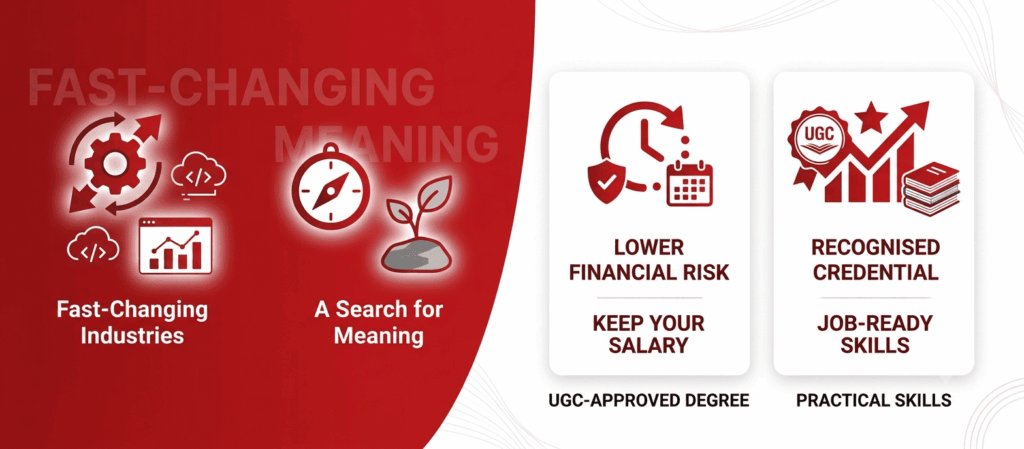
- Fast-changing industries. New tools and roles appear every year, and fresh skills are in demand.
- Skill-first hiring. More employers now judge candidates on ability, not just their first degree.
- Flexible learning. Online education lets you study without pausing your income.
- A search for meaning. After a decade of work, many want a role that fits their goals and values.

Your career, our expertise - talk to a counsellor
Why professionals choose online degrees to switch
An online degree is not the only route into a new field, but it fits working adults especially well. The table below shows how it meets the real needs of a career changer.
| What you need | How an online degree helps |
|---|---|
| Keep your salary | Study in the evenings and on weekends while you stay fully employed. |
| Lower financial risk | Fees are usually far lower than a full-time on-campus program. |
| A recognised credential | A UGC-approved online degree carries the same value as a regular one. |
| Job-ready skills | Courses focus on the tools, cases, and methods used in real roles. |
| Flexibility | Learn from any city, at your own pace, around work and family. |
Popular career switch paths at 30
A smart switch rarely means starting from zero. The best moves build on what you already know. Here are common paths and the online degrees that support them.
| Coming from | Moving toward | Online degree that helps |
|---|---|---|
| Any non-tech role | IT and software | Online BCA or MCA |
| Support or operations | Data analytics | Online MBA or MCA in Data Science |
| Sales or admin | Management, leadership | Online MBA |
| Commerce background | Finance, banking | Online MBA in Finance or M.Com |
| Any field | Digital marketing | Online MBA in Marketing |
Here is a simple example of how this looks in practice. Imagine a support executive with six years in a call centre. She enjoys spotting patterns in customer data more than handling calls. An online MBA in business analytics, studied over evenings and weekends, gives her the tools and the credential to apply for analyst roles. Two years later, she moves into a data-focused job with better pay and clearer growth. Her prior experience did not go to waste — it became her edge. That is the pattern behind most successful mid-career switches: build on what you know, then add the missing skill.
Your career, our expertise - talk to a counsellor
The salary story: what a switch can do
Money is often the deciding factor, so let us look at real trends. Working professionals who finish an online MBA from a recognised, UGC-DEB approved university commonly report a salary rise of 30% to 70%. Those who move into high-demand areas — such as analytics, finance, or product roles — sometimes see even larger jumps.
A few clear patterns stand out:
- Experience matters. A professional with three to seven years of history usually gains more than a fresher.
- Specialisation matters. Fields like business analytics, finance, and marketing tend to pay well.
- Application matters. People who use their new skills at work earn faster promotions.
For a detailed breakdown by specialisation and experience, see our guide on online MBA salary in India.
How online degrees make the switch realistic
The old worry was that online degrees carried less weight. That view has faded. Today, most employers hire on skills first. Here is what makes the online route practical for a career changer:
- No career break. You keep earning while you learn, so there is no income gap.
- Nationwide access. Quality programs now reach learners in Tier 2 and Tier 3 cities.
- Practical learning. Live classes, projects, and case studies help you build a portfolio.
- Recognised value. UGC-approved degrees are accepted for jobs, exams, and higher study.
- Affordable fees. Many universities offer EMI options that ease the cost.
Your career, our expertise - talk to a counsellor
What employers really look for in a career changer
A degree opens the door, but a few other things seal the deal. When hiring someone who is switching fields, most employers look beyond the certificate. Knowing what they value helps you prepare well.
- Transferable skills. Communication, problem-solving, and teamwork carry over from any role.
- Proof of new ability. Projects, certifications, and a small portfolio show you can do the work.
- A clear story. A simple reason for the switch reassures a hiring manager.
- Current tools. Comfort with the software and methods of the new field stands out.
The takeaway is simple. Pair your degree with visible skills, and frame your past experience as an asset rather than a detour. A career changer who can point to real work often beats a fresher with only theory.
How to plan your career switch at 30
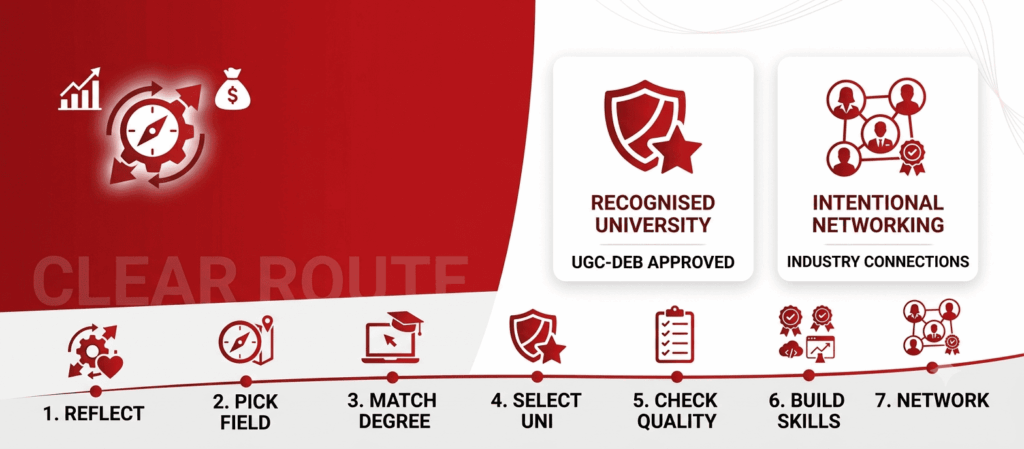
A switch works best with a plan. These seven steps turn a vague wish into a clear route.
- Reflect on your goal. Note what you enjoy, your current skills, and the salary you are aiming for.
- Pick a target field. Choose one with strong demand and room to grow. Our list of top high-paying skills in India can help you spot the right direction.
- Match a degree to the field. Select a program that teaches the exact skills the new role needs.
- Choose a recognised university. Look for UGC-DEB approval and a strong NAAC grade. Working-professional-friendly options include NMIMS Online and Manipal University Online.
- Check quality carefully. Use a simple framework — our 10-point checklist for choosing an online university makes this easy.
- Build skills alongside study. Add short certifications and real projects to stand out to recruiters.
- Network with intent. Many role switches happen through referrals, not job portals, so stay connected.
Your career, our expertise - talk to a counsellor
Balancing work, study, and life
The biggest fear for most working professionals is time. A full-time job, family duties, and study can feel like too much at once. The trick is not to work harder, but to plan smarter. A few simple habits make the load manageable.
- Set a fixed weekly rhythm. Block two or three short study slots and protect them.
- Use recorded lectures. Watch classes when your day allows, not only when they are live.
- Study in small pieces. Thirty focused minutes often beats a rushed three-hour session.
- Tell people around you. Support from family and managers makes the year far smoother.
Remember that the study period is temporary, while the career gain lasts for years. Most online programs run for two to three years, and the flexible format is built to fit around a full-time job.
Common concerns, answered
Doubts are natural before a big move. Here are honest answers to the worries that hold most people back.
| Your concern | The reality |
|---|---|
| Am I too old at 30? | No. Employers value the maturity and experience you bring. |
| Will an online degree be respected? | Yes, when it is UGC-approved and backed by real skills. |
| Can I manage work and study? | Yes. Programs are built around evenings and weekends. |
| Is it worth the money? | Often yes, given low fees and strong salary growth. |
Your career, our expertise - talk to a counsellor
Mistakes to avoid
A few missteps can slow your switch. Steer clear of these:
- Chasing a trendy field without any real interest in the daily work.
- Picking a university without checking its UGC-DEB approval.
- Collecting degrees but skipping hands-on skills and projects.
- Waiting for the “perfect” moment instead of simply starting.
- Ignoring your professional network during the program.
Final word
A career switch at 30 is not a gamble — it is a planned step that thousands of professionals take every year. With a clear goal, the right skills, and a recognised online degree, you can move into work you enjoy without pausing your income. The best time to start is not “someday.” It is now.
Ready for your next chapter?

Compare UGC-approved universities and career-focused online programs on CollegeSathi, and take a confident first step toward the career you want.



Popular PG Programs
Trending UG Programs
Doctorate Programs
Executive Programs
Trending Online Universities
In Demand MBA Specializations
In Demand MCA Specializations
CollegeSathi aims to provide unbiased and precise information to aspirants, along with comparative guidance on universities and their programs. The content on the CollegeSathi website, including text, graphics, images, blogs, videos, and university logos, is meant for informational purposes only and should not be considered a substitute for official information provided by academic partners. While we make every effort to keep the information accurate and up to date, CollegeSathi does not guarantee the completeness or reliability of the content and is not responsible for any errors, omissions, or losses resulting from its use.
© CollegeSathi 2026. All Rights Reserved.