



AI and Machine Learning in India 2026: Careers, Salaries and How to Start

Ask anyone who switched careers into artificial intelligence and machine learning in the last three years and you will hear a version of the same story: they were not sure where to start, spent months confused about which course to pick, and then found the job market was genuinely rewarding once they got in. That story is playing out across India right now — in Bengaluru, Pune, Hyderabad, and increasingly in smaller cities where remote-first AI roles have changed the rules of the game.
This is not a 'future of tech' explainer. AI and machine learning are already inside your everyday life — the fraud alert your bank sent you last month, the way your e-commerce app knows what to show you before you search for it, the diagnosis tool your doctor's software flagged before the specialist reviewed the scan. What is shifting in 2026 is scale and speed. These systems are now everywhere, and India needs the people who can build and maintain them.
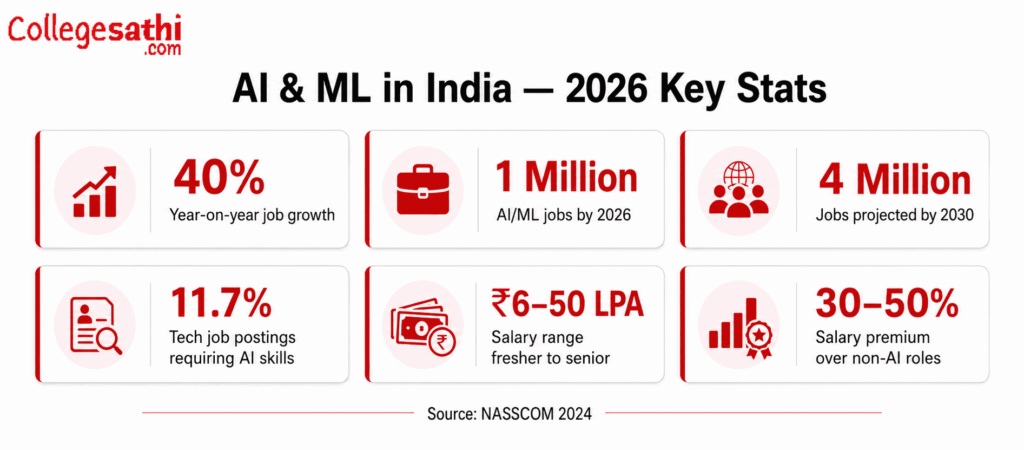
According to NASSCOM, AI job postings in India have grown by roughly 40% year-on-year for three consecutive years. The country is on track to host over 1 million active AI and ML roles by end of 2026, with projections pointing to 4 million by 2030. The uncomfortable truth for anyone still on the fence: the talent gap is wide, and it is not closing fast. That is actually good news for you, if you are willing to put in the work.
This guide covers the full picture — what AI and ML actually mean in practice, which roles exist, what the money looks like, which courses give you the best foundation, and a realistic roadmap for getting started regardless of where you are today.
AI, ML, Deep Learning, Generative AI — What Actually Is What?
The terminology trips up a lot of people at the start. Let's sort it out clearly.
Artificial Intelligence is the big umbrella. Any computer system that mimics human-like reasoning, decision-making, or language understanding falls under AI. It is a broad field with many subfields — Machine Learning being the most important one in practical terms today.
ML is the approach where systems learn from data rather than following rigid, hand-coded rules. Feed a model enough examples of spam emails and it starts identifying new ones on its own. That learning from patterns — without explicit programming for every scenario — is what makes ML so powerful and so widely applicable.
Deep Learning sits inside ML. It uses neural networks with many layers — inspired loosely by how the brain works — and it is behind most of the impressive AI you have seen recently: image recognition, voice assistants, translation, and the next item on this list.
Generative AI has been the dominant conversation in tech since 2022. Unlike traditional ML models that classify or predict, generative models create — text, images, code, audio, video. ChatGPT, Claude, Midjourney, GitHub Copilot — these are all generative AI. The explosion of enterprise GenAI adoption has reshaped hiring patterns, created entirely new job titles, and pushed up salaries across the entire AI/ML spectrum. If you are entering this field in 2026, understanding generative AI is not optional.
Is AI & ML Actually in Demand in India — or Is It Just Hype?
A fair question, given how many tech trends have been oversold over the years. The honest answer here is that the data is unusually strong, and the demand is structural rather than cyclical.
A few numbers worth sitting with:
- AI skills now feature in 7% of all tech job postings in India — up from under 4% in 2020. That is not a blip.
- India is expected to host over 1 million AI/ML roles by end of 2026 and 4 million by 2030, making it the second-largest AI talent market globally after the US.
- The demand-supply gap is real. There are more open roles than qualified candidates — which is why AI/ML engineers earn 30–50% more than software engineers at the same experience level.
- Generative AI roles — particularly LLM engineers — are the fastest-growing and highest-paid specialisation right now, with average packages around ₹39 LPA and senior roles at product companies well above ₹1 crore.
- The demand is not limited to tech companies. Banking, healthcare, logistics, manufacturing, and FMCG all have active AI deployments that need talent to run them.
What makes this different from, say, the blockchain hiring wave of 2018 is that AI/ML is deeply embedded in core business operations — not just experimental R&D budgets. Companies are not hiring AI talent as a bet on the future. They are hiring because their existing products and processes already depend on it.
Career Options in AI and Machine Learning: The Roles That Actually Exist
One of the things that catches people off guard is how many distinct roles fall under the AI and machine learning umbrella. It is not one career path — it is closer to a cluster of related specialisations, each with its own skill requirements and salary trajectory.
Machine Learning Engineer
Probably the most common entry point for engineering graduates. ML engineers build and train predictive models, manage data pipelines, and get models working reliably in production. Mid-level salary ranges from ₹10–20 LPA; senior engineers with deployment experience pull ₹20–35 LPA. Core tools: Python, Scikit-learn, TensorFlow, PyTorch, AWS/GCP.
AI Engineer
A broader role that wraps software engineering around ML capabilities — building production systems where AI is one component among many. AI engineers often work on recommendation systems, decision automation, and intelligent search. Mid-level: ₹12–25 LPA. Senior: ₹25–50 LPA.
Data Scientist
Data scientists extract business insights from large datasets using statistical analysis, ML models, and visualisation tools. The role overlaps with ML engineering but places more emphasis on analysis and communicating findings to non-technical stakeholders. Average mid-level salary: ₹8–18 LPA.
Generative AI / LLM Engineer
The hottest and highest-paid track in 2026. LLM engineers fine-tune large language models, build RAG (Retrieval-Augmented Generation) pipelines, and deploy GenAI applications into enterprise systems. Entry-level: ₹8–12 LPA. Mid-level: ₹15–40 LPA. Senior roles at product companies: ₹40 LPA and beyond. The tools define the resume here — LangChain, LlamaIndex, Pinecone, ChromaDB, Hugging Face, OpenAI API.
MLOps Engineer
As AI systems move from prototypes to production at scale, someone needs to make sure they stay running, accurate, and cost-efficient. That is MLOps. It is one of the least glamorous but most in-demand specialisations right now — senior MLOps engineers at product companies earn ₹28–50 LPA. Tools: Docker, Kubernetes, MLflow, SageMaker, Vertex AI.
NLP Engineer
Natural Language Processing engineers build systems that understand and generate human language — chatbots, translation tools, sentiment analysis, document summarisation. With generative AI, the boundaries between NLP and LLM engineering are blurring fast. Average salary: ₹8.7–20 LPA.
Computer Vision Engineer
These engineers work on systems that process and interpret visual information — medical imaging, quality control in manufacturing, facial recognition, autonomous vehicle perception. Healthcare AI and automotive companies pay significant premiums for this specialisation. Average: ₹10–25 LPA.
AI & ML Salary in India 2026: A Role-by-Role Breakdown
Salaries vary considerably based on company type (product vs IT services), city, and specialisation depth — but the table below gives you a realistic reference range for artificial intelligence and machine learning roles across experience levels in India:
| Role | Fresher (0–2 yrs) | Mid-Level (3–6 yrs) | Senior (7+ yrs) |
| Machine Learning Engineer | ₹5–9 LPA | ₹10–20 LPA | ₹20–35 LPA |
| AI Engineer | ₹6–10 LPA | ₹12–25 LPA | ₹25–50 LPA |
| Data Scientist | ₹5–8 LPA | ₹8–18 LPA | ₹18–30 LPA |
| Generative AI / LLM Engineer | ₹8–12 LPA | ₹15–40 LPA | ₹40 LPA–1 Cr+ |
| MLOps Engineer | ₹6–10 LPA | ₹14–28 LPA | ₹28–50 LPA |
| NLP Engineer | ₹5–8 LPA | ₹8–18 LPA | ₹18–25 LPA |
| Computer Vision Engineer | ₹5–9 LPA | ₹10–20 LPA | ₹20–35 LPA |
One number worth remembering separately: the gap between working at an IT services firm versus a product company at the same experience level is 60–150%. Where you work matters more than almost any other variable in determining your compensation in this field. Bengaluru consistently leads on AI salaries, followed by Hyderabad, Pune, and Delhi NCR.
AI & ML Courses in India 2026: Finding the Right Starting Point
The ai and machine learning courses landscape in India has genuinely expanded — which is good for accessibility but confusing if you are trying to pick the right one. Here is a practical breakdown by career stage:
If You Are Starting Out as a Student
A degree-level program gives you the strongest foundation and the widest range of job options later. A BCA in Machine Learning is a three-year undergraduate program that combines core computer science with ML-specific subjects — the right choice for students who want a recognised degree without the higher cost of a B.Tech. It covers algorithms, data structures, Python, and machine learning fundamentals in a structured sequence that leads you toward job readiness.
If You Already Have a Degree and Want to Specialise
This is where postgraduate options become important. An online MCA with AI & ML specialisation is worth serious consideration — it is a UGC-recognised two-year postgraduate degree that takes you through machine learning, deep learning, data engineering, and modern software practices. For anyone targeting product companies or organisations that filter resumes by qualification, having a postgraduate credential in the specific domain makes a tangible difference.
If You Are a Working Professional Who Needs a Faster Path
Not everyone has two years to commit to a degree. An online diploma in AI & ML typically covers Python, statistics, supervised and unsupervised learning, neural networks, and model deployment in 12–18 months. For someone already in a tech-adjacent role — say, a software tester, a data analyst, or a business analyst — this kind of focused upskilling course can be the bridge to an AI/ML role without starting from scratch.
Certifications Worth Having
AWS Machine Learning Specialty, Google Professional Machine Learning Engineer, and Azure AI Engineer are the three cloud certifications that carry the most weight with employers. They are not substitutes for foundational knowledge — but as a complement to a degree or diploma, they signal practical deployment capability that resonates with hiring managers. Expect to spend 3–6 months preparing for each.
The AI ML Roadmap: A Realistic Sequence for Getting Started
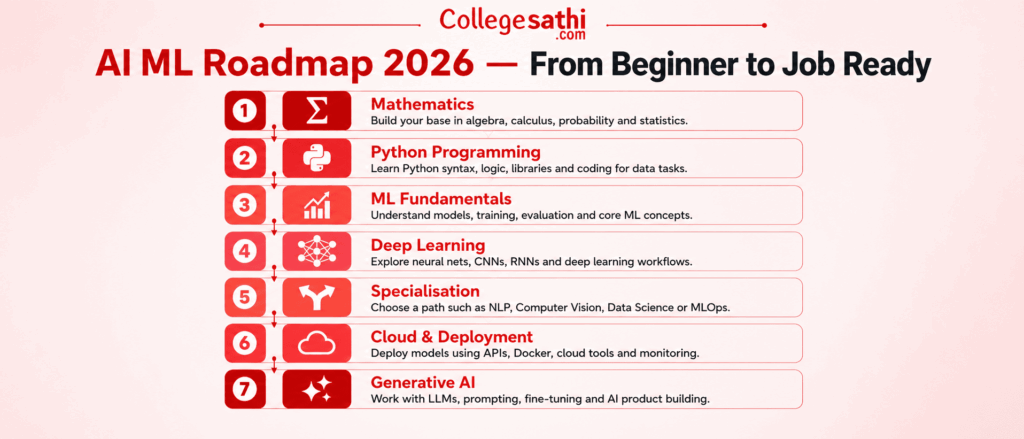
A lot of beginners get stuck because they try to learn everything at once. The AI ML roadmap below gives you a sequence that actually works — each stage builds on the previous one, and you can realistically assess your progress at each step.
- Stage 1 — Mathematics (do not skip this): Linear algebra, basic calculus, probability, and statistics. You do not need a mathematics degree, but you do need enough to understand why models behave the way they do. Khan Academy and the Mathematics for Machine Learning Coursera specialisation are good starting points.
- Stage 2 — Python fundamentals: Python is the working language of the field. Focus first on NumPy and Pandas for data manipulation, then Matplotlib and Seaborn for visualisation. Build comfort with data before touching any ML library.
- Stage 3 — Core Machine Learning: Supervised learning (linear regression, logistic regression, decision trees, SVMs), unsupervised learning (k-means, PCA), model evaluation, and the bias-variance tradeoff. Scikit-learn is your library here. Build small end-to-end projects — do not just follow tutorials.
- Stage 4 — Deep Learning: Neural networks, backpropagation, CNNs for image tasks, RNNs and Transformers for sequences and text. TensorFlow or PyTorch — pick one and go deep on it. Kaggle competitions are genuinely useful at this stage for building real problem-solving instincts.
- Stage 5 — Pick a specialisation: NLP, Computer Vision, MLOps, or Generative AI. Go deep on one rather than spreading across all of them. Build two or three substantive projects that demonstrate real capability — these will matter more in interviews than your certificate list.
- Stage 6 — Cloud and deployment: A model that lives only on your laptop is not a product. Learn AWS SageMaker, Google Vertex AI, or Azure ML. Understand Docker. Basic Kubernetes knowledge is increasingly expected even at mid-level roles in 2026.
- Stage 7 — Generative AI literacy: Regardless of your primary specialisation, comfort with LLM APIs, prompt engineering, and tools like LangChain is now a baseline expectation at most product companies. It does not have to be your core skill — but you need to understand how it works and how to work with it.
The Future of AI in India: Three Shifts That Will Shape the Next Five Years
Predicting the future of any technology field is a fool's errand — but there are three trends in the future of AI that look stable enough to plan around:
AI Is Moving from Pilot to Production
Most large Indian enterprises — banks, insurance firms, hospitals, logistics companies — spent 2022–2024 running AI pilots. By 2026, many of those pilots have become operational systems. This shift from experimentation to scale is what is driving the surge in MLOps, AI infrastructure, and AI product management roles. Building a model is one thing. Keeping it accurate, cost-efficient, and compliant in a live production environment is a genuinely different and increasingly valued skill.
Generative AI Is Becoming a Layer, Not a Product
The standalone ChatGPT moment has passed. What is happening now is that generative AI is being embedded as a capability layer inside existing software — CRMs, ERP systems, content tools, coding assistants, customer support platforms. Every software company in India is either building this in or being asked by clients to. The engineers who understand how to integrate, fine-tune, and deploy LLM-based features into real products are in a very good place right now.
Remote Work Has Rewritten the Geography of Opportunity
This one does not get enough attention. Indian AI engineers working remotely for US or European companies are earning ₹60–100 LPA while living in Pune or Chennai. Global companies prefer Indian AI talent for a combination of reasons — technical quality, English proficiency, time zone overlap with Asia-Pacific, and cost advantage relative to equivalent US-based hires. The practical implication: your skill quality now matters more than which city you are based in.
Best AI & ML programs in India 2026: A Practical Comparison
Choosing the right AI ML course comes down to three things: your current qualification, how much time you can commit, and whether you need a degree credential or just practical skills. Here is a comparison across program types:
| program Type | Duration | Best For | Fee Range (Approx.) |
| Online BCA (ML Specialisation) | 3 Years | School passouts, career starters | ₹60,000–₹1,20,000 |
| Online MCA (AI & ML Specialisation) | 2 Years | Graduates, career switchers | ₹80,000–₹1,50,000 |
| Online Diploma in AI & ML | 12–18 Months | Working professionals, fast upskilling | ₹30,000–₹80,000 |
| B.Tech CS (AI/ML Track) — Campus | 4 Years | School passouts targeting product companies | ₹4–20 Lakhs |
| M.Tech AI/ML — IIT/NIT Campus | 2 Years | Engineers targeting research or leadership | ₹2–8 Lakhs |
| Cloud AI Certifications | 3–6 Months | Working professionals adding credentials | ₹10,000–₹30,000 |
For students and professionals looking at online routes specifically — whether for cost, flexibility, or the ability to study while working — CollegeSathi's course finder lists verified AI and ML programs from UGC-recognised institutions across all levels, with fee structures, admission timelines, and counsellor support in one place.
Where to Go From Here
The window for getting into AI and ML at an advantageous time is not closed — but it is not as wide as it was two years ago either. Salaries are high, demand is strong, and the infrastructure for learning is better than it has ever been. What separates people who break into this field from those who stay on the fence is usually just a decision to start, followed by enough consistency to get through the foundational stages.
The roadmap is not secret. The courses exist. The demand is documented. What this guide gives you is enough clarity to make the decision and the first move.
If you are ready to explore your options, the online MCA in AI & ML on CollegeSathi is a strong starting point for postgraduate paths, the online BCA in Machine Learning on CollegeSathi for undergraduate options, and CollegeSathi's course finder for a broader comparison across programs, fees, and institutions.
Disclaimer: Salary figures in this blog are sourced from NASSCOM, Scaler, Taggd, and industry reports as of April–May 2026. Actual compensation varies based on company type, location, and individual skill depth. Verify current data before making career or education decisions.
Frequently Asked Questions
Three months is enough to build a genuine foundation — you can get comfortable with Python, work through the core ML algorithms, and build a few small projects. But job-ready? That takes longer. Most people who successfully transition into AI/ML roles put in 9–18 months of structured learning before they start getting interview calls. Any program promising full AI/ML mastery in 12 weeks is compressing what is actually a multi-stage learning process. That said, three focused months is not nothing — it is a meaningful start, and better than waiting for the perfect moment to begin.
Yes — and unusually so, even by tech standards. AI job postings have grown 40% year-on-year for three years running. India will have over 1 million active AI/ML roles by end of 2026. The thing that makes this demand different from previous tech waves is that it spans industries — it is not just IT services companies and product startups. Banks, hospitals, manufacturers, and logistics companies are all hiring AI talent now. The demand is structural, not seasonal.
Freshers with the right project portfolio can expect ₹5–10 LPA. Mid-level engineers with three to six years of experience are typically earning ₹12–25 LPA. At the senior level — particularly with specialisations in Generative AI, MLOps, or Computer Vision — the range stretches from ₹25 LPA to ₹80 LPA and beyond. LLM engineers are currently the highest-paid slice of the field, with averages around ₹39 LPA and top compensation well above ₹1 crore at major tech firms. Product companies pay 60–150% more than IT services at equivalent experience, so where you work matters enormously.
AI is the big umbrella — any system that mimics human-like intelligence. ML is a specific method within AI where systems learn patterns from data rather than following hand-coded rules. Deep learning is a further subset of ML using multi-layer neural networks. Generative AI is a branch of deep learning focused on creating content rather than classifying or predicting. In practice: all ML is AI, but not all AI uses ML. When someone talks about a career in ai machine learning, they are almost always referring to the ML/deep learning end of the spectrum — not older symbolic AI systems.
Depends heavily on where you are starting from. Fresh graduates or students benefit most from a full degree — an online MCA with AI & ML specialisation gives you both the credential and the curriculum depth that product company interviews require. Working professionals who need a faster path tend to do well with an online diploma in AI & ML — it covers the practical stack in 12–18 months without requiring a full career pause. Cloud certifications from AWS or Google work best as add-ons to existing qualifications, not as standalone routes.
The main roles are Machine Learning Engineer, AI Engineer, Data Scientist, Generative AI / LLM Engineer, MLOps Engineer, NLP Engineer, and Computer Vision Engineer. Beyond these core technical tracks, there are adjacent roles growing fast — AI Product Manager, AI Solutions Architect, Prompt Engineer, and AI Ethicist are all titles that barely existed five years ago. The field also includes research paths for those who want to work on foundational model development rather than application engineering.
Python, without much debate. The ecosystem is unmatched — NumPy, Pandas, Scikit-learn, TensorFlow, PyTorch, Hugging Face, LangChain — virtually every important AI/ML tool has a Python-first implementation. After Python, SQL is essential for anyone working with data. For deployment and infrastructure work, shell scripting and basic cloud CLI knowledge helps significantly. C++ matters for specialised roles in edge AI or robotics. But for the overwhelming majority of machine learning career paths in India, Python mastery plus strong mathematical foundations is the foundation that everything else builds on.
Not universally — but practically, yes for many paths. Top product companies and research organisations either require or strongly prefer a relevant degree. Startups and mid-tier companies are often more flexible, particularly if you have a strong project portfolio and demonstrable skills. The safest positioning is a recognised degree in computer science or a related field, supplemented by real projects and certifications. This combination covers the widest range of opportunities. A diploma or certification alone can open doors, but a degree keeps more options open — especially as you progress into senior roles where credentials become more relevant again.



Popular PG Programs
Trending UG Programs
Doctorate Programs
Executive Programs
Trending Online Universities
In Demand MBA Specializations
In Demand MCA Specializations
CollegeSathi aims to provide unbiased and precise information to aspirants, along with comparative guidance on universities and their programs. The content on the CollegeSathi website, including text, graphics, images, blogs, videos, and university logos, is meant for informational purposes only and should not be considered a substitute for official information provided by academic partners. While we make every effort to keep the information accurate and up to date, CollegeSathi does not guarantee the completeness or reliability of the content and is not responsible for any errors, omissions, or losses resulting from its use.
© CollegeSathi 2026. All Rights Reserved.