



The 10 Toughest Exams in India: Only the Best Make It Through


India is known for its most difficult exam in the world, where lots of students compete for only a few seats. Whether you get through the UPSC Civil Services to join as an IAS officer or survive through one of the toughest examinations, such as the JEE Advanced, to study at a reputed IIT, these examinations test not just knowledge but patience, perseverance and the ability to solve problems.
Here, the question is: What makes these examinations so difficult?
If you’ve ever wondered which is the toughest exam in India, the answer isn’t simple. Different exams test different skill sets, but some consistently rank among the top 10 toughest exams in India due to their vast syllabi, intense competition, and extremely low success rates. In this detailed guide, we’ll explore India’s top 10 toughest exams, understand why they are so challenging, and share preparation tips to help you succeed.
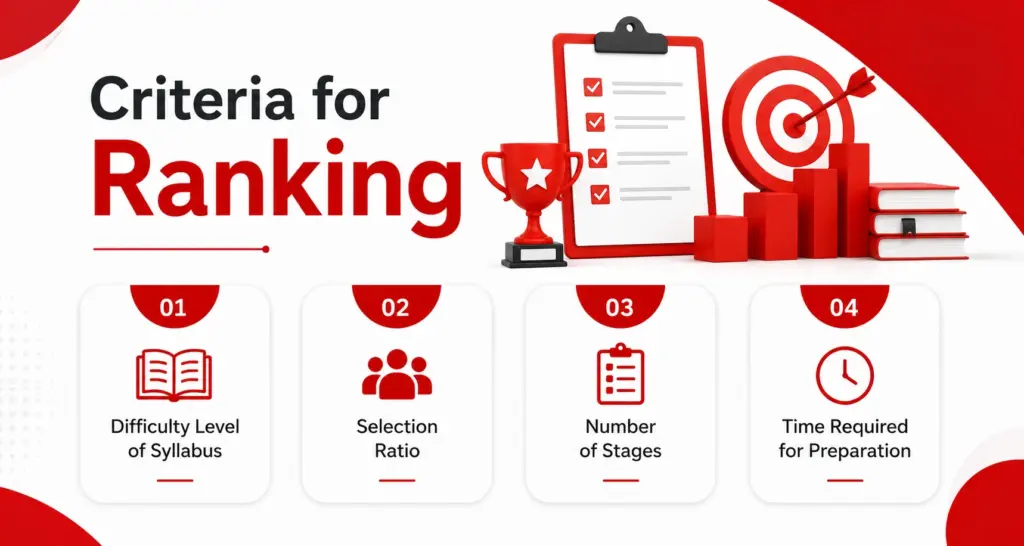
Criteria for Ranking the Toughest Exams
Before jumping into India’s top 10 toughest exam, it’s important to understand what makes an exam difficult. It’s not just about tough questions, it’s a combination of multiple factors:
- Difficulty Level of Syllabus: Many exams span several subjects, which require a deep understanding with analytical skills.
- Selection Ratio: There are lots of competitive candidates, but only a few hundred/thousand openings; an exam with fewer selections is tougher than one with more openings.
- Number of Stages: A number of the exams have multiple rounds consisting of prelims, mains, and interviews; each stage is considerably more difficult than the previous stage.
- Time Required for Preparation: While some exams take months, some take years of deep-buried effort to succeed, thus creating extra emotional strain on candidates for study.
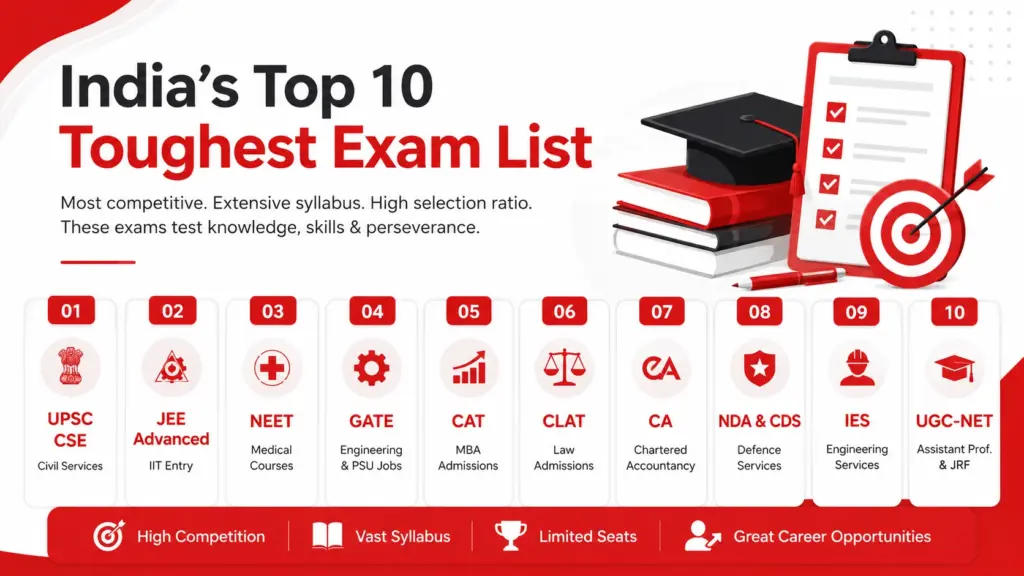
India’s Top 10 Toughest Exam List (2026)
India has some of the hardest exams in the world. They examine not only knowledge but also critical thinking, analytical skills, and perseverance. The list below highlights the top 10 hardest exams in India in addition to details related to their difficulty:
1. UPSC Civil Services Examination (CSE)
Purpose: Selection of IAS, IPS, IFS, and other central government officers.
The UPSC Civil Services Examination, regarded as the most prestigious and established exam in India, has a selection ratio of less than 1%. Also, UPSC is known as the most difficult exam in India.
The examination is conducted in three stages: Prelims, Mains, and Interview, each designed to evaluate various competencies, including analytical ability, writing skill, and personality characteristics.
The syllabus covers all major subjects: history, polity, economy, ethics, and current affairs, making it one of the most comprehensive exams available. With over 10 lakh candidates applying every year, it is apparent that only the most focused and well-prepared aspirants can emerge successfully from this examination.
2. JEE Advanced
Purpose: Admission to the Indian Institutes of Technology (IITs).
Considered one of the hardest engineering entry exams in the world, the JEE Advanced exam is very conceptual and tests application-based questions. Only candidates who clear the JEE Main are eligible to appear for the JEE Advanced exam. The JEE syllabus has a comprehensive difficulty level with subjects like Physics, Chemistry, and Mathematics, where standard problem-solving and critical thinking are tested.
Over 2 lakh students are competing, with very few seats available to enter the IIT system. Thus, aspirants need to manage time, be able to think logically, and know major concepts to succeed on exam day.
3. NEET (National Eligibility cum Entrance Test)
Purpose: Admission to MBBS, BDS, and other medical courses in India.
NEET is the only medical entrance examination in India, which makes it an extremely competitive test, as over 20 lakh students apply for the examination every year. NEET is well known for its extensive syllabus, which comprises Biology, Chemistry and Physics.
The candidate also needs to have a strong conceptual understanding of the subjects and the speed to answer 200 questions in 3 hours and 20 minutes. NEET is extremely tough with very high cut-off scores and limited seats in government colleges, so intense preparation and good problem-solving skills are required to crack this exam.
4. GATE (Graduate Aptitude Test in Engineering)
Purpose: Admission to M.Tech/Ph.D. programs and PSU recruitment.
GATE is one of the toughest exams for engineering graduates, as it assesses aspirants on their in-depth knowledge of core subjects of engineering. GATE consists of 65 questions to be solved in 3 hours, requiring strength of problem solving and written calculations, numerical ability and strong conceptual understanding. GATE is competitive, as many PSUs, such as ONGC, IOCL, and NTPC, recruit students based on GATE scores.
Hence, aspirants must push hard to prepare and develop a good understanding of their relevant field of study to succeed.
5. CAT (Common Admission Test)
Purpose: To gain admission into top online MBA Colleges, including IIMs.
CAT is the most challenging management entrance examination and is well known for testing candidates on Quantitative Aptitude, Logical Reasoning, Data Interpretation, and Verbal Ability. It creates a challenging environment for aspirants by adding restrictions related to time and unexpected patterns of questioning related to the paper, and the base of selection is merely based on the percentile.
Over 2 lakh candidates are competing for only a few thousand IIM seats. Scoring 99% tile means exceptional problem-solving capabilities, understanding the concepts thoroughly, and a smart preparation strategy.
6. CLAT (Common Law Admission Test)
Purpose: To gain admission into other top law universities (NLUs) in India.
CLAT is the toughest law entrance examination in India. It has been testing aspirants on Logical Reasoning, Legal Aptitude, General Knowledge, English, and Mathematics. What sets it apart? a dynamic and unpredictable paper pattern.
Candidates require excellent comprehension ability, critical thinking skills, and legal reasoning to tackle a competition wherein thousands of students compete for limited seats in National Law Universities (NLUs). Cracking CLAT necessitates thorough preparation and ensures analytical thinking capability.
7. CA (Chartered Accountancy) Exams
Purpose: To become a Chartered Accountant.
The Chartered Accountancy (CA) exam conducted by the ICAI is one of the toughest professional exams in the country. It is made up of three levels: CA Foundation, CA Intermediate, and CA Final, and each level has a very low pass percentage (5-10% at Final).
The syllabus includes topics such as Accounting, Taxation, Corporate Laws, and Auditing, which require a thorough understanding of concepts and typically involve lengthy hours of study. Students will often make many attempts at the final level, making CA one of the more difficult career options in the country.
8. NDA (National Defence Academy) & CDS (Combined Defence Services)
Objective: Join the Indian Army, Navy and Air force
The NDA and CDS academic exams are some of the toughest defence entrance exams in India, with a lot of competition, both academic and otherwise. These are based on Mathematics, General Knowledge and English with an accompanying SSB interview at the conclusion that includes psychological testing, physical aptitude testing (including physical standards), SSB interview group's decision-making ability/leadership assumptions and a 5-day observation of overall personality, attitude and presence of mind. These interviews and physical standards make these the toughest exams and entrance processes to face.
9. IES (Indian Engineering Services)
Objective: The Hiring of engineers for state ventures.
The IES exam, conducted through UPSC, is one of the most esteemed engineering exams in India. The test consists of Prelims and Mains, followed by a Personality Test, which requires relevant technical and problem-solving abilities.
IES is also highly competitive because engineers from multiple engineering disciplines apply for limited posts in central government sectors like Railways, Power, and Telecommunications. The extensive technical nature of questions and a low ratio of successful applicants make IES among the hardest exams in India.
10. UGC-NET (University Grants Commission-National Eligibility Test)
Objective: Qualified for being engaged as an Assistant Professor and upcoming JRF positions.
The UGC-NET exam is conducted by the National Testing Agency (NTA) to test eligibility for being hired as an Assistant Professor and the qualification for a Junior Research Fellowship at universities throughout India. UGC-NET consists of two test papers: one assessing teaching as an aptitude and the other as a subject-specific to the professorship.
UGC-NET requires significant preparation and advanced knowledge of the subject in both paper assessments. The cut-off marks and required extensive research skills for completion of the examination process make it hard for future Assistant Professors and researchers. If you're preparing for exams like CAT but also exploring flexible MBA options, platforms like Collegesathi can help you discover top online MBA programs, compare colleges, and choose the right path without unnecessary confusion.

Your career, our expertise - talk to a counsellor
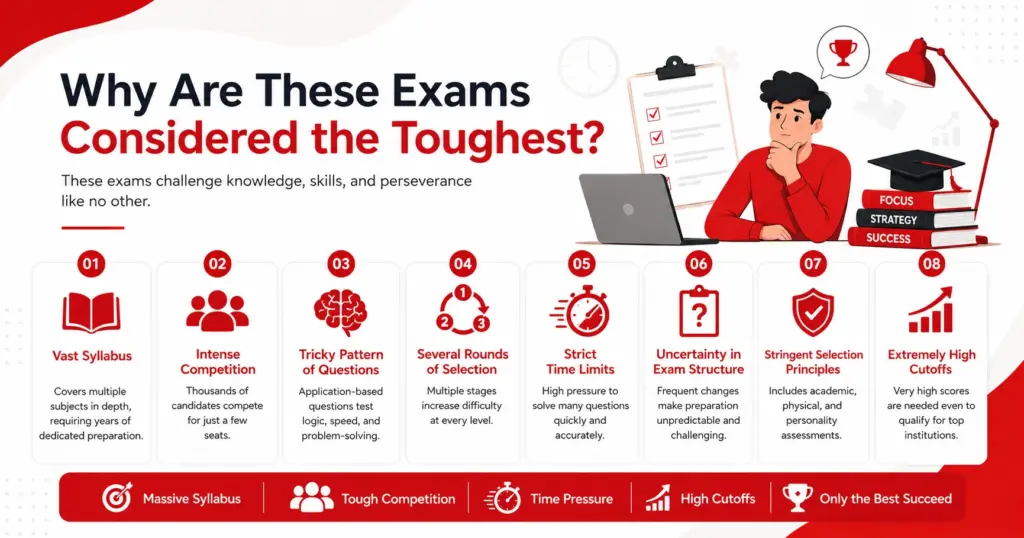
Why Are These Exams Considered the Toughest?
The most challenging examinations in India are not difficult just because of the extensive syllabi or its complex questions. The extreme difficulty of these exams is based on a range of objective factors that frequently demonstrate the ultimate limits of even the most intelligent of minds.
In this regard, consider the following items of consideration:
- Vast Syllabus: Most of the most difficult exams, such as UPSC, NEET and JEE Advanced, entail a huge syllabus across multiple subjects. The candidates will be tested on topics from multiple streams, which may take years of preparation to master. The syllabus is so vast because it requires candidates to possess a deep conceptual understanding instead of a truly rote understanding.
- Intense competition: There are always thousands of candidates who take these examinations every year, with fewer than a handful being granted a top rank, which is another factor for the extreme difficulty. To illustrate, UPSC only selects less than 1% of all applicants, while JEE Advanced has approximately 16,000 seats out of 2 lakh who will be eligible for admission to high-ranking engineering schools. The very low rate of success translates to extreme difficulty.
- Tricky Pattern of Questions: Examinations such as JEE Advanced, CAT, and GATE are notorious for their tricky, application-based questions. Not only do they test candidates' knowledge, but they also test candidates' problem-solving abilities, logical reasoning, and speed. Many of the questions are designed to make a statement for the candidate who is well prepared for the exam.
- Several Rounds of Selection: Many of these exams have multiple rounds (levels) to increase their difficulty. For example, UPSC has Prelims, Mains, and interviews, while CA exams are conducted at Foundation, Intermediate, and Final levels. Each level is more difficult than the last, and candidates must keep up their efforts over extended periods.
- Strict Time Limits: Time management is also a critical part of these exams. For example, tests like CAT, NEET, and CLAT require candidates to solve a large number of questions under strict time limits. Upon deciding, candidates need to answer quickly and accurately, which also adds to the perceived difficulty of these exams.
- Uncertainty in the Exam Structure: Most of these exams, like UPSC, CLAT, and CAT, often change the exam structure or the nature of the exam and its difficulty. This uncertainty makes it difficult for an aspirant to prepare for the exam subject to a fixed plan and requires candidates to remain updated and very flexible.
- Stringent Selection Principles: Some exams, like NDA, CDS, and UPSC, not only test academic knowledge but also have physical fitness tests, psychological testing, and personality testing as part of the selection process. This is an additional layer to a covert selection method to select out the best of the best.
- Extremely High Cutoffs: Exams such as NEET, JEE Advanced, and GATE can have extremely high cutoff marks. A score of 80-90% does not guarantee you admission in premier colleges and institutions, making these exams even more challenging.
How to Prepare for the Most Difficult Exams in India
Cracking some of India’s most difficult exams requires more than just work; it requires smart strategies, consistent efforts, and discipline. Given below are some effective tips which aspirants can adopt to help improve their chance of passing these tough exams:
Cracking the top 10 toughest exams in India requires more than just hard work; it requires smart strategies.
- Understand the Exam Pattern: India's top 10 toughest exams have their own different syllabus to cover, hence you should know the syllabus, marking scheme, and question trends.
- Create a Realistic Study Plan: Break your preparation into manageable goals as per India's toughest exam list.
- Focus on Conceptual Clarity: Strong fundamentals are essential to pass top exams in India.
- Practice Mock Tests: to crack India’s most difficult exam in India, you should improve speed and accuracy.
- Revise Regularly: to crack the most difficult exam in India, you need to understand that consistency is key.
- Stay Updated: You need to stay updated about the changes in syllabus, exam dates, and other information about the most difficult exams in India, like UPSC and CLAT.
- Manage Time Efficiently: The most difficult exam in India requires practice, i.e. solving questions under time constraints.
- Seek Guidance: To pass India’s toughest exam list, you must seek mentors and coaching can help you stay on track.
Your career, our expertise - talk to a counsellor
Conclusion
Succeeding in one of India's hardest examinations might feel impossible, but it's achievable through the right mindset, skill set, and perseverance. These examinations will test your knowledge, patience, commitment, and problem-solving qualities. Regardless of whether you're looking at UPSC, JEE, NEET, or CA, all these necessitate preparation for a year or even 2 years, with careful planning of study techniques and constant attention to revising the content you've learned.
There is plenty of competition, but there are enough success stories to show that hard work, coupled with the right approaches, will yield results. Staying motivated and managing your stress levels while ensuring enough time for breaks during study sessions is considerable as well. Don't give up – failure is simply the first of the many lessons a topper has learned on their way to achieving successful results.
So, remain positive, keep the desire to learn, and continue striving to accomplish your goal. Your dream of becoming successful is at your fingertips. It's only time and hard work that prevent you from achieving it. At Collegesathi, we believe that every aspirant has the potential to succeed with the right guidance and resources. Whether you're exploring career options, choosing the right course, or preparing for competitive exams, Collegesathi is committed to supporting your academic and professional goals.
Frequently Asked Questions
The UPSC Civil Services Examination (CSE) is thought to be the hardest exam in the country due to the size of the syllabus, its multi-layer selection process, and low success rate. Other exams like JEE Advanced, NEET, CA Final and CAT are considered difficult in their own right, especially depending on the individual.
The preparation time for competitive exams varies based on the exam and the student's learning pace. On average, UPSC preparation takes 1–2 years, JEE Advanced and NEET require 2–3 years, CA takes around 4–5 years, and CAT preparation typically requires 6 months to 1 year.
Absolutely! Most toppers of UPSC, JEE, NEET, and CAT passed without formal classes. They studied from NCERT books, online resources, and mock tests while also practising on the previous year's paper. Moreover, coaching or mentorship would be a better option, as they will add extra guidance structure to your preparation.
Both UPSC and CA Final have very low success rates, making them among the most challenging exams in India. Less than 1% of UPSC aspirants successfully clear all stages of the examination, while the CA Final pass percentage is typically around 5–10%. Their vast syllabus, rigorous evaluation process, and intense competition contribute to their high difficulty level.
Set small daily goals to enable tracking of progress, which ultimately builds confidence in students. It is important to take breaks and participate in activities outside of studying so you don't burn out. Toppers can also motivate you by reading their stories to see that you also can do it. A daily study plan with daily targets will provide consistent momentum and progress in your studies.



Popular PG Programs
Trending UG Programs
Doctorate Programs
Executive Programs
Trending Online Universities
In Demand MBA Specializations
In Demand MCA Specializations
CollegeSathi aims to provide unbiased and precise information to aspirants, along with comparative guidance on universities and their programs. The content on the CollegeSathi website, including text, graphics, images, blogs, videos, and university logos, is meant for informational purposes only and should not be considered a substitute for official information provided by academic partners. While we make every effort to keep the information accurate and up to date, CollegeSathi does not guarantee the completeness or reliability of the content and is not responsible for any errors, omissions, or losses resulting from its use.
© CollegeSathi 2026. All Rights Reserved.